AI Content Optimization: How to Write Content AI Engines Actually Cite



Quick Answer: What Is AI Content Optimization?
AI content optimization is the work of shaping your pages so AI search engines can find them, understand them, trust them and name them as a source inside a generated answer. It builds on SEO. It doesn’t replace it.
- What it covers: clear answers, checkable facts, honest authorship, crawlable pages, consistent brand details and ongoing measurement across ChatGPT, Gemini, Claude, Perplexity and Google AI Overviews.
- What it isn’t: using an AI writer to draft faster. That’s AI assisted writing. AI content optimization asks a different question: would an engine quote this page?
- Where to start with AI content optimization: put the answer in the first one or two sentences, turn headings into real questions, name the source behind every statistic, and add something only you can say.
- What it can’t do: promise a citation. No tool, plugin or tag can, and anyone who says otherwise is guessing.
I wrote this for startups, SMBs, mid sized companies and agencies, because the problem looks the same at every size. Your buyers ask an AI tool for a recommendation, the tool names a handful of sources, and you’re either one of them or you aren’t. If you want the citation side in more detail after this guide, read how to get cited in ChatGPT and Perplexity. It’s the closest companion to this page.
What Is AI Content Optimization, and How Is It Different From AI Writing?
AI content optimization is the process of improving a page’s accuracy, structure, evidence and accessibility so AI answer engines can retrieve a passage from it, trust that passage and credit you for it. The goal is a mention or a link inside the answer itself, not only a ranking on a results page.
Search the phrase and you’ll find two meanings tangled together. Here they are, separated:
- Using AI to optimize content. Tools suggest keywords, score a draft or speed up writing. Think of AI tools for content optimization as helpers.
- Optimizing content for AI. You edit pages so engines like ChatGPT search or Google’s AI Overviews can cite them. That’s the job this guide is about.
They meet in the middle, since you’ll probably use AI somewhere in your editing. But a tool that writes quickly hasn’t made anything citable. A fast draft with no sources, no original point and a buried answer is still a weak page. It’s just a weak page you produced in ten minutes.
How does it differ from traditional SEO content optimization?
Mostly in the unit you’re working on. Classic SEO tries to rank a whole page for a query. AI content optimization tries to make a single passage survive being lifted out of the page and dropped into someone else’s answer. Here’s the comparison.
| Area | Traditional SEO | AI content optimization |
|---|---|---|
| Main objective | Rank a page for a query and earn the click | Get a passage understood, trusted and credited inside a generated answer |
| Discovery | Crawling, indexing, links, rankings | Crawler access, retrieval, related searches the engine runs for itself, and sources it already trusts |
| Content structure | Keyword focused headings, a page built around one topic | Question style headings, a direct answer first, passages that make sense when quoted alone |
| Authority signals | Backlinks, brand strength, page experience | Named authors, cited sources, original data, consistent brand and product facts across the web |
| Measurement | Rankings, impressions, clicks, organic traffic | Mentions, citations, share of voice, accuracy of how you’re described, referral visits |
| Desired outcome | Visit | Visit when it happens, plus being named even when nobody clicks |
They overlap more than most vendors admit. Google says that for its own AI features, optimizing for generative AI search is still SEO. Crawlable pages, accurate facts and useful writing help in both worlds. The difference is a smaller, sharper test: quote one paragraph of yours, alone, to a stranger. Does it still land?
Where do GEO and AEO fit?
Think of them as neighbors. Generative engine optimization (GEO) is the broader practice of improving how your brand shows up in generated answers across the web. Wikipedia’s entry on generative engine optimization gives the general definition. Answer engine optimization (AEO) focuses on winning the direct answer. AI content optimization is the writing and editing layer underneath both: what’s on the page and how it’s phrased. Our guides on what generative engine optimization is, what answer engine optimization is and SEO vs GEO vs AEO cover the wider picture. This page stays on the content.
Why Isn’t Being Indexed Enough to Get Cited?
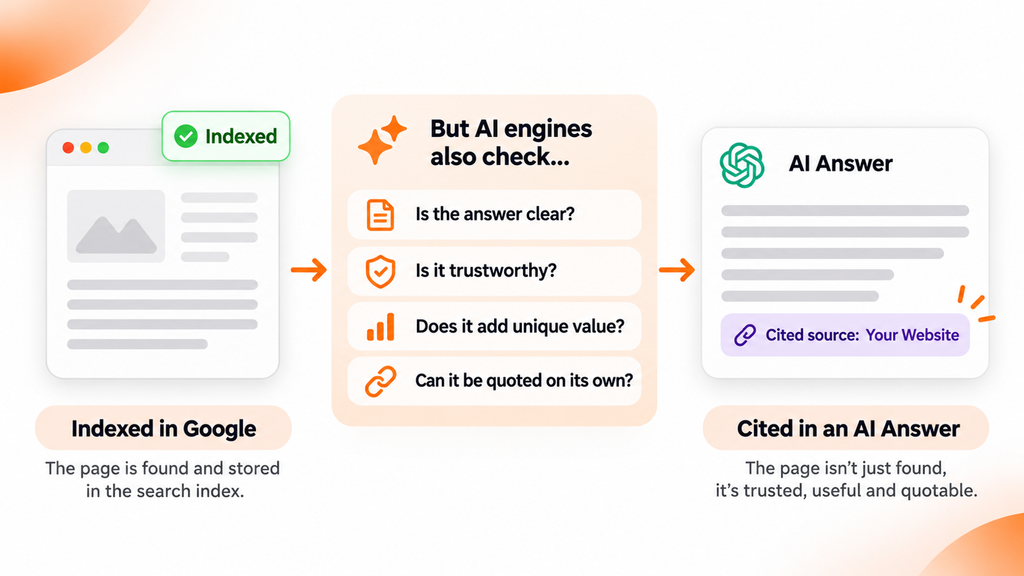
Because indexing only gets you into the pool. Google’s documentation says a page can appear as a supporting link in AI Overviews and AI Mode if it’s indexed and eligible to show a snippet, and it adds that “indexing and serving isn’t guaranteed.” The rest is selection, and selection is where content quality does its work.
Why does it matter this much now? Because people read the answer and move on. Pew Research Center followed 900 US adults who shared their browsing activity and found they clicked a traditional result in 8% of visits that showed an AI summary, versus 15% without one. Clicks on the links inside the summary happened in about 1% of visits. That’s one study of one product in 2025, so don’t treat it as a law. But the direction is hard to ignore: more of the attention goes to whoever is named in the answer.
So you’re now writing for two readers. One is the person skimming. The other is the engine that summarizes you for that person. AI content optimization lets one page serve both.
How Do AI Engines Discover, Evaluate and Cite Content?
Each engine works a little differently, and the companies don’t publish full ranking details. That’s why so much AI content optimization advice online is guesswork. What follows sticks to what their documentation says. Where I’m reasoning from experience, I’ll say so.
At a practical level, most AI search experiences share a loose pipeline:
- Access. A crawler or search index has to be able to fetch your page. Block it and you’re out.
- Query interpretation. The system decides whether the question needs fresh web information at all, and rewrites it into one or several searches.
- Retrieval. It pulls candidate pages or passages from a search index.
- Source selection. Some of those candidates make it into the answer. The criteria aren’t public.
- Answer generation. The model writes a response using the selected material.
- Citation. The answer shows links, source lists or inline references.
Here’s how the documentation describes each engine.
| Engine | How it gets web information | How sources appear | What site owners can control, per the docs |
|---|---|---|---|
| ChatGPT search | Searches the web automatically when a question might benefit from it, according to OpenAI’s help article | Inline citations plus a Sources button listing what was used | OpenAI’s bot documentation says sites opted out of its search crawler “will not be shown in ChatGPT search answers” |
| Perplexity | PerplexityBot is designed to surface and link sites in Perplexity search results, per Perplexity’s docs |
Linked sources attached to answers | Allow PerplexityBot in robots.txt and permit its published IP ranges |
| Gemini | Google’s developer docs for Grounding with Google Search say the model decides whether to search, then generates one or more queries on its own | Inline url_citation annotations with a URL and title |
Controlled through the same Google Search eligibility that applies to your site |
| Claude | Anthropic’s web search tool documentation says Claude decides whether to search, and the search can repeat several times in one request | Citations are always enabled and include the URL, title and a short cited text | That page covers developer controls such as allowed and blocked domains, not site level crawler rules |
| Google AI Overviews and AI Mode | Can run “multiple related searches across subtopics and data sources,” per Google’s AI features page | Supporting links shown with the response | Indexed, snippet eligible pages qualify; nosnippet and related controls can limit what appears |
Two honest caveats. First, the Gemini and Claude rows describe developer tools, and the consumer apps may behave differently. Second, this table shows plumbing, not ranking. Nobody outside these companies can tell you how a candidate page beats another one.
Notice one useful detail, though. OpenAI separates its search crawler from the crawler used for model training, and says a site can allow one while disallowing the other. Perplexity makes a similar split. So blocking “AI bots” with one blunt rule might hide you from search answers you actually want. If you’re not sure what your robots.txt and firewall are doing, the free AI Crawler and robots.txt Checker tests it without a signup.
Why Does Some Content Get Cited While Other Content Doesn’t?
There’s no formula for AI content optimization, and I’d distrust anyone who sells one. What exists is a mix of documented requirements, published research and industry observation. I’ll label each so you know how much weight to give it.
| Factor | What we can say | Evidence level |
|---|---|---|
| Indexed and snippet eligible | Required for Google’s supporting links | Documented by Google |
| Crawler access | Blocking an engine’s search crawler keeps you out of its search answers | Documented by OpenAI and Perplexity |
| Original information and firsthand experience | Google’s helpful content guidance asks for “original information, reporting, research, or analysis” and says credit to other sources “doesn’t replace the need for original effort” | Documented guidance, written for Search broadly |
| Named quotes, statistics and sources | In the GEO research benchmark, adding quotations, statistics and cited sources raised visibility more than most other edits, while keyword stuffing scored about 8% below the baseline | Published research, one benchmark |
| Clear authorship | Google encourages accurate bylines and warns that fake authors are deception | Documented guidance |
| Covering related subtopics | Google says AI features run related searches, so covering neighboring questions is a sensible response | Reasoned from documentation, not a proven ranking rule |
| Freshness | Google says retrieval looks for “up to date web pages,” and beyond that the evidence is thin | Partly documented, mostly unclear |
| Consistent brand facts and mentions elsewhere | Plausible, and common in practitioner advice, but I haven’t found official confirmation. Google says seeking inauthentic mentions “isn’t as helpful as it might seem” | Industry observation |
The research behind the quotes and statistics row is the GEO paper, accepted to KDD 2024, from researchers at Princeton, IIT Delhi and independent contributors. It reported visibility gains of up to 40% on its GEO bench dataset. Treat that as a benchmark result, not a promise for your site. It does point the same way as everything else here: specific, supported writing beats padding.
Notice what’s missing from the table: word count, schema, a magic heading pattern. Google’s guide says there’s no ideal page length and no need to break content into tiny pieces. So write for people, and let structure follow clarity.
What Are the 12 Practical AI Content Optimization Strategies?
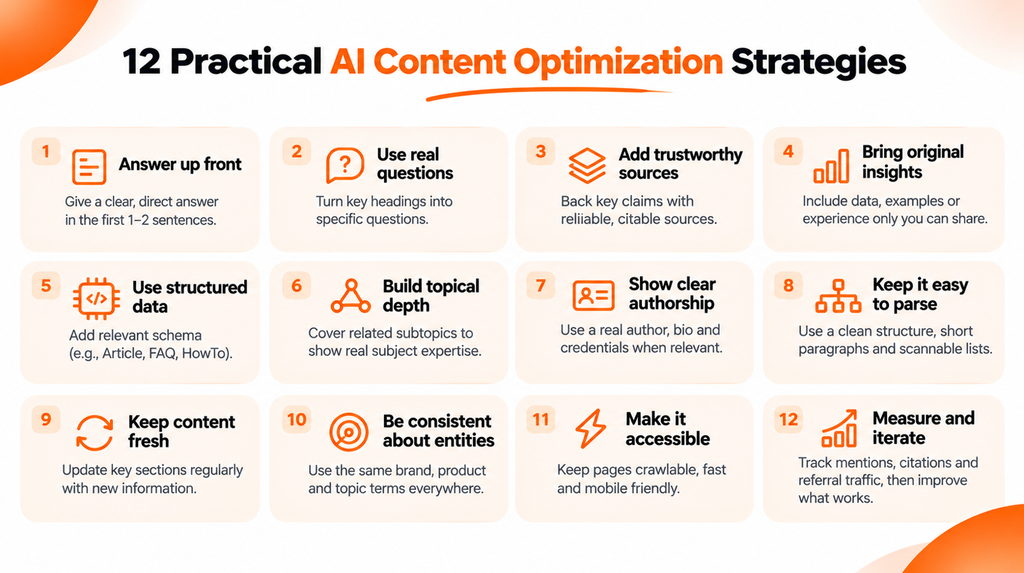
These are habits, not tricks. Each one gets the same treatment: what it means, why it matters, how to do it, a quick example and the mistake that wrecks it. The examples use a made up payroll software company, so none of them are client results.
1. Understand the search intent behind the query
What it means. Work out what the person actually wants before you write. A shortlist? A definition? Steps? A price? Why it matters. AI content optimization starts with intent, because engines match a passage to a need. A page that answers a different need gets skipped even if it ranks. How to do it. Read the live results and the AI answer for your query. Note the format that appears, then decide the single job your page does. Example. “Best payroll software for agencies” wants a shortlist with criteria. “How payroll software works” wants an explainer. One page can’t be both. Mistake to avoid. Writing a product pitch for an informational query.
2. Research the questions your audience actually asks
What it means. Collect real questions in the words buyers use. Why it matters. AI answers often cover several related questions at once. Google calls this query fan out: the system runs related searches behind the scenes. Your page needs the neighbors, not just the headline. How to do it. Mine sales calls, support tickets, People Also Ask boxes and the prompts you’d type into a chat tool. Group them under one main question. Example. For “payroll software for agencies,” follow ups might be pricing, contractor support and how migration works. Mistake to avoid. Spinning up a separate thin page for every variation. Google warns that creating pages just to target fan out queries can fall under its scaled content abuse policy.
3. Lead with direct, answer first explanations
What it means. Put the answer in the first one or two sentences under the heading, then add detail. Why it matters. It hands an engine a clean passage to lift and a hurried reader what they came for. That’s the heart of answer first content. How to do it. Draft the heading as a question, then write the shortest accurate answer you can. Add the nuance after. Example. “What is payroll software? It’s a system that calculates pay, withholds taxes and files reports for employees.” Mistake to avoid. Three paragraphs of throat clearing before the point.
4. Organize content with meaningful headings
What it means. Headings should say something specific and mirror real questions. Why it matters. Descriptive headings help people scan and help machines map which passage answers what. How to do it. Replace labels like “Overview” or “Benefits” with the question or claim underneath. Keep one H1, then a clean H2 and H3 hierarchy. Example. “Pricing” becomes “How much does payroll software cost for a 20 person agency?” Mistake to avoid. Stuffing the keyword into every heading until they all sound the same.
5. Write specific, standalone answer passages
What it means. Each key paragraph should make sense without the three before it. Why it matters. Engines tend to lift pieces of a page, so a passage that depends on context gets dropped. The standalone passage is the basic unit of AI content optimization. How to do it. Name the subject instead of writing “it,” drop “as mentioned above,” and keep one idea per paragraph. (Google says you don’t need to chop content up for its systems. This is plain readability.) Example. Write “Payroll software handles tax filing” instead of “It handles that automatically.” Mistake to avoid. Forcing artificial 50 word blocks everywhere. No length guarantees a citation.
6. Demonstrate firsthand experience and subject expertise
What it means. Show that someone who knows the subject, and ideally used it, wrote the page. Why it matters. Google’s helpful content guidance asks whether content shows firsthand expertise and depth of knowledge, and says trust matters most among its quality signals. How to do it. Add real screenshots, process notes, mistakes you’ve seen and a named author with relevant background. Example. An implementation lead explains the three payroll errors that cause the most corrections. Mistake to avoid. Inventing an anecdote. If you have no real example, leave the claim out.
7. Use original research, examples, statistics and useful insights
What it means. Give engines something they can’t get from ten other pages. Original information is where AI content optimization pays off most. Why it matters. Summarizing what everyone already says makes you replaceable. A fresh number, benchmark or teardown gives an engine a reason to cite you specifically. How to do it. Run a small survey, analyze your own anonymized data, publish a pricing range you track or document a process step by step. Example. A yearly table of how long onboarding really takes, from your own customer records. Mistake to avoid. Publishing a “study” with no method. Say how you collected it.
8. Support important claims with trustworthy sources
What it means. Name the source and link it right where the claim appears. Why it matters. “Pew Research found 8% of visits” is easier to trust and repeat than “studies show clicks are down.” The GEO benchmark also favored cited sources. How to do it. Open every source yourself. Prefer official documentation and primary research. Link the specific page, not the homepage. Example. Cite a government tax authority page for a filing deadline, not a blog summarizing it. Mistake to avoid. Trusting a statistic because an AI tool produced it. Google warns that generative models predict likely words and can be wrong, so every fact needs checking.
9. Build clear brand, product, author and entity relationships
What it means. Make it unambiguous who you are, what you sell, who it’s for and who wrote the page. Why it matters. Engines connect pages to topics through names and relationships. Consistent facts mean less guessing. How to do it. Write one plain sentence describing the company and reuse it on your homepage, About page and profiles. Use the same product names everywhere. Add author pages and Organization details. Example. “Acme Payroll is cloud payroll software for companies of 5 to 50 people.” Same wording on every profile. Mistake to avoid. Calling one product by four names across the site.
10. Improve internal linking and topical coverage
What it means. Connect related pages so readers and crawlers can see the depth of your coverage. For AI content optimization, this is the site level layer. Why it matters. A cluster of connected, non overlapping pages shows a topic is handled thoroughly, which supports topical authority. How to do it. Link from supporting pages to the main guide and back, using descriptive anchor text. Cover real subtopics, not rewordings. Example. A payroll pillar linking to guides on contractor pay, tax filing and migration. Mistake to avoid. Repeating the same explanation across five posts. Pages compete with each other.
11. Maintain accurate, accessible, technically sound pages
What it means. Make sure engines can fetch and read what you wrote. Why it matters. A great passage on a blocked or empty page can’t be cited. Cloudflare announced in 2025 that it would block AI crawlers by default for the sites it hosts, which is a reminder to check your own setup. How to do it. Confirm indexing, snippet settings, robots.txt, firewall rules, load speed and that key text appears in the delivered HTML. Example. A pricing table built entirely with a script that crawlers don’t run, fixed by rendering it as plain HTML. Mistake to avoid. Treating schema as a fix for unreadable pages. Structured data gives clues about meaning and doesn’t guarantee anything.
12. Review and refresh outdated content
What it means. Keep facts, prices, screenshots and statistics true. Why it matters. Wrong numbers get quoted as happily as right ones, and Google notes that retrieval looks for up to date pages. This is the content freshness habit. How to do it. Review your key pages on a schedule, fix what changed, add the question people now ask, and only then change the visible date. Example. Updating a payroll tax threshold the week it changes. Mistake to avoid. Changing the date without changing the content.
How Should You Structure Content So AI Engines Can Quote It?
Structure doesn’t make content good. It makes good content easier to lift, which is why formatting sits at the center of AI content optimization. Here’s the toolkit I’d use, matched to the question type:
- Definition for “what is” questions: one sentence, then context.
- Numbered steps for “how to” questions.
- Comparison tables for “which one” questions, with the same attributes in each row.
- Short lists where items are parallel, and prose where reasoning matters.
- Question and answer blocks for real follow ups.
- Attributed statistics with the source and year in the sentence.
- Contextual internal links placed where a reader would want the next step.
- Useful examples, labeled as hypothetical when they are.
- A clear conclusion that says what to do.
What does a before and after edit look like?
Here’s a vague paragraph that depends on the page around it. (Hypothetical, written to show the pattern.)
Before: “We know content is hard. That’s why we built something different. It does everything you need, and teams love how simple it is. Check out the features below to see what we mean.”
An engine learns nothing from that. What is “it”? Who is it for? No idea. Now the same section, rebuilt.
After: “What is Acme Payroll? Acme Payroll is cloud payroll software for companies of 5 to 50 people. It calculates pay, withholds taxes, files quarterly reports and exports journal entries to common accounting systems. Pricing is per employee, per month.”
The second version names the subject, states what it does, says who it’s for and can be read cold. It can be quoted alone. Then add a plan table, a named author and a current date, and the page has real substance.
One caution. Don’t read this as “short paragraphs win.” Length isn’t the lever. Self contained clarity is.
How Do You Optimize Content for ChatGPT, Perplexity, Gemini, Claude and Google AI Overviews?
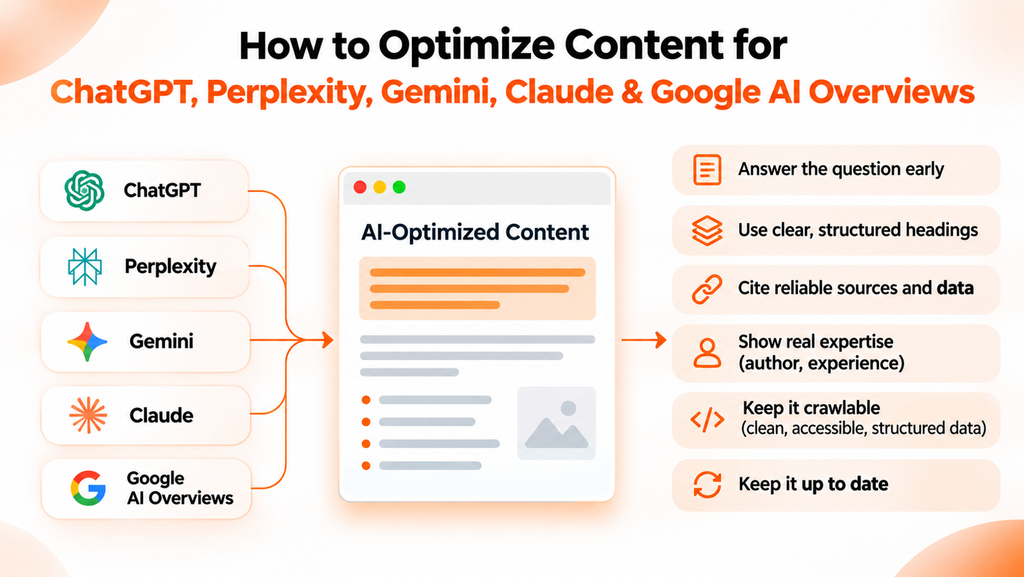
You can optimize content for AI search across all five without writing five versions of every page. Start with what they share, since it covers most of the work in AI content optimization: crawlable pages, direct answers, named sources, original information, consistent facts. After that, a few engine specific notes, all from the documentation above.
- ChatGPT. Confirm OpenAI’s search crawler can reach your pages and that you’re not blocking it by accident. Because training and search crawlers are separate, you can decide on each one. Citations appear inline and in a Sources list, so a passage that stands alone has the best chance of being the one that’s linked.
- Perplexity. Allow
PerplexityBotand its IP ranges. Perplexity saysPerplexity-Usergenerally ignores robots.txt because a person triggered the visit, so robots rules don’t govern those fetches. - Gemini. The developer docs describe the model choosing its own search queries. That’s one more reason to cover neighboring questions on a page instead of only the headline term.
- Claude. Anthropic’s documentation shows Claude deciding when to search and returning citations with a short cited text. Short, precise, quotable sentences make sense when a citation shows a snippet.
- Google AI Overviews and AI Mode. Be indexed and snippet eligible. Google says there are no additional technical requirements, and that AI feature traffic is counted in the Search Console Performance report. Don’t use
nosnippeton pages you want quoted.
Engines pull from different places and answer differently on different days. So test all five on your own questions instead of assuming advice for one carries over. The deeper source factors are in our guide to how AI search engines cite sources.
How Do You Use AI Content Optimization Software?
AI content optimization software helps with the repeatable parts of the job. It doesn’t replace the thinking. Used well, it covers:
- Topic and keyword research
- Search intent analysis
- Content gap identification
- Content briefs
- Entity and topic coverage checks
- Structure recommendations
- SEO checks
- GEO and AI search readiness checks
- Citation and mention monitoring
- Refresh and update workflows
- Performance measurement
What it can’t do matters more. It can’t see inside an engine’s ranking systems, and Google specifically cautions against third party tools that promise ranking success or special access to its internal metrics. A score is a hint. A tool that claims to predict your citation is guessing.
The label covers five different kinds of product, and mixing them up is the most common buying mistake:
| Type | Main job | What it doesn’t do |
|---|---|---|
| AI writing software | Drafts, rewrites and expands text | Check whether engines cite you |
| Traditional SEO content tools | Score a draft against pages that already rank | Show live AI answers |
| AI search visibility trackers | Run buyer prompts on a schedule and log mentions and citations | Fix the page |
| Technical SEO auditing tools | Find crawl, index, speed and markup problems | Judge whether your writing is quotable |
| Combined SEO and AI content platforms | Bundle several of the above | Do every part at the depth of a specialist |
Before you buy any AI content optimization tools, or any AI tools for content optimization with a shinier label, run through this checklist:
- Which of the five jobs is actually missing from my workflow?
- Which engines does it cover, and how often does it refresh?
- Does it measure real AI answers, or only give writing advice?
- Can I see sources, not just a score?
- Does it publish to my CMS, or will I copy and paste?
- How many seats, brands and prompts does my plan include?
- Do I get full price details without a sales call?
- Who owns fact checking? (It should be a person.)
If you’re weighing editors specifically, our guide to Surfer SEO alternatives compares content scoring tools side by side, and the AI powered writing assistant vs traditional SEO copywriting article covers where drafting help ends.
Which AI Content Optimization Tools Fit Which Job?
This pillar isn’t a roundup, and a long vendor list would be out of date within weeks. Think in categories when you shop for AI content optimization tools, and pick based on the gap.
| Category | Typical job | When you need it |
|---|---|---|
| Keyword and topic research | Find questions, subtopics and demand | Before you brief anything |
| Content optimization and writing | Brief, draft and score a page | When drafts are slow or thin |
| SEO analysis | Rankings, links, competitors | When you need search performance data |
| AI search visibility monitoring | Track mentions, citations and competitors in AI answers | After publishing, ongoing |
| Technical SEO and site auditing | Crawlability, indexing, markup | Before and after any big change |
| Publishing and workflow automation | Schedule, push to your CMS | When output volume grows |
Here’s how they fit together. Research tells you what to write. A writing and optimization tool helps you draft and tighten it. A technical audit confirms engines can read it. A tracker shows whether anyone cites it. A publishing tool saves the copy and paste. Some platforms bundle several of these; none I know of does everything at specialist depth. For comparisons of specific products, see best AI blog writers for SEO and GEO and Writesonic alternatives. Both name vendors and show verified limits. For automated publishing into WordPress, the WordPress AI SEO automation guide shows a safe draft and review flow.
How Does Spyro AI Support SEO and AI Content Optimization?
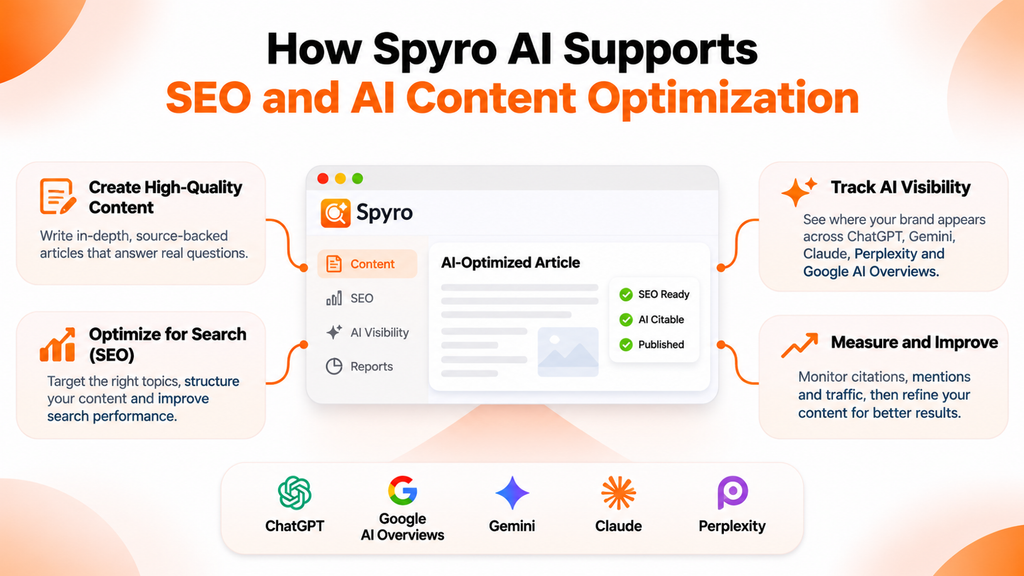
This blog is published by Spyro AI, so read this section as a product description and not an independent review. I’ll stick to what’s documented on the Spyro AI site and say where it doesn’t help.
- Audit a page. The free SEO and GEO Audit runs SEO checks (technical, metadata, Core Web Vitals) alongside GEO checks such as answer first openings, question style headings, schema, author signals, freshness dates, AI crawler access, llms.txt presence and whether content renders without JavaScript. It needs no signup. It gives an SEO score and a GEO score.
- Check crawler access. The AI Crawler and robots.txt Checker tests GPTBot, ClaudeBot, PerplexityBot and Googlebot, and flags engines that a server or firewall blocks even when robots.txt allows them.
- Get a first read on mentions. The free AI Visibility Checker runs five buyer style prompts on ChatGPT and Google AI Overviews and shows whether your brand was mentioned or linked. It asks for your name, email, website and a one time email code.
- Track over time. Spyro AI provides AI citation, mention and prompt tracking across ChatGPT, Claude, Gemini, Perplexity and Google AI Overviews, with competitor gap analysis and keyword position tracking. The Starter plan covers two of those engines, ChatGPT and Google AI Overviews. Pro and Agency cover all five.
- Write and publish. For the drafting side of AI content optimization, a GEO mode adds answer first snippets, summaries, Q&A blocks and JSON schema to long form articles, with automatic internal and external linking and publishing to connected systems such as WordPress and Shopify.
Where it doesn’t help: Spyro AI doesn’t document a term by term editor built on SERP analysis, the way dedicated SEO editors do. It doesn’t replace a human editor, fact checking or your own original research. And like every tool here, it can’t promise a ranking or a citation. Plans start at $29 a month with a 3 day free trial; see the pricing page for current limits, or start a trial to try tracking on your own questions.
What Does a Practical AI Content Optimization Workflow Look Like?
You don’t need a six month roadmap. One marketer can run a decent first pass of AI content optimization in a few weeks, mostly by editing pages you already have. Here’s the full process in order.
| Stage | Task | Expected output | Useful tools |
|---|---|---|---|
| 1. Topic and audience | Pick one topic and the reader it serves | A one sentence brief | Sales notes, support tickets |
| 2. Keyword and intent check | Validate the phrase and what the result page shows | Chosen primary keyword and intent | Keyword research tool, live search |
| 3. SERP and AI answer review | Read what ranks and what AI engines say | Notes on gaps and formats | Search, chat tools |
| 4. Questions list | Gather the questions that need answers | Grouped question list | People Also Ask, customer questions |
| 5. Content brief | Set outline, sources and angle | Approved brief | Brief tool or document |
| 6. Draft | Write or generate a first version | Rough draft | Writer or AI assistant |
| 7. Evidence and expertise | Add sources, examples, data, author input | Verified draft | Source pages, subject experts |
| 8. Headings and answers | Rewrite openings, headings, standalone passages | Structured article | Editor |
| 9. Links and technical review | Add internal links, check markup and crawlability | Clean page | Site auditor, crawler checker |
| 10. Publish | Release it and make sure it’s indexable | Live page | CMS, Search Console |
| 11. Monitor | Track mentions and citations across engines | Baseline and trend | AI visibility tracker |
| 12. Update | Refresh on evidence and performance | Revised page | Editor, notes from tracking |
Two cautions. Run stage 9 before stage 11, because tracking a page engines can’t read wastes your time. And treat month one as groundwork. Results in the first month tend to be small and patchy. AI answers shift between runs, and engines are slow to pick up edits. You’ll end up with a baseline, a handful of better pages and a routine, which is the point.
How Do You Measure AI Content Optimization Results?
Clicks alone will mislead you, because a win can happen with no click at all. To measure AI content optimization, track a mix:
- Organic performance: impressions and clicks in Search Console. Google says AI feature traffic is counted there, inside the Web search type.
- AI brand mentions: how often your brand is named for a fixed set of buyer prompts.
- AI citations: how often your pages are linked as sources.
- Share of voice and competitor visibility: your mention rate compared with others in the same answers.
- Accuracy: does the engine describe your product, pricing and location correctly?
- Referral traffic: visits from AI tools, tagged in your analytics.
- Content freshness: the share of key pages reviewed on schedule.
- Engagement and conversions: what visitors do once they arrive.
Why isn’t one ChatGPT response enough? Because answers vary. In a study reported by Search Engine Land, SparkToro and Gumshoe had 600 volunteers run 12 prompts nearly 3,000 times through ChatGPT, Claude and Google’s AI and found the odds of the same brand list appearing twice were under 1 in 100. So log how often you appear across repeated runs, such as “mentioned in 3 of 5 checks,” and not whether you showed up once.
Keep four things apart, since they’re easy to blur: readiness (can engines read your page), visibility (do they mention you), citations (do they link you) and business outcomes (leads and sales). Improving the first doesn’t prove the last. And no engine exposes complete measurement data, so treat any single dashboard as one view.
What Are the Most Common AI Content Optimization Mistakes?
Most AI content optimization mistakes look reasonable until you’ve made them.
- Publishing unedited AI drafts. Google says to fact check AI output, including titles and meta descriptions.
- Writing for keyword density. The GEO benchmark scored keyword stuffing below doing nothing.
- Repeating yourself across posts. Five pages saying the same thing compete with each other.
- Making claims with no source. If you can’t link it, soften it or cut it.
- Quoting statistics you haven’t opened.
- Producing generic content. If your intro could open any article on any site, it adds nothing.
- Overusing FAQs and lists. A FAQ helps when the questions are real. Padding it with repeated keywords doesn’t.
- Treating schema as a guarantee. Google says structured data isn’t required for generative AI search.
- Ignoring technical access. Blocked crawlers, hidden text and slow pages quietly cancel good writing.
- Letting pages go stale. Old prices and dead features get quoted too.
- Mixing up AI detection with AI visibility. A detector score says nothing about whether an engine will cite you. Stanford researchers reported that detectors flagged 61.22% of TOEFL essays written by non native English students as AI generated, even though people wrote them.
- Assuming one good response proves anything.
A note on that FAQ point. Google’s documentation says FAQ rich results stopped appearing in Search in 2026. Keep a visible FAQ when readers have real questions, but don’t add markup hoping for expandable boxes.
What Is the AI Content Optimization Checklist?
Run this AI content optimization checklist before you publish. Tick what’s true, fix what isn’t.
- Search intent: the page does one job for one kind of reader.
- Topic coverage: the main question and its likely follow ups are answered.
- Clear answers: each question heading is answered in the first one or two sentences.
- Heading structure: one H1, descriptive H2s and H3s, no generic labels.
- Factual accuracy: every figure, price and feature has been checked by a person.
- Source attribution: each statistic names its source and links to it.
- Author information: a real byline, with background where it matters.
- Original insight: at least one thing here that isn’t on competing pages.
- Entity clarity: your brand, product and category are described the same way as elsewhere.
- Internal links: descriptive anchors to related pages, and links back to this one.
- Technical access: indexable, snippet eligible, readable without special scripts, not blocked.
- Structured data: present only where it matches visible content, and validated.
- Freshness: facts are current and any visible date reflects a real update.
- Measurement setup: prompts, engines and a baseline are recorded before launch.
Key Takeaways
- AI content optimization means writing pages an engine can pull a passage from, trust and credit by name. It builds on SEO.
- Being indexed gets you into the pool. Clear answers, named sources and original information help you get picked.
- The highest return AI content optimization edits are answer first openings, question style headings, standalone passages and sources you’ve opened yourself.
- AI content optimization software helps with research, structure, tracking and refreshes, but it can’t see inside any engine, so no score guarantees a citation.
- Measure repeated runs across several engines, and keep readiness, visibility, citations and revenue as separate questions.
Frequently Asked Questions
What is AI content optimization?
AI content optimization is improving a page’s clarity, evidence, structure and accessibility so AI search engines can retrieve a passage, trust it and cite it in generated answers. It overlaps with SEO, generative engine optimization and answer engine optimization. The phrase is also used for AI tools that help edit content, which is a related but separate job.
How is AI content optimization different from SEO?
SEO aims to rank a page and earn a click. AI content optimization aims to get a single passage understood and credited inside an AI answer, often without a click. They share crawlable pages, accurate facts and useful writing. Google says its own AI features still depend on SEO basics.
What is AI content optimization software?
AI content optimization software is any tool that uses AI to help research, brief, write, score, monitor or refresh content. The category covers AI writers, SEO content editors, AI visibility trackers, technical auditors and combined platforms. Check which job a product actually does before you buy.
What are the best AI content optimization tools?
The best AI content optimization tools depend on the gap in your workflow. Editors and scoring tools help with drafts. Trackers show whether engines mention you. Auditors catch technical problems. Compare options by engines covered, refresh rate, publishing and cost at your volume, and read the pricing page for the plan you’d actually buy.
How do I optimize content for ChatGPT?
Make sure OpenAI’s search crawler can reach your pages, then answer each question heading in the first sentence or two, name your sources and add something original. Check results by asking ChatGPT your buyer questions several times and logging how often you’re named.
Does AI generated content rank on Google?
It can, but Google’s guidance says producing many pages with generative AI without adding value may violate its scaled content abuse policy. Google also says to fact check and review AI output before publishing. A person should edit, verify and add original insight.
Can AI content optimization guarantee citations?
No. Engines don’t publish their selection criteria, answers vary between runs, and competitors publish too. AI content optimization improves clarity and eligibility. It doesn’t buy a citation, and anyone promising one can’t back it up.
Final Thoughts: Write Like a Source Worth Quoting
AI content optimization isn’t a trick. It’s what happens when a page works for the person skimming and the engine quoting: the answer comes first, the facts have names, the follow ups are covered and the basics are healthy. Most of the work is editing pages you already have.
So pick your ten most important pages this week. Rewrite each opening, turn the headings into questions and put a named source behind every claim that matters. Then see whether AI tools start naming you.
If you want a starting point, run the free SEO and GEO Audit on one page, or start a Spyro AI trial to track how ChatGPT, Claude, Gemini, Perplexity and Google AI Overviews describe your brand over time.