


What Is Answer Engine Optimization? (AEO Guide 2026)


Quick Answer
- What is answer engine optimization (AEO)? It’s writing and structuring your pages so AI answer engines like ChatGPT, Gemini, Perplexity, Claude and Google AI Overviews can lift a clean answer from them and credit you as the source.
- SEO earns the ranking and the click. AEO earns the mention inside the answer, and that matters more every month because fewer searches end in a click.
- AEO sits on top of SEO. It doesn’t replace it. Google says there’s no special markup or extra requirement for AI Overviews, so the work is clear writing, real facts and a healthy site.
- Startups, SMBs, mid sized companies and agencies can all begin this week: list real buyer questions, put a short direct answer at the top of key pages, then check whether AI tools actually name you.
What is answer engine optimization? It’s the habit of writing a page so an AI tool can grab a clean answer from it and name you as the source. That’s the whole idea. The acronym just makes it sound heavier than it is. It’s also the exact question people type into Google, “what is answer engine optimization”, so let’s answer it properly.
If you’ve already read our guide on what is generative engine optimization, think of this one as the close up on the answer itself. Same family, narrower job. And no, you don’t need to be an SEO person to use any of this. Maybe you run a local service business, a mid sized company with a dozen product lines, or an agency with twenty clients. Your buyers are asking AI tools questions right now, and AEO decides whether your name is in the reply.
What Is Answer Engine Optimization? The Plain English Definition
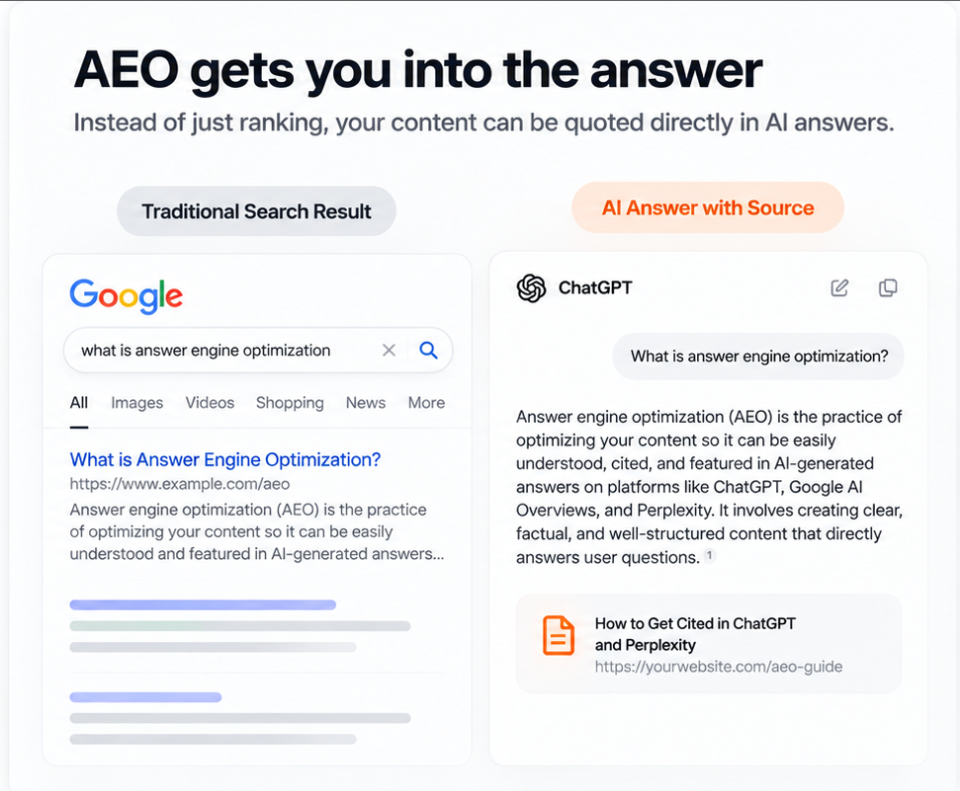
Answer engine optimization is the practice of making your content easy for an AI system to find, understand, trust and quote when it answers a question. An answer engine is any tool that replies with an answer instead of a list of ten links. Google AI Overviews and AI Mode, ChatGPT search, Perplexity, Gemini and Claude all count.
So what is answer engine optimization in real life? Picture someone typing “what’s the best way to track my AI search visibility?” into ChatGPT. The reply names three or four sources. AEO is the work of becoming one of them.
The idea isn’t brand new. It grew out of the featured snippet and voice search days, when winning the one box above the results was the whole game. What changed is the size of the prize. Now the answer box isn’t a small feature on the page. For a growing number of searches, it is the page. What is answer engine optimization fixing? A mismatch: most pages were written to rank, not to be quoted.
Here’s a quick test. Open ChatGPT, Perplexity or Gemini, then ask the exact question your best page is meant to answer. Does your business show up? If it doesn’t, you’ve found your AEO to do list. You can also type “what is answer engine optimization” into an AI tool and see whose pages it quotes. Those are the pages doing it well.
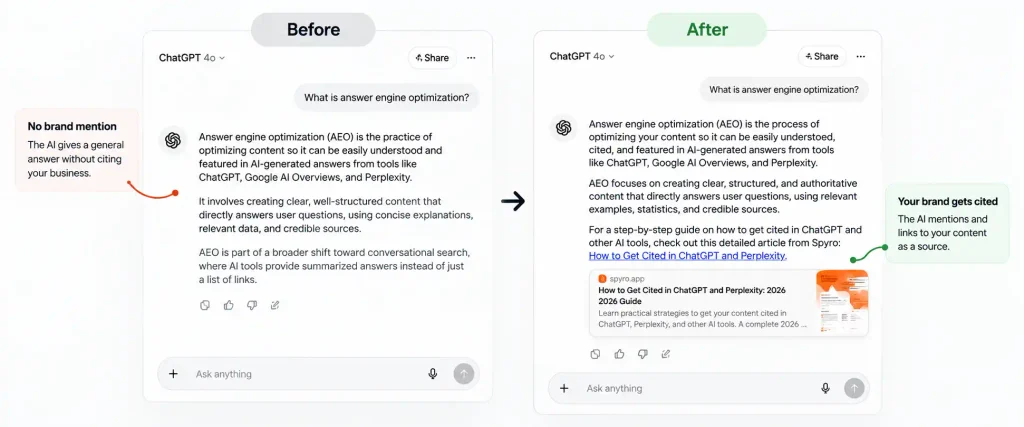
What is answer engine optimization not? It’s not a plugin. It’s not a secret tag. And it’s not a weekend project you finish and forget, because the engines change how they pick sources all the time.
Why Does Answer Engine Optimization Matter in 2026?
Because people get their answer and leave. That’s the short version, and the data backs it up.
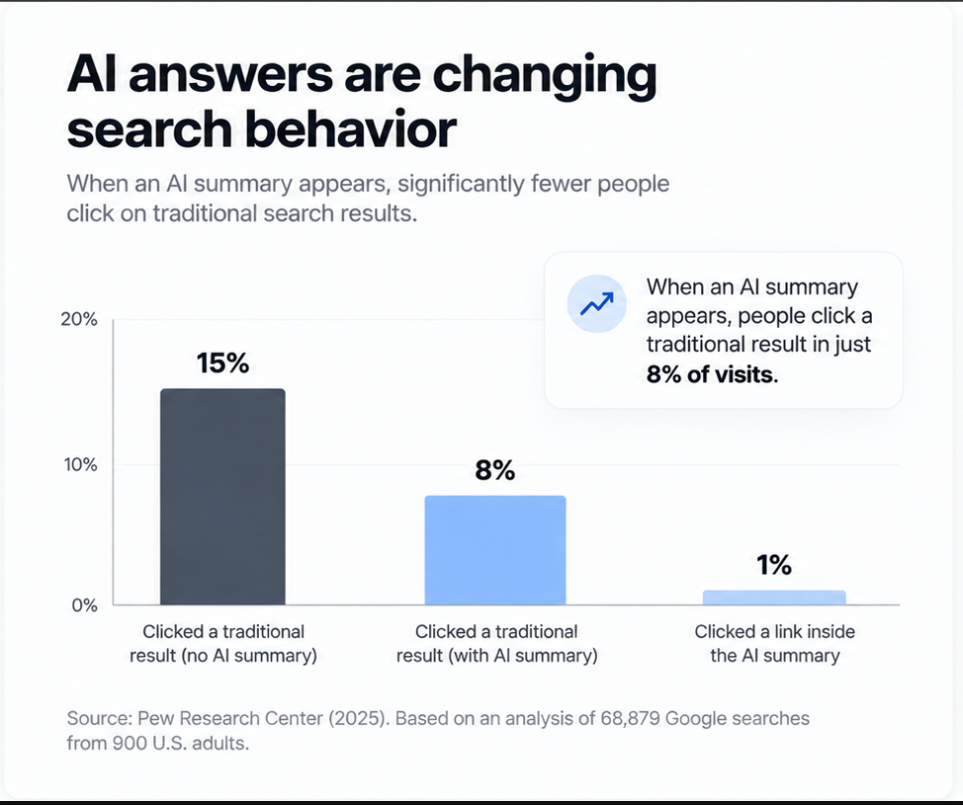
Pew Research tracked 900 US adults and 68,879 real Google searches in March 2025. When an AI summary appeared, people clicked a regular result link in 8% of visits. Without a summary, it was 15%. And clicks on the links inside the summary itself? Just 1% of visits (Pew Research Center).
Ahrefs looked at the top ranking spot specifically. Across 300,000 keywords, position one click through rate on searches with an AI Overview was 58% lower than it would have been without one, based on Search Console data from December 2023 to December 2025 (Ahrefs). Ahrefs is upfront that this is a correlation, not proof of cause. I’d still take it seriously.
Then there’s how often the summary shows up. Comscore’s Q2 2026 report found Google AI Overviews on 39.4% of US desktop searches in June 2026, up from 25.8% a year earlier (Search Engine Land). That’s roughly four searches in ten.
Put those together. More searches get an AI answer. People click less when they do. So the brands named inside the answer get the attention, and everyone else gets the scraps. That’s why “what is answer engine optimization” has moved from a niche question to a standing item in marketing meetings.
AEO vs SEO vs GEO: What’s the Difference?
SEO gets your page ranked. AEO gets a passage from your page quoted. GEO is the wider umbrella for how generative AI tools describe your brand across everything they read.
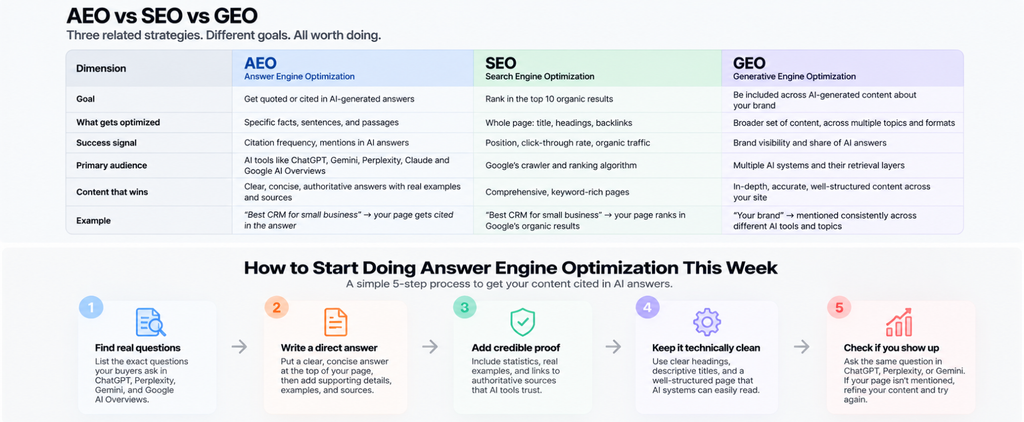
People often search “what is answer engine optimization vs SEO”, and a table is the quickest reply:
| Dimension | SEO | AEO | GEO |
|---|---|---|---|
| Goal | Rank and earn the click | Be quoted or named inside the answer | Shape how AI tools represent your brand overall |
| Unit you work on | The whole page | A passage, a fact, a definition | Your brand across many sources |
| Win looks like | Position, clicks, traffic | Citations and mentions in AI answers | Share of voice across AI engines |
| Typical tactics | Keywords, links, site speed | Answer first writing, question headings, clear facts | Everything in AEO plus off site mentions and entity clarity |
So what is answer engine optimization compared with GEO, and where does one stop? People use these terms loosely, and sources disagree on where the lines fall. Some treat AEO as the older, narrower term. Others treat it as a synonym for GEO. I’d treat AEO as the answer writing part of a wider GEO plan, and not argue about the labels. The tactics overlap so much that one good page usually helps with all three.
The GEO term itself comes from a November 2023 research paper, later accepted to KDD 2024. Its authors reported that changing how content is written can boost visibility in generative engine responses by up to 40% (arXiv). Notice what drove it: clearer, better supported writing. Not tricks.
How Do Answer Engines Decide What to Cite?
Nobody outside these companies knows the full recipe. So what is answer engine optimization actually responding to? A few things are measured well enough to act on.
Pages that cover the related questions win more often. Google’s AI features break one search into several smaller searches behind the scenes (people call it query fan out). Ahrefs found pages ranking for those related sub queries were 161% more likely to be cited than pages ranking only for the main term (Ahrefs). So one narrow keyword page isn’t enough. Cover the neighbors.
Rankings help, but they’re no longer the whole story. In a March 2026 update covering 863,000 keyword searches and about 4 million AI Overview URLs, Ahrefs found only 38% of cited pages came from the top 10, down from 76% a year earlier. And 31% of cited pages didn’t rank in the top 100 for the original query at all (Ahrefs). Translation? You can’t rank your way into every answer, and you can’t ignore ranking either.
Question searches trigger AI answers most. Ahrefs analyzed 146 million search results and found AI Overviews on 57.9% of question queries, versus 15.5% of non question queries (Ahrefs). If your headings sound like real questions, you’re fishing where the fish are.
Being talked about beats being linked to. In a May 2025 Ahrefs study of 75,000 brands, mentions of a brand across the web correlated with its AI Overview visibility at 0.664, while backlinks sat at 0.218 (Ahrefs). Correlation again, not a guarantee. Still, it suggests the old habit of chasing links for their own sake may be the wrong place to spend your next hour.
And what does Google say? Plainly: there are no additional requirements to appear in AI Overviews or AI Mode, and no special optimizations are needed. Your page has to be indexed and eligible to show a snippet, like any other (Google Search Central). I read that as good news. It means AEO is mostly craft, not hacks. Boil it down and what is answer engine optimization asking for? Clear pages from a brand people already talk about.
What Is Answer Engine Optimization Worth to SMBs, Mid Sized Companies, Agencies and Startups?
The basics don’t change with size. Where you start does.
- Small and medium businesses: Pick your five to ten money pages, the ones that say what you sell and where. Answer the top customer question in plain words, right at the top. That alone puts you ahead of most local competitors.
- Mid sized companies: Your problem is consistency. Many product lines, many writers. Make “answer first” a house rule, give each product line an owner, and add AI mentions next to organic traffic in the monthly report.
- Agencies: Clients are already asking you what is answer engine optimization and whether they need it. A baseline check, a short fix list and a monthly citation report turn that question into a service line.
- Startups: Nobody knows your brand yet, so you can’t win on authority. Clear, quotable, well sourced content is one of the few ways to sit in the same AI answer as bigger names.
How Do You Do Answer Engine Optimization? Seven Steps
What is answer engine optimization asking you to change on a page? Mostly the sentences. You don’t need a big team or a six month roadmap. A solo marketer can do a solid first pass in a week, mostly by editing pages you already have.
- Collect real questions. Pull them from sales calls, support tickets, Google’s People Also Ask boxes and the questions customers type into chat tools. Full sentences, the way people actually say them.
- Write headings as those questions. A heading like “How long does a roof replacement take?” tells a machine exactly what the paragraph below resolves. “Overview” tells it nothing.
- Answer in the first one or two sentences. Give a direct answer of roughly 40 to 60 words, then add the detail. Most pages bury the answer under a warm up. Don’t.
- Make each passage stand alone. AI tools cut your page into chunks and grab the ones that fit. If a paragraph only makes sense after reading the three above it, it gets skipped. Cut the “as mentioned earlier” lines.
- Back claims with named sources. “Pew Research found 8% of visits” is easier for a model (and a person) to trust than “studies show clicks are down.” Link the source.
- Cover the neighboring questions. Because of query fan out, a page that answers the main question plus the two or three follow ups beats a thin page that only answers one.
- Keep it fresh and findable. Update key pages on a schedule, put a visible date on them, let search crawlers in, and keep important text as real text, not images.
Ask me what is answer engine optimization in daily practice and that’s my answer: seven habits, none of which needs a developer. One more thing outside your own site: get mentioned. Reviews, community threads, partner pages, guest posts, a YouTube video. The brand mention numbers above are the reason I’d spend real effort there.
Do You Need Schema Markup, FAQ Schema or Special Files for AEO?
Everyone asking what is answer engine optimization seems to wonder about schema next. Short answer: it’s not a requirement. Google’s own AI features guidance says no special markup or AI specific file is needed. What it does say is that structured data should match what’s visible on the page.
Here’s a detail that catches people out. Google’s FAQ rich result is gone: its documentation says the feature stopped showing in Search results, following a May 2026 changelog entry (Google Search Central). So don’t add FAQ schema hoping for expandable boxes in Google.
I’d still keep a visible FAQ section on key pages. It’s good for readers, and it gives you tidy question and answer pairs that any engine can read. Add the markup if your CMS makes it easy, just don’t expect a ranking boost from it. Think of it as tidy housekeeping, not a growth lever.
How Do You Measure Answer Engine Optimization?
What is answer engine optimization worth if you can’t see the clicks? Clicks alone won’t tell you, because some wins happen with no click at all. Track these instead:
- Citation rate: out of a fixed list of buyer prompts, how often does an AI engine link to your site?
- Mention rate: how often does it name your brand, linked or not?
- Referral traffic: visits that arrive from chat tools, tagged in your analytics. Google says traffic from its AI features shows up inside the normal Web results in Search Console, mixed in with everything else.
- Accuracy: when a tool does describe you, does it get your product, pricing and location right?
Do the prompt check by hand first. Take 10 questions a buyer would ask, run them across ChatGPT, Gemini, Perplexity, Claude and Google, then write down who gets named. It’s slow, but you’ll learn a lot.
When you’re ready to stop doing that manually, Spyro (that’s our product, so weigh this accordingly) has a free AI visibility checker for a quick read on whether the big engines mention your brand, plus a free SEO and GEO audit for site health. For ongoing weekly tracking across ChatGPT, Claude, Gemini, Perplexity and Google AI Overviews, that’s what the full platform does.
Want to go deeper on the citation side? Our guide on how to get cited in ChatGPT and Perplexity covers crawlability and freshness, and how AI search engines cite sources breaks down the ranking factors.
What Are the Most Common AEO Mistakes?
Most teams learning what is answer engine optimization trip over the same five things:
- Burying the answer. Three paragraphs of throat clearing before the point. Engines skip those pages and quote someone who got to it faster.
- Stuffing keywords. The GEO research found repeating keywords didn’t help. Clear, supported writing did.
- Optimizing for one engine. ChatGPT, Gemini, Claude, Perplexity and Google don’t pick sources the same way. Test across all of them.
- Treating it as a one off. Sources shift, competitors catch up, models update. A monthly check beats a heroic one time rewrite.
- Skipping the basics. If your page isn’t indexed, loads badly or hides its text, nothing above matters.
Key Takeaways
- What is answer engine optimization? Writing so an AI tool can pull a fact from your page, trust it and name you as the source.
- It builds on SEO. Google says no special markup is required, so clear writing and a healthy site do most of the work.
- AI Overviews appear on about 4 in 10 US desktop searches, and clicks fall when they do, so being named in the answer is worth real effort.
- Cover related questions, not just one keyword. Pages that rank for the sub queries behind a search are far more likely to be cited.
- Measure citations and mentions across engines every month. Don’t judge AEO by clicks alone.
FAQ
What is answer engine optimization?
Answer engine optimization (AEO) is the practice of structuring your content so AI answer engines like ChatGPT, Gemini, Perplexity, Claude and Google AI Overviews can find it, understand it and cite it when they respond to a question. The goal is to be named inside the answer, not only listed under it.
What is AEO in digital marketing?
In digital marketing, AEO is the channel focused on winning visibility inside AI generated answers, featured snippets and voice replies. It sits next to SEO and content marketing, uses the same fundamentals, and is measured by citations and brand mentions instead of rankings alone.
How do you do answer engine optimization?
Collect real buyer questions, use them as headings, answer each in the first one or two sentences, make every passage stand on its own, back claims with named sources, cover the follow up questions and keep key pages fresh. Then check weekly whether AI tools mention you.
Will AEO replace SEO?
No. AEO builds on SEO and depends on it. Google says its AI features use the same indexing and snippet eligibility as regular Search, and rankings still decide every search that ends in a click. Most sites need both, and the work overlaps heavily.
Is AEO real or just SEO with a new name?
It’s a real shift in emphasis. Most good practice carries over from SEO, but the target changes from ranking a whole page to getting a passage quoted. And the measurement changes too, from clicks to citations. Call it what you like. The behavior it responds to, people reading an AI answer and moving on, is well documented.
Do you need schema markup for AEO?
Not as a requirement. Google says no special markup is needed for AI Overviews or AI Mode, and its FAQ rich result was retired in May 2026. Structured data still helps describe your page accurately, as long as it matches what readers see. A visible FAQ section is worth keeping either way.
What is the best AEO tool?
There isn’t one best tool, because the job splits into tracking AI mentions, finding questions and writing the content. Decide which you need first, then compare options on the engines they cover and their pricing on the official pages. Spyro is our product and covers ChatGPT, Claude, Gemini, Perplexity and Google AI Overviews.
So, what is answer engine optimization, once you strip off the jargon? It’s writing like a source worth quoting. Run a free check, find the three questions where a competitor gets named and you don’t, and fix the first one this week.