Best AI Blog Writers for SEO and GEO in 2026



Quick Answer: What Is the Best AI Writer for Blog Content in 2026?
The best AI writer for blog content in 2026? Honestly, it depends on the part of the job that’s slowing you down. Maybe it’s topic research or briefs. Maybe it’s long drafts, SEO scoring, publishing, or finding out whether AI engines mention you at all. No tool I looked at does all of it well.
- If you want writing and AI visibility tracking together: Spyro AI (from $29 a month) writes and publishes the posts, then checks whether ChatGPT, Claude, Gemini, Perplexity and Google AI Overviews mention you (all five on Pro).
- If you live in an SEO editor: Surfer, Frase and NeuronWriter grade your draft against pages that already rank. NeuronWriter starts lowest, at $23 a month.
- Teams already inside an SEO suite: Semrush’s Content Toolkit ($60 a month) adds briefs, an AI Article Generator and a Content Optimizer.
- Big editorial teams with strict brand rules: Jasper, from $69 per seat a month, with GEO tracking on its custom Business plan.
Here’s the thing most lists skip. A tool can help you write SEO friendly content without ever checking whether ChatGPT or Google AI Overviews cite the page you publish. So the best AI writer for blog posts on your team is the one that covers the job you’re actually missing.
I wrote this for SMBs, in house marketing teams, SEO folks, bloggers and agencies. Curious how AI engines pick what to quote? The guide to AI content optimization covers that.
I pulled every price and limit from the vendor’s own pricing page or docs in 2026. SaaS pricing moves fast, so double check before you pay.
What Makes the Best AI Writer for Blog Content?
Speed isn’t the test. Ask instead: how much of the draft would you actually keep?
Here’s my checklist when I look at AI writing tools for SEO:
| Criterion | What to check | Why it matters |
|---|---|---|
| Research and search intent | Does it read your site, keywords and the results page? | A draft that misses intent won’t rank |
| Content briefs and outlines | Can you edit headings before drafting? | Fixing an outline beats fixing 2,500 words |
| Long form drafting | Length, structure, images | Sets how much editing you’ll do |
| Fact checking and sources | Does it cite sources you can open? | AI drafts invent details |
| SEO recommendations | Term coverage, headings, metadata | Helps the page match what ranks |
| Brand voice and readability | Voice settings, style controls | Generic copy reads like everyone else’s |
| Entity and topic coverage | Consistent names and subtopics | Connects the page to a topic |
| Editing, CMS and team features | Editor, WordPress or Shopify, seats | Cuts copy and paste work |
| Cost per usable article | Price divided by drafts you’d publish | The cost figure that counts |
Take fact checking seriously. In a 2025 study, the Tow Center for Digital Journalism tested eight AI search tools on 1,600 queries and found they answered more than 60% incorrectly when asked to identify a news article’s source. AI content writing software runs on similar models. Treat every statistic in a draft as unverified until you’ve opened the source. A fast tool that leaves you hours of checking is rarely the best AI writer for blog teams.
Three Jobs That Get Mixed Up
Vendors slap “AI SEO” or “GEO” on almost everything. Before you pick the best AI writer for blog work, split it into three jobs:
- AI blog writing. The tool writes, edits or refreshes the article.
- SEO and GEO content optimization. It helps you fix structure, coverage, clarity and crawl access, so the page is easier to rank and quote.
- AI visibility tracking. It asks AI engines your buyers’ questions on a schedule and logs whether you got mentioned or cited.
A writer isn’t automatically a tracker. And an SEO score doesn’t measure whether AI engines cite you.
How Do the Best AI Blog Writing Tools Compare?
Eight contenders for the best AI writer for blog content, side by side. Starting price is the lowest published paid plan. (On a phone you’ll need to swipe the table.)
| Tool | Verified starting price | Best for | Blog drafting | SEO optimization | GEO or AI search features | Actual AI visibility tracking | Publishing and integrations | Main limitation |
|---|---|---|---|---|---|---|---|---|
| Spyro AI | $29/mo | SMBs and agencies wanting content plus tracking | Researched 2,500+ word drafts with images and brand voice | SEO score panel in the editor | GEO mode: answer first snippets, Q&A blocks, schema, internal links | Yes: 2 engines on Starter, 5 on Pro | WordPress, Shopify, webhooks; scheduling and auto publish | No documented SERP term editor or brief builder |
| Surfer | $49/mo, billed yearly | Writers optimizing against ranking pages | Surfer AI drafts of about 2,000+ words from SERP data | Content Editor and Content Score | Content guidance for search | From Standard: 25 weekly prompts in ChatGPT; 5 engines on Pro | WordPress and Google Docs from Standard | Yearly billing; no tracking on Discovery |
| Semrush Content Toolkit | $60/mo | Teams already using Semrush | AI Article Generator; 5 SEO boosted articles a month | Content Optimizer, SEO Brief Generator, Topic Finder | Optimizer advice for Google and AI platforms like ChatGPT | Not in the toolkit; prompt tracking on SEO plans from $199/mo | WordPress (up to 100 sites), Google Docs | Tracking is a separate purchase |
| Jasper | $69/seat/mo ($59 yearly) | Large teams with brand rules | Chat, Canvas and marketing agents | Plan tier not clearly documented | GEO Agent creates and optimizes content | GEO Hub, with credits tied to the custom Business plan | Browser extension, Google Docs, Webflow; API on Business | Tracking and API need a sales call |
| Frase | $49/mo ($39 yearly) | Teams scoring for Google and AI answers | 10 to 100 articles a month | SEO score | GEO score on every plan | ChatGPT and Google AI on Starter; 5 engines on Scale | WordPress, MCP | Prompt allowances not published |
| Writesonic | $79/mo, billed yearly | Teams putting AI visibility first | 15 to 50 articles a month | Site audits; Content Optimization listed for Enterprise | AI article writer and SEO agent | Daily: 50 to 200 prompts in ChatGPT, Gemini, AI Overviews | WordPress, Search Console | No monthly price shown |
| Scalenut | $59/mo list price | SMBs wanting GEO articles cheaply | 5 to 75 GEO articles a month at list terms | Content scoring, keyword clusters, content audit | GEO article creation | Weekly: 10 to 100 prompts; Perplexity on Professional | WordPress and Shopify auto publish from Plus | Weekly refresh by default |
| NeuronWriter | $23/mo ($19 yearly) | Freelancers on a budget | One click articles from Gold ($69) | Term suggestions, content score, competitor analysis | Not clearly documented beyond monitoring | Limited: 5 to 20 monitored questions; add on for more engines | WordPress, Shopify, Search Console from Gold | Integrations start on Gold |
Read the tracking column twice. A “yes” there can mean 5 questions a month or 200 prompts a day. Only care about the best AI writer for blog drafting? Skip that column. Need proof your brand shows up in AI answers? Then it’s the only column that matters.
Which AI Blog Writers Are Worth a Look in 2026?
Don’t read the numbers as a ranking. Every review follows the same pattern, and I’ve called out where each tool comes up short. Short on time and just want the best AI writer for blog content for your situation? Jump to the “Best fit” lines.
1. Spyro AI
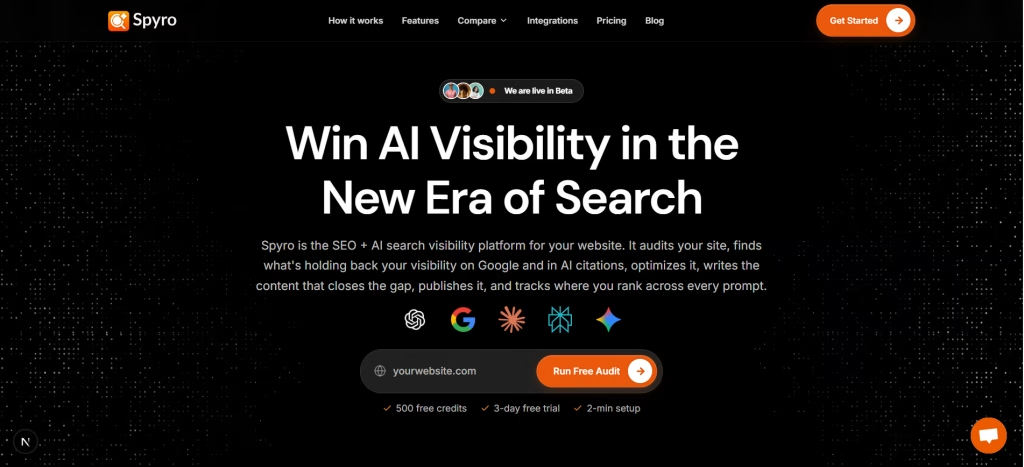
Overview. Spyro AI is an SEO and AI search visibility platform: an AI writer and content calendar alongside rank tracking, site audits and AI visibility tracking.
Blog writing capabilities. The calendar suggests topics from your site and market. Pick one and the writer does the research, writes 2,500+ words, drops in images, and matches a brand voice it picked up from your site.
SEO optimization. An SEO score panel sits beside the target keyword. The docs don’t explain how the score is calculated, and there’s no documented term level editor built on SERP analysis.
GEO and AI search capabilities. Turn on GEO mode and you get answer first snippets, quotable summaries, Q&A blocks, JSON schema and links to your own indexed pages. Tracking is a separate piece. It puts buyer questions to ChatGPT, Claude, Gemini, Perplexity and Google AI Overviews, then shows how often you came up (“mentioned in 3 of 5 checks”), your share of voice, and who beat you. You decide if that runs daily or weekly.
Where it publishes. Publish or schedule to self hosted WordPress, Shopify or webhooks, or switch on auto publish. Search Console and GA4 connect too. Wix and Framer are listed as coming soon.
Pricing and limitations. Starter $29 a month (4,000 credits, up to 10 articles, 2 brands, 15 prompts per brand on ChatGPT and Google AI Overviews). Pro $99 (15,000 credits, up to 30 articles, all five engines). Agency $399 (80,000 credits, unlimited brands). An article costs 250 credits from one shared pool. Yearly billing saves 20%, and the trial runs 3 days with 500 credits.
Strengths. Writing, publishing and AI visibility tracking in one AI content publishing workflow, with unlimited team members.
Weaknesses. No documented fact checking, plagiarism checks or SERP term guidance.
Best fit. SMBs and agencies looking for the best AI writer for blog publishing that also measures AI visibility after launch. See the Spyro AI pricing page.
2. Surfer
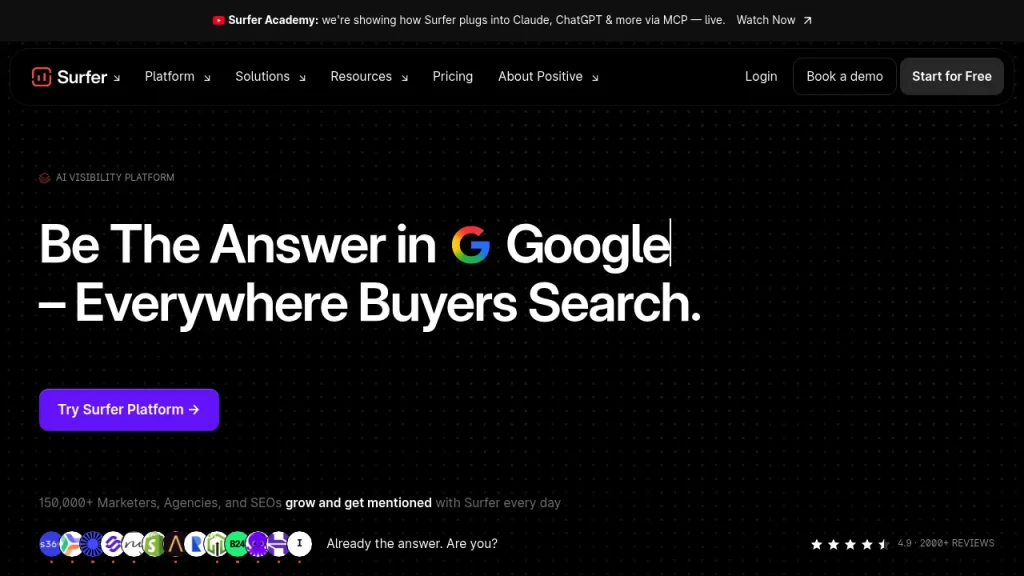
Overview. Surfer is a content optimization tool known for its Content Editor, with an AI writer and AI Tracker on top.
Blog writing capabilities. Surfer AI takes about 20 minutes to build a long draft. Expect 2,000 words or more and as many as 30 headings, and you can tweak the outline before it starts writing.
SEO optimization. The core strength. The Content Editor scores drafts against top ranking pages, with term guidelines, topics and questions.
GEO and AI search capabilities. Standard tracks 25 prompts weekly in ChatGPT only. Pro tracks 50 daily prompts across ChatGPT, Perplexity, Google AI Mode, Google AI Overviews and Gemini.
Where it publishes. WordPress and Google Docs from Standard. API access only on Peace of Mind.
Pricing and limitations. Discovery $49, Standard $99, Pro $182 and Peace of Mind $299 a month, billed yearly.
Strengths. A mature, SERP based editor many writers already know.
Weaknesses. Multi engine tracking starts at $182 a month, and Claude isn’t listed.
Best fit. SEO writers who want the best AI writer for blog optimization at term level. The Surfer SEO alternatives guide covers other options.
3. Semrush Content Toolkit
Overview. The Content Toolkit is the content side of the Semrush suite, sold as its own plan.
Blog writing capabilities. The AI Article Generator writes from scratch or from briefs. You get unlimited standard articles and 5 SEO boosted articles a month, with 10 more for $30.
SEO optimization. You get Topic Finder for ideas, a brief generator that lists keywords and subtopics, and the Content Optimizer for drafts.
GEO and AI search capabilities. Semrush says the optimizer helps content show on Google and in AI search, with advice for platforms like ChatGPT. That’s optimization advice. Prompt tracking sits in the SEO and AI Search plans, starting at $199 a month for 50 daily prompts.
Where it publishes. One click WordPress export (up to 100 sites), Google Docs and up to 50 brand voices.
Pricing and limitations. $60 a month with a 7 day trial. Extra Semrush users start at $45 a month.
Strengths. Keyword data, content briefs and AI content generation inside a suite many teams already pay for.
Weaknesses. Only 5 SEO boosted articles, and tracking means another plan.
Best fit. Teams that want the best AI writer for blog briefs and SERP analysis inside Semrush.
4. Jasper

Overview. Jasper is an AI content platform for marketing teams, built around brand controls and agents.
Blog writing capabilities. Drafting happens in Chat and Canvas. Pro includes 2 brand voices and 3 audiences. Business makes both unlimited.
SEO optimization. Jasper markets SEO and AEO features. Which plan gets which one? The pricing page doesn’t really say.
GEO and AI search capabilities. Real tracking. The GEO Hub monitors brand presence, citation rate, sentiment and share of voice, running each tracked prompt five times per AI provider. The GEO Agent then creates or improves content. Pricing ties GEO Hub credits to the Business plan.
Where it publishes. A browser extension, Google Docs, Webflow and Slack. WordPress isn’t a named publishing integration. API access is Business only.
Pricing and limitations. Pro $69 per seat a month, or $59 billed yearly, with a 7 day trial. Business is custom.
Strengths. Brand governance for large teams, with tracking connected to content work.
Weaknesses. The GEO features sit behind a sales conversation.
Best fit. Large editorial teams that judge the best AI writer for blog content by brand consistency.
5. Frase
Overview. Frase scores drafts for both search and AI answers, with an agent that drafts and publishes.
Blog writing capabilities. Starter gives you 10 articles a month. Professional bumps that to 40, and Scale to 100.
SEO optimization. An SEO score on each draft, plus 50 to 1,000 audit pages a month.
GEO and AI search capabilities. A GEO score on every plan. Tracking covers ChatGPT and Google AI on Starter, adds Perplexity on Professional, and Claude and Gemini on Scale. Base prompt counts aren’t published.
Where it publishes. WordPress publishing and MCP access on every plan.
Pricing and limitations. Starter costs $49 a month, or $39 if you pay yearly. Professional is $129 ($103 yearly) and Scale is $299 ($239). Extra seats are $29. The 7 day trial needs no card.
Strengths. Separate SEO and GEO scores in one AI content editor.
Weaknesses. Tracking costs are hard to forecast without prompt allowances.
Best fit. Writers who want the best AI writer for blog scoring across Google and AI answers.
6. Writesonic
Overview. Writesonic leads with AI search visibility, with an article writer and site audits alongside.
Blog writing capabilities. 15, 25 or 50 articles a month, plus 20 more for $100 on Growth.
SEO optimization. Site audits with automatic fixes. The pricing page lists Content Optimization under Enterprise.
GEO and AI search capabilities. It checks 50, 100 or 200 prompts every day in ChatGPT, Gemini and Google AI Overviews. Enterprise covers more platforms.
Where it publishes. WordPress and Search Console on every plan. GA4 is Enterprise only.
Pricing and limitations. You’ll pay $79 (Starter), $199 (Basic) or $399 (Growth) a month, and those are yearly billing prices.
Strengths. Daily tracking and article output in one plan.
Weaknesses. Claude and Perplexity aren’t on standard plans, and editing features are gated.
Best fit. Teams that want AI visibility tracking more than the best AI writer for blog editing depth.
7. Scalenut

Overview. Scalenut combines keyword planning, GEO article creation and AI visibility tracking.
Blog writing capabilities. At list terms, 5 GEO articles a month on Starter, 30 on Plus and 75 on Professional.
SEO optimization. Content scoring, keyword clusters and a GEO content audit.
GEO and AI search capabilities. ChatGPT and Google AI Overviews on all plans, Perplexity on Professional. Weekly refresh unless you upgrade.
Where it publishes. WordPress and Shopify auto publishing from Plus.
Pricing and limitations. List prices are $59, $89 and $199 a month. When I checked, a 60% discount offer was showing, so your price may differ. 7 day trial.
Strengths. Low entry price for writing and basic tracking.
Weaknesses. Weekly data, and the offer makes long term pricing hard to read.
Best fit. Budget conscious SMBs hunting for the best AI writer for blog GEO articles.
8. NeuronWriter
Overview. NeuronWriter is a budget SEO content editor.
Blog writing capabilities. AI credits on every plan. One click articles through Content Designer start on Gold.
SEO optimization. Term suggestions, a content score and competitor analysis, with 25 to 150 analyses a month. Plagiarism checks from Gold.
GEO and AI search capabilities. 5 to 20 AI monitored questions. An Advanced add on covers Google AI Overviews, AI Mode, ChatGPT and Perplexity.
Where it publishes. WordPress, Shopify and Search Console from Gold, plus unlimited team members.
Pricing and limitations. Bronze $23, Silver $45, Gold $69, Platinum $93 and Diamond $117 a month, 20% off yearly. 7 day trial on Gold terms.
Strengths. The cheapest serious editor here.
Weaknesses. Integrations and one click articles start at $69.
Best fit. Freelancers who want the best AI writer for blog editing on a small budget.
Which Is the Best AI Writer for Blog Work Like Yours?
There’s no universal best AI writer for blog teams. These matches come from the features and limits above.
- Bloggers and solo creators: NeuronWriter Bronze ($23) if you mostly edit. Spyro AI Starter ($29) if you’d rather the drafts get written and published for you.
- SEO writers who need content scoring: Surfer or Frase.
- Agencies with multiple clients: Spyro AI Agency (unlimited brands and team members) or Scalenut Professional (unlimited workspaces).
- Teams publishing to WordPress: Spyro AI, Frase, Writesonic and Semrush publish from their entry plans. Surfer starts on Standard, NeuronWriter on Gold.
- Teams that need detailed briefs and SERP analysis: Semrush Content Toolkit or Surfer.
- Businesses prioritizing GEO and AI search optimization: Frase for GEO scoring, Spyro AI for GEO mode articles.
- Teams measuring AI visibility after publishing: Writesonic for daily data on three engines, Spyro AI Pro for five engines at $99.
- Budget conscious users: if the best AI writer for blog work is simply the cheapest one that’s good enough, look at NeuronWriter, Spyro AI Starter, or Scalenut at its current offer.
- Large editorial teams with brand voice rules: Jasper Business, or Semrush with up to 50 brand voices.
Still torn? Run the same brief through two tools and time the edit.
How Do You Use an AI Blog Writer for SEO?
An AI blog writer for SEO gets you to a first draft faster. That’s it. It won’t run your blog content workflow for you. Whatever you end up calling the best AI writer for blog posts in your stack, I’d run it in this order:
- Settle on one intent and one reader. Someone searching “best payroll software for agencies” wants a shortlist. Someone searching “how payroll software works” wants an explainer.
- Gather sources first. Do it before the draft exists, not after.
- Look at what already ranks. Note the format, and note the gaps.
- Outline with the answer up top. The direct answer goes right under the H1.
- Draft with the AI writer. Give it your outline, sources and voice settings.
- Open every source. A stat you can’t trace back gets deleted. No exceptions.
- Add original examples and experience. Your data, screenshots and opinions.
- Fix the boring stuff. Headings, internal links, title tag, meta description, paragraph length.
- Edit hard. Is it right? Is it useful? AI drafts also love making the same point twice, so trim.
- Publish and watch. Rankings, clicks and AI mentions, over weeks.
Even the best AI writer for blog posts only handles step 5 well. SEO optimized blog writing happens in steps 6 to 9, and Google is clear about skipping them. Its spam policies list “using generative AI tools or other similar tools to generate many pages without adding value for users” as scaled content abuse. Its guidance on helpful content says producing large amounts of text “without manual oversight or curation” represents little to no effort.
So AI generated content for SEO works when a person shapes it. No word count, content score or heading pattern guarantees a ranking.
How Do You Optimize AI Written Blogs for GEO?
GEO content optimization makes a page easier for AI search engines to read, trust and quote. It overlaps heavily with good SEO. Google’s AI features documentation says there are “no additional requirements to appear in AI Overviews or AI Mode, nor other special optimizations necessary.” A page needs to be indexed and eligible to show a snippet.
What helps, for both content optimization for ChatGPT and content optimization for Google AI Overviews:
- Direct answers in the first sentence or two under each question heading.
- Descriptive headings phrased the way buyers search.
- Evidence from named, linked sources.
- The same name every time for a product, person or concept.
- Internal links that send readers somewhere deeper.
- Original information like your own data and examples.
- Current facts and dates, updated when prices or features change.
- Crawlable pages that AI bots aren’t blocked from reading.
- Structured data that matches the page. Google’s structured data policies say markup “must be a true representation of the page content”, and that markup doesn’t guarantee rich results.
- Clear author and organization details.
- Monitoring of mentions and citations after publishing.
Is there research behind this? Some. The GEO paper from Princeton researchers, presented at KDD 2024, found optimization could boost visibility “by up to 40%” in generative engine responses on its benchmark, varying by domain. Useful. Not a promise.
Citation readiness raises your odds. It doesn’t guarantee inclusion in AI answers, and no tool (not even the best AI writer for blog content) can promise one. The SEO vs GEO vs AEO guide explains how generative engine optimization and answer engine optimization fit with classic SEO. To check one page quickly, run the free SEO and GEO Audit.
AI Blog Writing vs AI Visibility Tracking: What’s the Difference?
This is the distinction that matters most when you shop for the best AI writer for blog growth in AI search.
| Area | AI blog writing | AI visibility tracking |
|---|---|---|
| Purpose | Produce or improve an article | Measure whether AI engines mention or cite a brand |
| Input data | Topic, keywords, sources, brand voice | Buyer questions (prompts) and a list of engines |
| Output | A draft, outline, score or published post | Mention rates, citations, share of voice, competitors |
| How success is measured | Rankings, traffic, editing time saved | Mentions and citations across many runs |
| Typical workflow stage | Before and at publishing | After publishing, ongoing |
| Measures actual AI answers? | No | Yes |
Picture this. Your AI writer turns out a solid guide on a buyer question, say “what’s the best AI writer for blog posts at a small agency?” Then a tracker types that exact question into ChatGPT, Gemini, Perplexity, Claude and Google AI Overviews each week. Did your brand come up? Which pages got cited? That’s what it writes down.
So why can a great article still get zero mentions? AI engines draw on many sources, answers change between runs, and competitors publish too. Clicks are shrinking as well. Pew Research Center looked at real browsing data and found people clicked a regular result on just 8% of Google visits that showed an AI summary. Without a summary, it was 15%. Being named inside the answer counts for more now, and you have to measure that on its own.
What Does an AI Blog Writer Really Cost per Article?
Cheap plans can cost more than they look, so the best AI writer for blog budgets isn’t always the lowest sticker price. Watch these:
- Billing term. Surfer and Writesonic show yearly prices. Jasper, Frase, NeuronWriter and Spyro AI discount annual plans.
- Article limits. Semrush stops at 5 SEO boosted articles a month. On Writesonic you get somewhere between 15 and 50, on Frase 10 to 100.
- Credits. Spyro AI and NeuronWriter use credit pools, so heavy tracking leaves less for articles.
- Seats. Spyro AI includes unlimited team members. Jasper charges per seat, Frase $29 per extra seat.
- Projects and allowances. Scalenut allows one workspace on Starter. NeuronWriter caps analyses at 25 to 150 a month.
- Publishing and API. Integrations start on Surfer Standard, NeuronWriter Gold and Scalenut Plus. API access needs Surfer Peace of Mind or Jasper Business.
- Tracking add ons. Semrush sells tracking in separate plans, NeuronWriter as an add on.
- Human editing time. Usually the biggest cost, and no pricing page shows it.
Here’s a rough illustration of what each contender for the best AI writer for blog output costs per post. It isn’t a vendor quote. I divided each entry price by the published article allowance and assumed you use every article.
| Entry plan | Monthly price | Articles included | Subscription cost per article |
|---|---|---|---|
| Spyro AI Starter | $29 | Up to 10 | $2.90 |
| Frase Starter (monthly) | $49 | 10 | $4.90 |
| Writesonic Starter (billed yearly) | $79 | 15 | About $5.27 |
| Semrush Content Toolkit | $60 | 5 SEO boosted | $12.00 |
Now add editing. At a hypothetical 90 minutes per draft and $40 an hour, that’s $60 an article, more than any figure above. And these plans do different things, so matching prices never mean matching capability. The AI visibility tools pricing guide breaks down tracking costs on their own.
How Do You Check the Quality of AI Generated Content?
Whichever tool you pick as the best AI writer for blog content, run every draft through this checklist:
- Is the article accurate?
- Does it answer the query directly, near the top?
- Are claims supported by reliable, linked sources?
- Does it include meaningful examples?
- Is it written for the intended audience?
- Does it repeat itself?
- Are product capabilities and prices current?
- Are the internal links relevant?
- Does it offer something beyond a generic summary?
- Has a human reviewed the final article?
What about AI detectors? Use them as a rough signal, never as proof. Stanford researchers found that detectors flagged 61.22% of essays by non native English speakers as AI generated, even though people wrote them. A low score doesn’t make a draft good. Human editing does.
How These AI Blog Writers Were Compared
This is a research based comparison of features and pricing, checked in 2026. I didn’t run controlled tests, generate the same article in each tool, benchmark output quality or interview users. Nothing here is a measured performance result. The goal is to help you choose the best AI writer for blog work like yours, not to crown a winner.
I reviewed each tool’s official product pages, pricing pages and help docs, plus Google Search Central, the Tow Center for Digital Journalism, Pew Research Center, Stanford HAI and the Princeton GEO research. This comparison appears on the Spyro AI blog, so Spyro AI details come from its own pricing page and product documentation, held to the same standard as every other tool.
Where a vendor didn’t publish a figure, I wrote “not clearly documented” or “custom.” Where a vendor’s pages disagreed, I used the pricing page. I left out Copy.ai, because its current plans focus on chat and sales workflows rather than SEO blog writing, and general chatbots without a blog publishing workflow.
Key Takeaways
- There’s no best AI writer for blog content in general, only the one that fixes your gap (research, drafting, SEO scoring, publishing or tracking).
- Useful SEO features are briefs, SERP based term guidance, metadata help and a real editor.
- GEO support means clearer structure, direct answers, evidence and schema. It doesn’t guarantee citations.
- Writing a draft and tracking AI answers are different jobs, so check which one your best AI writer for blog content actually does.
- Every AI draft needs human editing and fact checking, and plan limits decide the real cost.
Frequently Asked Questions
What is the best AI writer for blog content in 2026?
There’s no single best AI writer for blog content in 2026. Surfer, Frase and NeuronWriter suit writers who want SEO content scoring. Semrush suits teams already using its suite, and Jasper suits large brand teams. Spyro AI, Writesonic and Frase pair writing with AI visibility tracking.
Which AI blog writer is best for SEO?
Surfer and NeuronWriter are the ones to look at if you want drafts graded against top ranking pages. Semrush’s Content Toolkit throws in briefs and topic research. Honestly, the right AI blog writer for SEO is whichever one’s briefs and scoring fit how you already work (and what you can spend). You’ll still need to edit.
Can AI write SEO friendly blog posts?
Yes. It handles headings, keywords and structure just fine. But Google’s spam policies call mass produced pages that add nothing for users scaled content abuse. So have a person check the facts, add real insight and edit before anything goes live.
What is the difference between SEO and GEO for blog writing?
Think of it this way. SEO gets a post onto page one. GEO (generative engine optimization) gets ChatGPT, Google AI Overviews and other engines to pick it up and quote it. Both reward the same habits, like answering early and backing claims up. You just keep score differently: rankings for one, mentions and citations for the other.
Do AI blog writers track ChatGPT citations?
Mostly no. Even the best AI writer for blog drafting tends to stop the moment a post goes live. Knowing whether ChatGPT names or cites you takes AI visibility tracking, which is a separate feature. Spyro AI, Surfer, Frase, Writesonic, Scalenut, NeuronWriter and Jasper have some version of it. Coverage isn’t equal, though. Engines, prompt counts and plan tiers vary.
Is an AI writer enough for a complete SEO workflow?
Rarely. You’ll still need keyword research, a technical audit, internal links and rank tracking, plus visibility tracking if AI search matters to you. Some platforms bundle a few of these. Read the plan page before assuming yours does.
Should AI generated blog posts be edited before publishing?
Every time. AI drafts can invent sources, get prices wrong and make one point four different ways. Google’s helpful content guidance says text produced without manual oversight or curation is little to no effort. So edit, check and add real examples before anything goes out.
Choose the Best AI Writer for Blog Work by the Gap You Need to Close
Start with the gap. If drafts take too long, test a writer. Drafts feel thin? Try an SEO content editor. No idea whether AI engines mention your brand? Get a tracker. Need all three? Then do the math: one combined plan versus two separate tools, at the number of posts you really ship.
Thinking about Spyro AI as the best AI writer for blog publishing plus tracking? The Spyro AI pricing page lays out the plans. Or get a baseline first. The free AI Visibility Checker shows whether ChatGPT and Google AI Overviews mention your brand today. It won’t guarantee a citation. It will show you where you stand.