Writesonic Alternatives for SEO and AI Search Content




Quick Answer: Which Writesonic Alternatives Fit SEO and AI Search Content?
The right Writesonic alternatives depend on the job you need done: drafting articles, scoring them for Google, or measuring whether AI engines mention your brand. Writesonic now leads with AI visibility tracking, so many people shopping for Writesonic alternatives want something more writing focused, or something that costs less.
- Drafting and AI visibility tracking in one account: Spyro AI (from $29 a month) writes and publishes articles, then checks ChatGPT, Claude, Gemini, Perplexity and Google AI Overviews (all five on Pro).
- An SEO content editor: Surfer starts at $49 a month billed yearly, NeuronWriter at $23 a month, and Frase at $49 a month with separate SEO and GEO scores.
- Brand voice for bigger teams: Jasper Pro costs $69 per seat a month, or $59 billed yearly.
- Sales and marketing workflows: Copy.ai now sits closer to workflow automation than to blogging.
Here’s the thing most lists skip. Writing a draft, optimizing it for search and tracking AI answers are different jobs, and a tool that does one rarely does all three. So the right pick among Writesonic alternatives is whichever one covers the job you’re missing. Want the editing side first? The AI content optimization guide explains how AI engines choose passages to quote.
I wrote this for SMBs, in house marketing teams, SEO specialists and agencies. Prices come from each vendor’s public pricing page, checked in 2026. SaaS pricing moves fast, so confirm before you pay.
Why Do Teams Look for Writesonic Alternatives?
Writesonic isn’t a bad tool, and none of these reasons applies to everyone. They’re just the ones I’d expect to come up when someone starts comparing Writesonic alternatives.
- Billing and price. Its pricing page lists Starter at $79 a month, Basic at $199 and Growth at $399, all billed annually. A monthly rate isn’t shown.
- Product direction. The homepage presents Writesonic as an AI search growth engine, with the article writer there to earn citations. If you mainly want a writing environment, that’s a different starting point.
- Editor depth. The pricing page lists content optimization under Enterprise. Self serve plans list a content strategy agent, an AI article writer and site audits.
- Engine coverage. Self serve plans track ChatGPT, Gemini and Google AI Overviews. The Enterprise tier lists nine platforms, including Claude and Perplexity.
- Seats. Starter includes one user. Extra users on Basic and Growth are $50 each.
- Brand voice. Writing styles run from 1 on Starter to 10 on Growth.
What Does Writesonic Offer Before You Compare Writesonic Alternatives?
Fair comparisons need a baseline. Writesonic describes a loop of tracking AI visibility across platforms, ranking fixes by impact, acting on them with content rewrites and technical fixes, then measuring results. Plans include 15, 25 or 50 articles a month, 50 to 200 tracked prompts, site audits, and WordPress and Search Console integrations.
That’s a real feature set for teams that put AI visibility first. The vendor’s own performance claims aren’t independently verified, and I haven’t tested the product, so I’m leaving them out. Judge it on the plan limits above.
What Should You Look for in Writesonic Alternatives?
Start by splitting four jobs that vendors blur together.
- Generating content. The tool drafts, rewrites or refreshes the article.
- Optimizing for conventional search. It helps with structure, term coverage, headings and metadata so the page can rank in Google.
- Optimizing for AI generated answers. It helps with direct answers, evidence and clarity, so a passage is easier to quote.
- Tracking AI mentions. It asks AI engines your buyers’ questions on a schedule and records whether you were named or cited.
A writer isn’t automatically a tracker, and a content score doesn’t measure whether ChatGPT cites you. Once you know which job is missing, check six things on each of the Writesonic alternatives you shortlist:
- Editorial control. Can you edit the outline before drafting, and see sources?
- SEO workflow. Briefs, term guidance, scoring, metadata.
- AI search relevance. Real tracking, or only writing tips? Which engines, how often?
- Collaboration. Seats, brand voices, approvals.
- Publishing. WordPress, Google Docs, Shopify, API.
- Cost at your volume. Plan limits matter more than the entry price.
How Do Writesonic Alternatives Compare Side by Side?
Here are the Writesonic alternatives covered below, with Writesonic last for reference. Starting price means the lowest published paid plan. On a phone, swipe the table sideways.
| Tool | Best for | SEO content features | AI search or GEO | Starting price | Main advantage | Main limitation |
|---|---|---|---|---|---|---|
| Spyro AI | SMBs and agencies wanting content plus tracking | AI writer, SEO score panel, content calendar | GEO mode drafting; tracking in 2 engines on Starter, 5 on Pro | $29/mo | Writing, publishing and tracking in one account | No documented SERP term editor |
| Jasper | Larger teams with brand rules | Agents and brand voices; SEO features not listed on Pro | GEO Hub and agents on the custom Business plan | $69/seat/mo ($59 yearly) | Brand voices and audiences | Pro includes one seat; GEO needs sales |
| Surfer | Writers optimizing against ranking pages | Content Editor, Content Score | From Standard: 25 weekly prompts in ChatGPT; five engines on Pro | $49/mo billed yearly | Mature SERP based editor | Five engines start at $182/mo |
| Frase | Teams scoring for Google and AI answers | SEO score, 10 to 100 articles a month | GEO score; ChatGPT and Google AI on Starter, Claude and Gemini on Scale | $49/mo ($39 yearly) | Separate SEO and GEO scores | Plan prompt allowances not listed |
| NeuronWriter | Freelancers and small teams on a budget | Term suggestions, content score | 5 to 20 AI monitored questions | $23/mo | Lowest entry price | Integrations start on Gold ($69) |
| Copy.ai | Sales and marketing workflow teams | Content creation is one use case; SEO blog features not listed on plans | Not documented | $29/mo chat plan; workflow plans from $1,000/mo | Workflows and agents across go to market tasks | Workflow plans cost a lot for a blog only team |
| Wordtune | Rewriting and polishing text | None listed | None listed | Free; paid from $6.99/mo | Cheap editing help | Not an SEO tool |
| Rytr | Short copy drafts | SEO appears only as a writing use case | None listed | Free; paid from $9/mo | Low price | Now leads with relationship management |
| Writesonic (reference) | Teams putting AI visibility first | Site audits, AI article writer; content optimization on Enterprise | Daily tracking, 50 to 200 prompts in ChatGPT, Gemini, AI Overviews | $79/mo billed yearly | Tracking and articles in one plan | No monthly price shown |
Read the AI search column twice. “Yes” can mean five monitored questions or 200 prompts a day.
Which Writesonic Alternatives Belong on Your Shortlist?
This isn’t a ranking. Each review follows the same format, and I’ve said where every tool falls short. I picked five full reviews of Writesonic alternatives because they cover different needs. The rest get shorter treatment further down.
1. Spyro AI
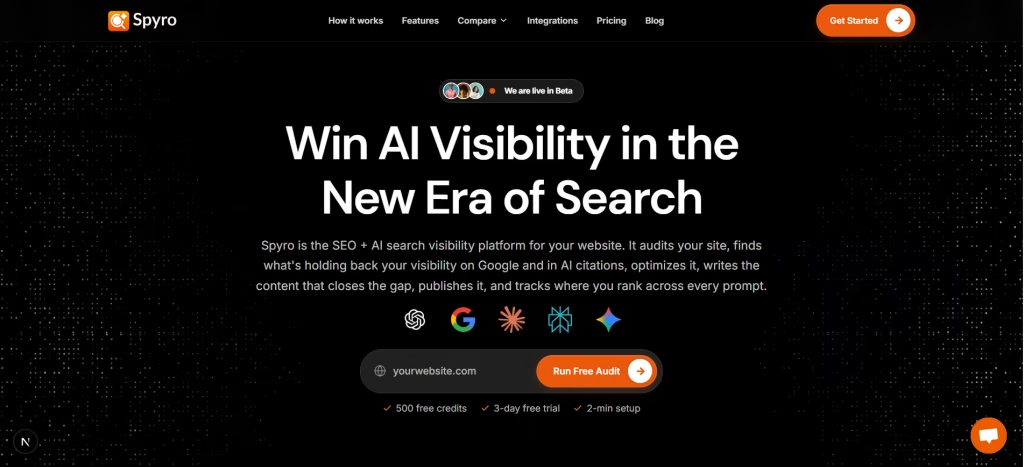
What it does. Spyro AI is an SEO and AI search visibility platform with keyword rank tracking, site audits, competitor research, an AI writer and AI visibility tracking.
SEO content workflow. A content calendar suggests topics. Pick one and the writer researches it, drafts a long article with images and shows an SEO score panel beside the target keyword. The documentation doesn’t explain how that score is calculated, and I found no term level editor built on SERP analysis.
AI search and GEO. GEO mode structures articles with answer first snippets, Q&A blocks and schema. Tracking is a separate piece. It puts buyer questions to ChatGPT, Claude, Gemini, Perplexity and Google AI Overviews, then reports frequency (“mentioned in 3 of 5 checks”), share of voice and competitors. You set checks to daily or weekly.
Pricing. Starter is $29 a month with 4,000 credits, up to 10 articles, 2 brands and up to 15 prompts per brand on ChatGPT and Google AI Overviews. Pro is $99 with 15,000 credits, up to 30 articles, 10 brands, up to 50 prompts per brand and all five engines. Agency is $399 with 80,000 credits, unlimited brands and up to 250 prompts per brand. Yearly billing saves 20%, and the trial gives you 3 days and 500 credits.
Strengths. Drafting, publishing and measuring in one place, with unlimited team members on every plan.
Limitations. It’s not a like for like swap for a SERP based editor. Starter covers two engines only.
Best fit. SMBs and agencies that want to publish content and then see whether AI engines mention them. Skip it if your writers need term level guidance as the main feature.
2. Jasper
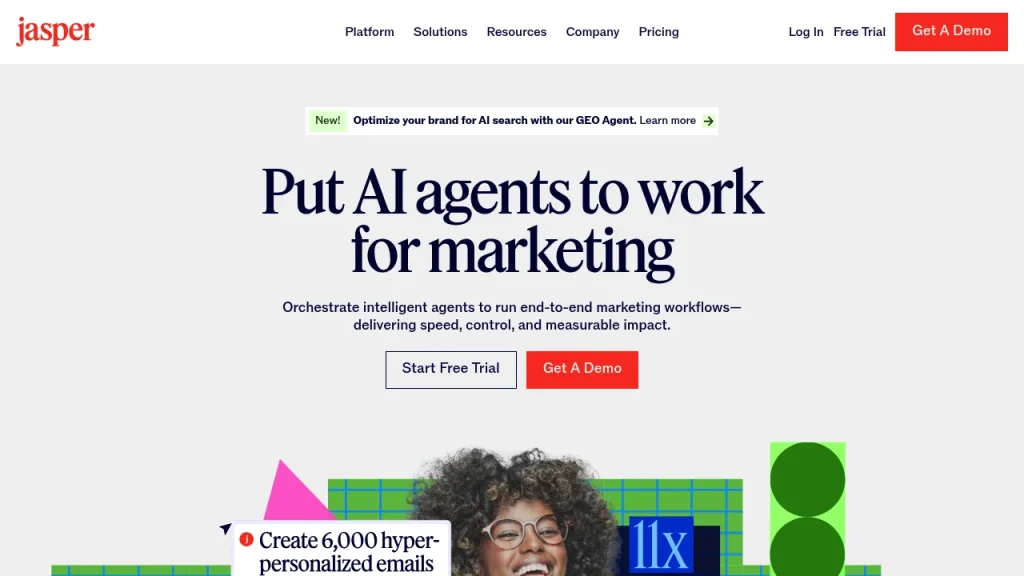
What it does. Jasper is an AI platform for marketing teams, built around brand voices, audiences and agents.
SEO content workflow. The pricing page describes agents for core marketing workflows, but it doesn’t list SEO or AEO features for the Pro plan. If SEO tooling is your reason for switching, ask what’s included before you pay.
AI search and GEO. The Business plan mentions agents for GEO, translations and deep research, and says GEO Hub and agents run on usage based credits. Business is quoted by sales.
Pricing. Pro is $69 per seat a month, or $59 per seat billed yearly. It includes one seat, 2 brand voices and 3 audiences, with a 7 day trial. Business adds unlimited users, brand voices and audiences, plus API access.
Strengths. Brand governance. Teams that care about consistent voice across many writers will like the controls.
Limitations. More than one user means Business, which means a sales call.
Best fit. Larger editorial teams with strict brand rules. Consider another option if you’re a solo writer who wants SEO scoring or visible tracking numbers on a public price.
3. Surfer
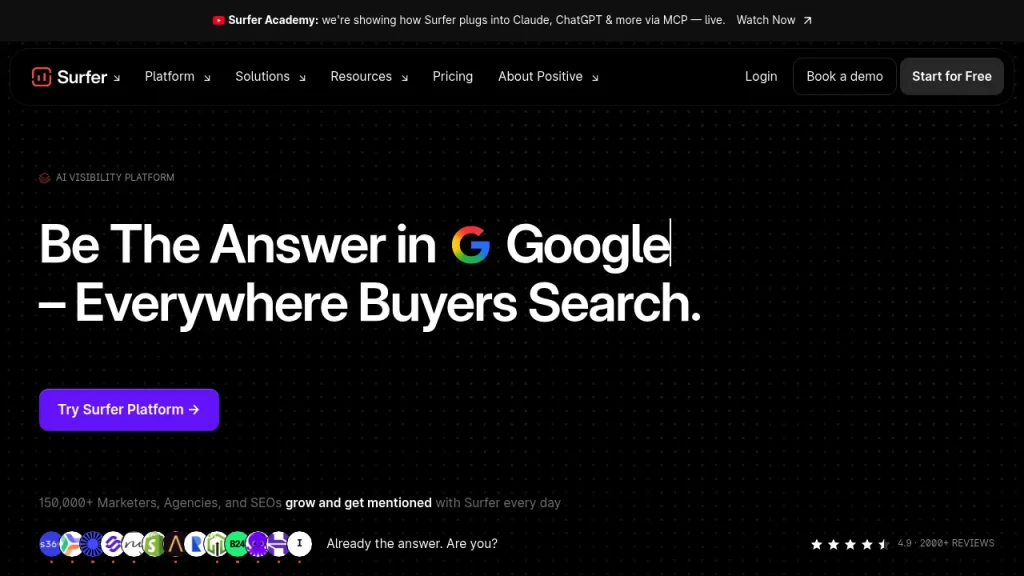
What it does. Surfer is a content optimization tool known for its Content Editor, with an AI assistant and AI search tracking added on top.
SEO content workflow. This is the core strength. The Content Editor scores drafts against pages that already rank, with term guidance, topics and questions. Integrations with WordPress and Google Docs start on Standard.
AI search and GEO. Standard tracks 25 prompts weekly in ChatGPT. Pro tracks 50 prompts daily in ChatGPT, Perplexity, Google AI Mode, Google AI Overviews and Gemini. Claude isn’t listed.
Pricing. Billed yearly: Discovery $49 a month, Standard $99, Pro $182 and Peace of Mind $299. A tracking only plan, AI Search Analytics, is $82. Monthly billing prices aren’t listed on the page.
Strengths. A mature editor that many SEO writers already know.
Limitations. Discovery has no prompt tracking, and the first plan with five engines is $182 a month.
Best fit. SEO writers who want to optimize at term level. Consider another option if you need Claude tracking or monthly billing. The Surfer SEO alternatives guide goes deeper on that comparison.
4. Frase
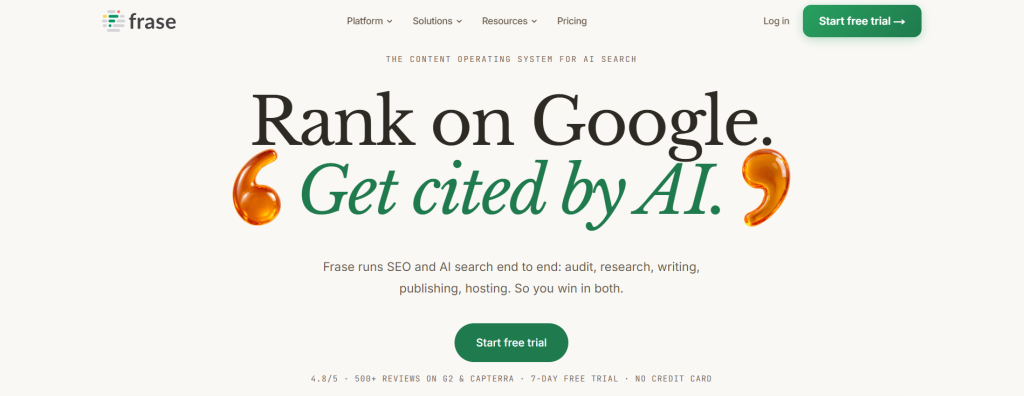
What it does. Frase scores drafts for both Google and AI answers and produces articles on a monthly allowance.
SEO content workflow. Starter includes 10 articles a month, Professional 40 and Scale 100. Every plan lists SEO and GEO scores.
AI search and GEO. AI visibility covers ChatGPT and Google AI on Starter, adds Perplexity on Professional (plus AI crawler monitoring), and adds Claude and Gemini on Scale.
Pricing. Starter is $49 a month, or $39 billed yearly. Professional is $129 ($103 yearly) and Scale is $299 ($239). Extra seats are $29 a month, and the 7 day trial needs no card.
Strengths. Two separate scores in one editor, which suits teams writing for both audiences.
Limitations. The pricing page doesn’t list how many prompts each paid plan includes, so tracking costs are hard to forecast.
Best fit. Teams that want one scoring tool for Google and AI answers. Consider another option if prompt counts matter to your budget.
5. NeuronWriter
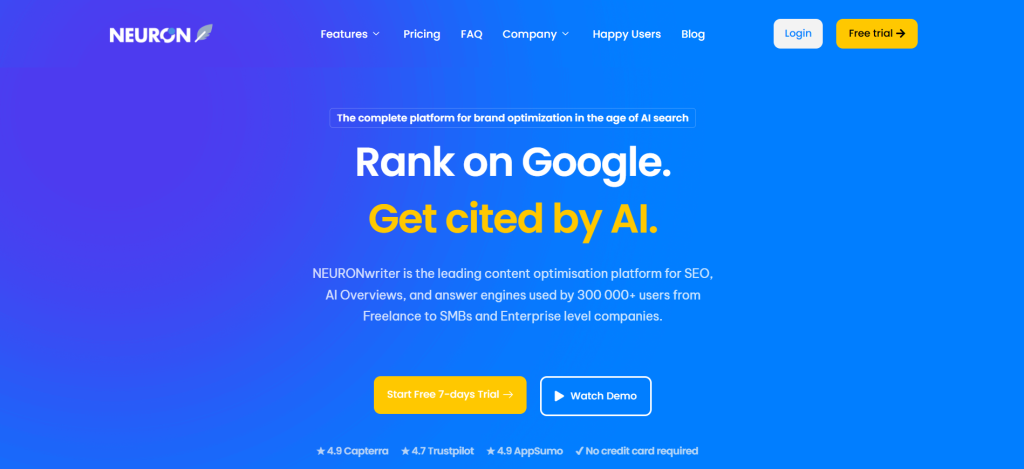
What it does. NeuronWriter is a budget SEO content editor.
SEO content workflow. Term suggestions, a content score and competitor analysis sit at the center. Documents run from 25 on Bronze to 150 on Diamond. Plagiarism checks start on Gold. Integrations with WordPress, Shopify and Search Console also start on Gold.
AI search and GEO. Plans list 5 to 20 AI monitored questions, plus an AI monitoring add on that extends coverage. That’s tracking on a small scale.
Pricing. Bronze $23 a month, Silver $45, Gold $69, Platinum $93 and Diamond $117, with yearly billing at ten times the monthly price. The 7 day trial uses Gold terms.
Strengths. The lowest entry price of any editor here.
Limitations. Publishing integrations and one click features start at Gold.
Best fit. Freelancers and small teams that mostly edit. Consider another option if you need heavy tracking.
Is Jasper AI One of the Writesonic Alternatives Worth Paying For?
Jasper AI is the name people search for most, so it deserves its own answer. It’s a marketing writing platform with strong voice controls. It isn’t an SEO editor, and on the plan most people can buy online, it isn’t an AI visibility tool either.
That matters because the two products start from opposite places. Writesonic leads with tracking and uses writing to act on it. Jasper leads with brand consistent writing and routes GEO work through its custom plan. If you’re moving from Writesonic because you want better drafting control, Jasper is a fair candidate among Writesonic alternatives. If you’re moving because you want cheaper tracking or an SEO editor, I’d look at the other Writesonic alternatives first.
One practical point: Pro includes a single seat. Add writers and you’re in a sales conversation. The Spyro AI vs Jasper vs Surfer comparison shows how the three differ in more detail, and the broader comparison of AI blog writers for SEO and GEO covers eight more tools.
Do Copy.ai, Wordtune and Rytr Make Sense as Writesonic Alternatives?
Sometimes, for narrower jobs. Of all the Writesonic alternatives here, these three are the narrowest. They aren’t identical products, and none of them is a tracking tool.
Copy.ai. Its homepage describes a go to market platform built on workflows, agents and tables, with content creation (including SEO content) as one use case. The chat plan is $29 a month, or $24 billed yearly, with 5 seats. Workflow plans start at $1,000 a month. That’s a sales and marketing operations product. A blog only team will rarely need it.
Wordtune. It rewrites, summarizes and polishes text. The free plan allows 10 rewrites a day, Advanced is $6.99 a month list price ($4.89 billed annually) and Unlimited is $9.99 ($6.99 annually). I found no SEO features on the plans page. Use it to improve sentences, not to plan or score articles.
Rytr. The pricing page lists a free plan with 10,000 characters a month, then Lite at $9, Personal at $19 and Pro at $49. Rytr now presents itself first as a relationship manager, with writing under a separate Create product (40 use cases, 22 tones, 38 languages). SEO shows up only as a use case. For long SEO articles, I’d pick something built for them.
What’s the Difference Between Content Creation, SEO Optimization and AI Search Visibility?
This table is the one I’d screenshot. Most disappointment with any of the Writesonic alternatives comes from buying one column and expecting another.
| Area | AI content creation | SEO optimization | AI search visibility |
|---|---|---|---|
| Question it answers | Can this tool draft the article? | Does the draft cover what ranks? | Do AI engines name or cite us? |
| Data it uses | Your brief, sources, voice | Pages that rank for the keyword | Answers from AI engines on a schedule |
| Typical output | A draft, rewrite or refresh | A score, term list, outline | Mention rates, citations, share of voice |
| Measures live AI answers? | No | No | Yes |
| Example tools in this guide | Jasper, Wordtune, Rytr | Surfer, NeuronWriter, Frase | Writesonic, Spyro AI, Surfer (from Standard) |
Plenty of Writesonic alternatives straddle columns. Spyro AI writes and tracks. Frase scores and tracks. Optimization for AI answers (direct answers, evidence, clear headings) is a writing habit, and tools can nudge it, but none of them can promise a citation.
How Do You Choose Between Writesonic Alternatives?
Pick by role and gap, not by feature count.
- Solo content writers: NeuronWriter Bronze ($23) if you edit a lot, or Wordtune if you only need polish.
- Small businesses: Spyro AI Starter ($29) if you’d like drafts published for you and a read on AI mentions. Check that two tracked engines is enough.
- SEO specialists: Surfer or Frase for term level scoring. Surfer’s first multi engine plan is Pro.
- Content marketing teams: Jasper Business when brand voice is the priority, or Frase when SEO and GEO scoring is.
- Agencies: Spyro AI Agency (unlimited brands) for content plus tracking, or Writesonic Growth if daily tracking across clients matters more than editing depth.
- Teams optimizing for AI generated answers: a tracker. Use Spyro AI Pro, Writesonic, Surfer Pro or Frase Scale, then compare engine lists with the answers your buyers actually see.
Does AI Written Content Rank or Get Cited?
Not automatically, whichever of the Writesonic alternatives you use. Google doesn’t ban AI content, but its spam policies treat using generative AI to produce many pages without adding value as scaled content abuse. And in 2026 Google updated its generative AI content guidance with a line I’d tape to the monitor. It says it is “critical to manually factcheck and review” AI generated content “for accuracy and trustworthiness before publishing,” according to Search Engine Journal’s report. The review includes metadata.
There’s data on ranking too. A Graphite analysis of 31,493 keywords found about 14% of ranking articles were AI generated, and only 7% of first place results. In a paired test, human written pages ranked higher. The authors note ranking has many causes, and they didn’t study AI drafts that people heavily edit. So treat it as a warning about unedited output, not a verdict on every tool.
My takeaway? With any of the Writesonic alternatives, the tool matters less than the edit. Add original examples, open every source and check every price.
How Were These Writesonic Alternatives Evaluated?
This is a research based comparison. I didn’t run controlled tests, generate the same article in each tool or benchmark output quality, so nothing here is a measured performance result.
I used each vendor’s public pricing page and product pages, checked in 2026, plus the independent sources linked above. For Surfer, Frase and NeuronWriter editor features, I relied on the earlier Spyro AI comparisons instead of rechecking each one today. Spyro AI details come from its own pricing page and documentation, held to the same standard as every other tool. Where a vendor didn’t publish a figure, I wrote “not listed.” Where a page didn’t name its currency, I report the dollar figure as shown. Criteria for judging Writesonic alternatives were editorial control, SEO workflow, AI search relevance, collaboration, publishing, price and fit by company size.
I left out general chatbots, which have no SEO workflow of their own, and tools whose current pricing I couldn’t check on the day of writing, such as the Semrush Content Toolkit and Scalenut. The earlier AI blog writers comparison covers some of those.
Where Does Spyro AI Fit in an SEO and AI Search Workflow?
Among Writesonic alternatives, Spyro AI covers the writing, publishing and measuring parts, and it’s built for SMBs, mid sized companies and agencies that want those in one account. It can complement other tools too. A team could keep a term level editor for scoring and use Spyro AI to publish and then watch AI mentions.
It doesn’t replace everything. Jasper’s brand governance, Wordtune’s sentence polish and a SERP based editor each do things Spyro AI doesn’t document. Spyro AI doesn’t track Microsoft Copilot, Google AI Mode or Grok, while Writesonic’s Enterprise tier lists some of them. And like every tool here, it can’t promise a ranking or a citation.
Where it helps is the gap after publishing. The WordPress AI SEO automation guide shows a safe draft and review workflow, and the pricing page lists plan limits. To see whether ChatGPT and Google AI Overviews mention your brand today, try the free AI Visibility Checker.
Key Takeaways
- The best Writesonic alternatives depend on whether you need drafting, SEO scoring, AI search tracking or a mix.
- Writesonic now leads with AI visibility, so editor focused writers may prefer Writesonic alternatives like Surfer, NeuronWriter or Frase.
- Jasper suits brand heavy teams, but Pro includes one seat and GEO features sit behind a sales call.
- Copy.ai, Wordtune and Rytr are narrower tools, and none of them tracks AI answers.
- No tool guarantees rankings or citations. Edit, fact check and measure over weeks.
Frequently Asked Questions
Which Writesonic alternatives are best for SEO content?
Which Writesonic alternatives suit you depends on the job. Surfer, NeuronWriter and Frase suit writers who want drafts scored against ranking pages. Spyro AI suits teams that want drafting, publishing and AI mention tracking together. Jasper suits brand heavy teams, though its Pro plan page doesn’t list SEO features.
Is Jasper AI better than Writesonic?
Neither wins outright, because they start from different places. Jasper focuses on brand voice and marketing agents, with Pro at $69 per seat monthly and one seat included. Writesonic focuses on AI visibility tracking and article output, with plans from $79 a month billed annually. Pick the one that matches your gap.
Is Copy.ai suitable for SEO content?
Partly. Its homepage lists SEO content as one use case, but the product is a go to market platform, and the plans page doesn’t list SEO blog features. For a blog focused team, the workflow plans from $1,000 a month are hard to justify.
Is Wordtune an AI writing tool or an SEO tool?
It’s a rewriting and polishing tool. Wordtune handles rewrites, summaries and grammar, and I found no SEO features on its plans page. Pair it with a separate SEO editor if you need scoring.
Is Rytr suitable for long form SEO articles?
I wouldn’t pick it for that. Rytr’s writing product covers 40 use cases, SEO is only one of them, and the company now leads with a relationship management product. Short copy drafts fit better than full articles.
What is the difference between an AI writer and an AI visibility tool, and can either help content appear in AI answers?
An AI writer produces or improves text. An AI visibility tool asks AI engines your buyers’ questions and records whether you were named or cited. Writing tools can improve structure and clarity, which may help a passage get quoted, but they can’t guarantee it. Only tracking shows what engines actually say.
Can I use another AI writing tool with Spyro AI?
Yes. Many teams draft elsewhere and use Spyro AI to publish, schedule and track mentions across five engines on Pro. Test the handoff on one article first, and check the published page with the free SEO and GEO Audit.
Pick the Gap First, Then Compare Writesonic Alternatives
Start with the job you’re missing. If drafts are slow, test a writer. If they feel thin, try an editor. If you can’t see whether AI engines name you, try a tracker. Then run two of the Writesonic alternatives on the same brief and time the edit.
Want a baseline before you spend anything? Run the free SEO and GEO Audit on one important page, or start a free trial of Spyro AI and see the draft, publish and track workflow on one article.