


How to Get Cited in ChatGPT & Perplexity: 2026 Guide
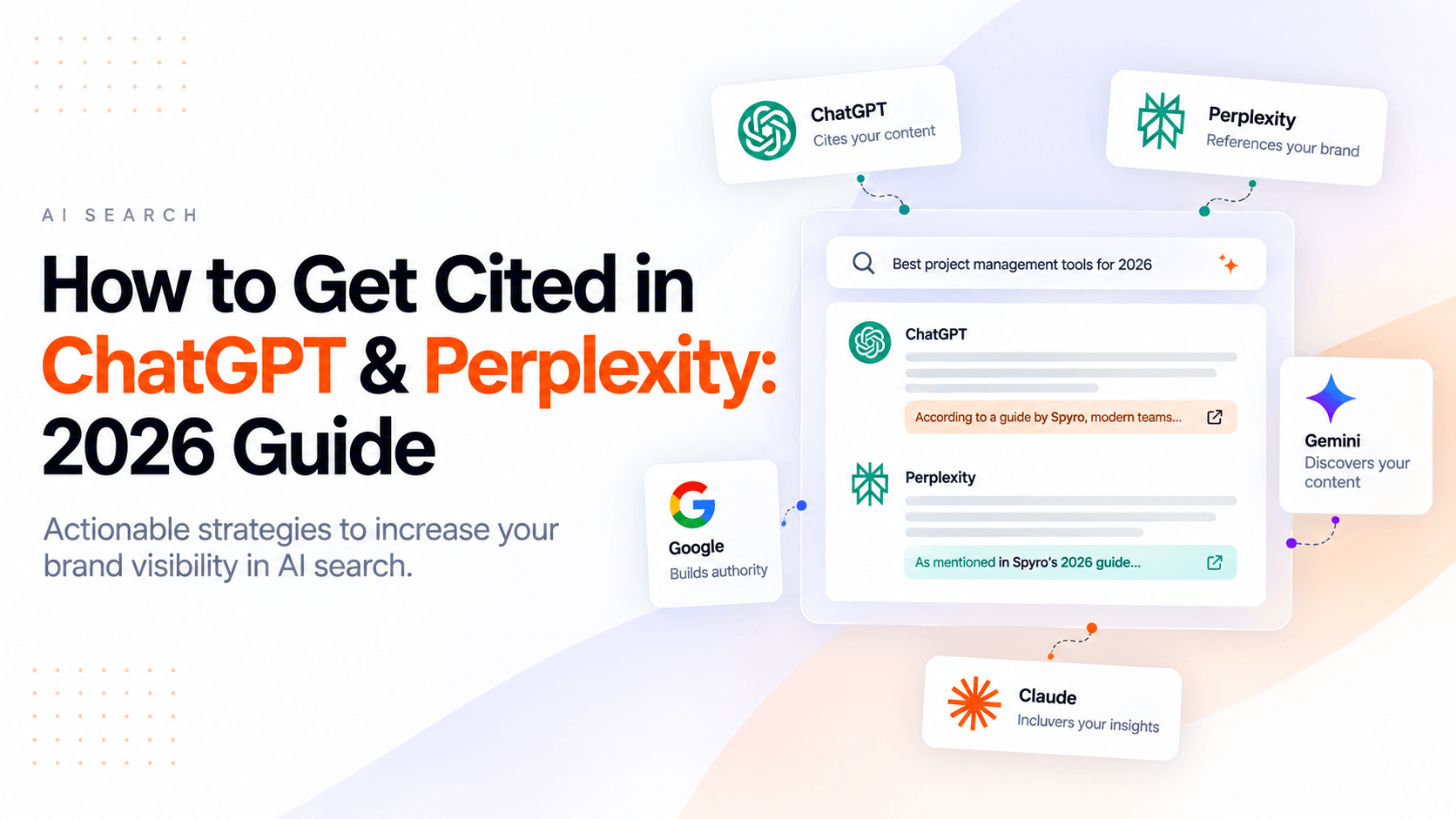


Quick answer: To get cited in ChatGPT and Perplexity, your page must be discoverable by their retrieval systems, competitive in mainstream web search, and structured so a specific passage directly answers a query. Add clean FAQ, HowTo, and Article schema, keep content fresh, and write self-contained answers near the top of each section. Both engines pull from a filtered pool of top-ranking, well-formatted, recently updated pages rather than the open web at large.
Why Do ChatGPT and Perplexity Cite Some Pages and Ignore Others?
Citation isn’t a lottery, and it isn’t purely a ranking contest either. It’s the output of a retrieval pipeline that filters out most of the web before a model ever references anything. Understanding that pipeline changes how you think about optimization, because by the time relevance and writing quality matter, a huge share of pages have already been eliminated on technical grounds.
Perplexity’s own help documentation describes the process in plain terms: it runs a web search, filters the results, and cites only a small subset of what it finds, so it is never reading “the whole internet” for a given question (Perplexity’s help center). ChatGPT’s browsing behavior follows a related but distinct logic. Rather than running its own independent crawl-and-rank system, its source pool is shaped heavily by an underlying web search index, and a page has to already be indexed and competitive in ordinary web search before ChatGPT can retrieve it at all (OpenAI’s documentation on ChatGPT search). An analysis of retrieval traffic by Ahrefs found that ChatGPT sources roughly 88% of the URLs it ends up citing from its general search index, well ahead of Reddit, YouTube, news, and academic sources combined (Ahrefs’ analysis of ChatGPT citation data). If you’re not in that search selection pool, structure and freshness never get the chance to matter.
How Does Perplexity Decide Which Sources Make the Citation List?
Perplexity doesn’t rank sources the way Google ranks a results page. It runs a filtering pipeline that starts broad and narrows aggressively, and most of the pages that get retrieved never make it into the final answer. Getting cited in ChatGPT and Perplexity comes down to surviving that pipeline, which asks for different signals than classic search ranking does.
The Retrieval Funnel: From Sub-Queries to 3-4 Citations
Perplexity breaks a single question into several sub-queries, runs each one separately, and only carries the strongest passages forward into the final answer, so a page can rank well for one sub-query and still get cut before the answer is assembled (Perplexity’s help center). Ranking first in Google is a starting condition for citation, not a guarantee of it. AI search visibility depends on surviving multiple filtering passes, not a single ranking signal.
Source Quality Labels: What Perplexity Checks at the Site Level
Beyond the query-matching stage, Perplexity applies quality evaluation at the site level rather than the page level. Its help documentation describes checking whether a site corrects mistakes, identifies its authors, and separates news reporting from opinion or sponsored content, treating those as trust signals independent of any single page’s wording (Perplexity’s help center).

What Structural Fixes Actually Get You Cited in AI Answers?
AI citation engines respond to specific structural signals, and most of them can be verified or fixed in an afternoon. Here’s what actually moves the needle, in order of impact.
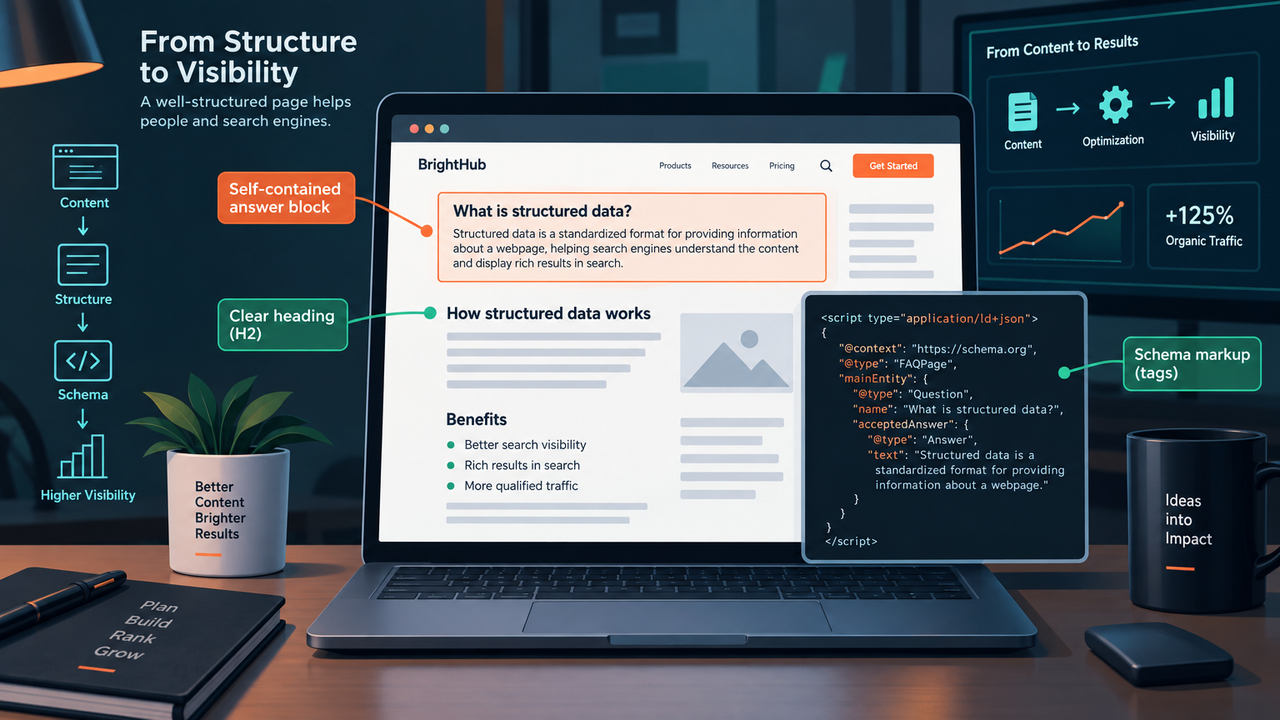
- Lead with a self-contained answer, not a windup. For a page to be cited, it first has to be retrieved for the query, then selected because it contains a clear passage that directly answers the question rather than diffuse or buried information. Practically, this means the first 40-60 words under any H2 or H3 should stand alone as a complete answer, with no throat-clearing and no “in this section we’ll explore.”
- Support that answer with clearly labeled subsections. Place the concise, direct answer near the top of the page, then back it with deeper context organized under clearly labeled headings. Headings act as retrieval anchors: they help the AI’s decomposition step match a sub-query to the right chunk of your page.
- Add structured data that names your content type. Structured data types like Article, FAQPage, HowTo, and DefinedTerm give AI systems a machine-readable signal for what kind of information sits on the page, making it easier to extract citation-friendly facts. A DefinedTerm block around a glossary term, for instance, tells the crawler exactly what’s being defined without forcing it to parse surrounding prose.
Does Content Freshness Really Change Whether You Get Cited?
Yes, and it works as a moving target rather than a one-time badge. A page optimized once in January and left untouched won’t hold its citation share through the year, because freshness is evaluated relative to what else is available at query time, not as a fixed score attached to your URL.
A page that was accurate and well-cited six months ago can quietly drop out of the filtered set simply because a competing page was updated more recently and now looks like the more current answer. That’s a relative comparison, not a penalty: nothing about the older page changed, but its position in the ranking did. Treat this as a maintenance cadence rather than a launch task. Revisit your highest-intent pages on a fixed schedule, update figures and examples that have aged, and refresh the publish date only when the content itself actually changed.
Freshness alone doesn’t guarantee selection, either. Fast loading times and clean indexation are baseline requirements Perplexity’s own documentation names as part of what makes a page eligible for retrieval in the first place (Perplexity’s help center). A recently updated page that loads slowly or sits behind indexation problems can still lose out to an older but technically clean competitor, so content freshness and technical health work best as a paired maintenance task rather than two separate projects.
ChatGPT vs. Perplexity: Which Citation Signals Matter Most?
ChatGPT and Perplexity don’t weigh the same signals equally, so treating them as one target wastes effort. Understanding where each engine puts its emphasis lets you prioritize fixes instead of chasing every optimization tactic at once, which is the practical core of answer engine optimization versus generic SEO.
| Signal | ChatGPT | Perplexity |
|---|---|---|
| Primary mechanism | Retrieval from underlying web search index, then selection based on passage clarity | Numbered citations tied to specific claims, drawn from its own filtered retrieval pipeline |
| What matters most | Concise, self-contained answers near the top of the page | Discrete, attributable facts rather than vague claims |
| Gatekeeper | Must already rank competitively in mainstream web search | AI crawler access to the page, plus site-level trust signals |
- ChatGPT prioritizes passage clarity. For ChatGPT to cite a page, it must first be retrieved for the query, then selected because it contains a clear, self-contained passage that directly answers the question rather than diffuse or buried information. Place concise, direct answers near the top of the page, supported by deeper context in clearly labeled sections underneath.
- Perplexity prioritizes attributable facts. Because Perplexity ties numbered citations to specific claims rather than to a page as a whole, content built around discrete, checkable statements gets pulled into answers more often than content that makes the same point in one long, unbroken paragraph.
Key Takeaways: How to Get Cited in ChatGPT and Perplexity
Everything in this guide reduces to a small number of repeatable actions. None of them guarantee a citation, since no one outside Perplexity or OpenAI knows the exact selection formula, but each one improves your odds based on observed behavior.
- Audit crawler access before touching content. Check robots.txt and server configs to confirm AI crawlers can actually reach your pages; a page that’s technically blocked from retrieval will never be eligible for citation, regardless of quality. Spyro’s AI crawler robots checker is built for exactly this pre-flight check.
- Get indexed and rank competitively in mainstream web search. Since both ChatGPT’s browsing feature and Perplexity’s retrieval layer lean on general web indexes, invisibility in traditional search means invisibility in AI answers too.
- Lead with a direct, self-contained answer. Place the concise response near the top of the page, then support it with structured context underneath using clear headings and lists.
- Treat freshness as ongoing maintenance, not a one-time fix. Stale pages lose ground to more recently updated competitors even when nothing else about them changes, so revisit high-intent pages on a set schedule.
- Add structured data deliberately. Article, FAQPage, HowTo, and DefinedTerm markup help AI systems parse content type and extract citation-friendly facts rather than guessing at structure.
- Fix the boring technical stuff. Slow load times and indexation gaps quietly disqualify pages before content quality ever enters the equation.
- Build topical authority over time. Repeated, in-depth coverage of a niche makes it more likely that AI systems encounter, and trust, your domain across multiple queries, not just one lucky page.
FAQ
How do I get cited by AI search tools like ChatGPT and Perplexity?
Make sure your page is indexed and competitive in mainstream web search, structure a clear self-contained answer near the top, add FAQ and HowTo schema, and keep the content updated so freshness signals stay strong.
Is Perplexity AI free to use?
Yes, Perplexity offers a free tier with limited daily searches, alongside a paid Pro plan that unlocks additional models and higher usage limits.
How do I appear in ChatGPT’s browsing answers specifically?
Since ChatGPT’s browsing source pool is shaped largely by the underlying web search index, your page needs strong organic rankings first, plus a concise passage that directly answers the likely query.
Is Perplexity considered an LLM, or something else?
Perplexity is an AI answer engine that combines large language models with real-time web retrieval; it is not itself a foundation LLM but a product layered on top of one or more models.
Does adding schema markup guarantee a citation in AI answers?
No single tactic guarantees citation, but structured data like FAQPage, HowTo, and Article schema helps AI systems parse and extract citation-ready facts, improving your odds meaningfully.
Conclusion
Getting cited in ChatGPT and Perplexity comes down to being retrievable, being readable at the passage level, and staying fresh enough to keep beating stale competitors. Start by auditing crawler access and schema on your highest-intent pages, then track whether citations actually appear. Run a free SEO and GEO audit to see exactly where your site stands before making changes.