


What Is GEO (Generative Engine Optimization)? A Complete Guide 2026


What is generative engine optimization? Short version? It’s getting ChatGPT, Perplexity, Gemini, Claude and Google’s AI Overviews to bring up your business when people ask them stuff. That’s really it. The name sounds a lot heavier than the idea.
The term is pretty new. A group of researchers (Princeton, Georgia Tech, the Allen Institute for AI and IIT Delhi) coined it in a November 2023 paper. KDD picked it up in 2024. Their finding: tweak how a page is written in a few specific ways, and its visibility in AI answers can jump by up to 40%. Not by gaming anything. Mostly by writing more clearly.
And no, this isn’t just a founder thing. Maybe you run a small shop, a mid sized company with a dozen product lines, or an agency juggling twenty clients. Either way, your customers are already asking AI for recommendations, and GEO decides whether your name comes up.
TL;DR
- What is generative engine optimization (GEO)? Making your content easy for AI tools like ChatGPT, Gemini, Perplexity and Claude to find, trust and quote.
- It doesn’t replace SEO. SEO gets you ranked and clicked. GEO gets you mentioned and cited, often in answers where nobody clicks at all.
- SMB, mid sized company, agency, startup? Doesn’t matter. Your buyers are already asking AI tools what to buy.
- Want to start today? Check your AI search visibility first. Then fix the top of your key pages, add FAQ schema, and keep an eye on AI citations weekly.
Yes, I know. Another acronym. But here’s the thing. Your buyers are asking ChatGPT the very questions your landing pages were built to answer. Most businesses have no clue whether they show up in those answers. Plenty of them don’t.
What Is Generative Engine Optimization? The Definition and Where the Term Came From
Generative engine optimization, or GEO, is writing and structuring your content so an AI system can pull out a fact, quote a line, or summarize a section correctly when it’s answering someone. That’s the working definition I’d give anyone who asks.
The original paper is literally titled “GEO: Generative Engine Optimization.” Its answer to what is generative engine optimization is more technical than mine. It looks at ChatGPT, Perplexity and friends as a new breed of search engine. Instead of ten blue links, you get one answer pieced together from several sources. The team put together a test set (they called it GEO bench), pushed around 10,000 real queries through it, and looked at which edits made a difference.
What worked? Adding statistics with sources. Quoting credible sources. Writing in a clean, quotable way. What didn’t? Keyword stuffing, and those vague “we’re the leading experts” claims.
This is the part people tend to miss. SEO earns you a click by ranking. GEO earns you a mention by being the passage a large language model trusts enough to repeat. Different systems grade those two things, so a page can sit on page one of Google and still never show up in a ChatGPT answer. It happens more often than you’d think.
So what is generative engine optimization in practical terms? Try this. Open ChatGPT or Perplexity and ask a question your product answers. Does it mention you? If it doesn’t, GEO is the work of fixing that.
What is generative engine optimization not? It’s not a plugin. It’s not a meta tag. It’s not something you knock out over one weekend and forget about. Think of it as a writing habit, the same way SEO slowly went from a checklist to just how good content gets written. Teams that treat it as a one off usually see a small bump, then watch it fade as competitors catch up and the AI models change how they pick sources.
You’ll also run into answer engine optimization (AEO). AEO comes from the featured snippet and voice search days, and it’s about winning one direct answer. GEO is wider. It covers how large language model search tools pull from several sources at once, blend them, and cite them. The tactics overlap a lot, so I’d treat AEO as one piece of a GEO plan rather than a separate project.
SEO vs GEO: Is SEO Being Replaced by AI?
No. But its job is getting narrower. This is usually the very next thing people ask after what is generative engine optimization, so let’s deal with it.
Rankings on Google and Bing still matter for any search that ends in a click. GEO covers the other kind: the zero click search, where someone gets their answer inside ChatGPT or an AI Overview and never visits a site. You want to show up in both. Don’t pick one.
Here’s the SEO vs GEO comparison in one table:
| Dimension | Traditional SEO | GEO |
|---|---|---|
| Goal | Rank in the top 10 organic results | Get quoted or cited inside an AI generated answer |
| Unit optimized | Whole page: title, headings, backlinks | Individual facts, sentences, and passages |
| Success signal | Position, click through rate, organic traffic | Citation frequency, share of AI answers mentioning you |
| Primary audience | Google’s crawler and ranking algorithm | The retrieval and summarization layers inside an LLM |
| Content shape that wins | Comprehensive, keyword rich pages | Self contained, quotable, fact dense passages |
The two overlap more than they differ, to be honest. A page that loads properly, gets its facts right and is clearly organized tends to do well in both. That’s why so much GEO advice just sounds like good SEO. Search Engine Land’s analysis lands in the same place: the fundamentals stay put, and the emphasis moves from rankings to citations.
Where they really split is at the sentence level. SEO rewards covering a topic thoroughly. GEO rewards a paragraph that still makes sense when it’s lifted out on its own. No “as mentioned above.” No “for this reason” that only works if you read the three paragraphs before it.
Will SEO still exist in five years? Almost certainly. Plenty of buying journeys still end with a search and a click. What’s shrinking is the number of searches where anyone clicks at all, and that’s exactly why GEO became its own thing.
Why AI Referral Traffic Is Growing Faster Than Anyone Expected
Next to Google, the numbers are still small. They’re growing fast, though.
According to Similarweb’s 2026 Generative AI Landscape report, generative AI platforms averaged 9.5 billion web visits a month in the year to May 2026. That’s up 70% on the year before. Meanwhile ChatGPT’s share of that traffic dropped from roughly 76% to about 53%, because Gemini and Claude are eating into it.
That second point is the one I’d pay attention to. A year ago you could optimize for ChatGPT and call it done. Not anymore. Gemini went from under 9% of generative AI web traffic to around 27% in twelve months. Claude went from close to 2% to nearly 9%, the fastest relative growth of any platform Similarweb tracked. If you’re building AI search visibility in 2026, you’re really writing for four or five different engines.
AI citations are climbing too, from a low base. Similarweb found the share of US ChatGPT prompts that included a citation went from about 1.6% in June 2025 to roughly 6.8% by May 2026. That’s more than four times in under a year. Over on Google, AI Overviews showed up on 39.4% of US desktop searches in June 2026, up from 25.8% a year earlier, per Comscore’s Q2 2026 AI Intelligence Report (via Search Engine Land). So roughly four in ten searches now show an AI summary before the first blue link.
Does that mean regular search traffic is about to vanish? No. It means a second channel is opening up faster than most SEO plans were built for. It’s also why “what is generative engine optimization” went from an academic question to something that comes up in normal marketing meetings.
It isn’t only a startup trend, either. Citation rates vary a lot by industry, from about 23% of Travel and Hospitality prompts down to under 4% in Professional Services, per the same Similarweb data. So an ecommerce brand, a SaaS company, a local service business and the agency working for all three are each playing a slightly different game. Measure your own category. Don’t borrow someone else’s benchmark.
One more thing. People who land on your site from an AI recommendation have usually compared options inside the chat already. They tend to show up closer to a decision than someone clicking a random organic result. So even a small channel can be worth building on purpose.
What Is Generative Engine Optimization for SMBs, Mid Sized Companies, and Agencies?
What is generative engine optimization going to look like for your business, specifically? The basics don’t change with size. Where you start does.
- Small and medium businesses (SMBs): Start small. Five to ten pages, the ones that say what you sell and where. A local clinic, a D2C brand, a B2B supplier… these usually land their first AI citations by simply answering what customers actually ask, in plain words, right at the top.
- Mid sized companies: Your problem is consistency. Lots of product lines, lots of writers. Give each product line an owner, make “answer first” a house rule, and put AI search visibility next to organic traffic in your monthly report.
- Agencies: Your clients are already asking you what is generative engine optimization and whether they need it. If you can show them a baseline, fix the big gaps and report progress every month, you’ve got a new service line.
- Startups: For early teams asking what is generative engine optimization worth when nobody knows your brand yet, here’s the upside. Clear, quotable content is one of the few ways to show up in AI answers right next to much bigger names.
Three Concrete Signs Your Site Is Invisible to AI Search
You can rank decently on Google and still be missing from AI answers entirely. Most businesses don’t find out until they actually check. Here are three quick tells, and you don’t need a paid tool for any of them.
- Nobody mentions you when you ask. Open ChatGPT, Perplexity, Claude and Gemini. Ask what a real buyer would ask about your category. (If you sell marketing services, try broad ones like “what is generative engine optimization” too.) If your brand never comes up across a handful of honest prompts, well, there’s your answer.
- Your pages bury the answer. If someone, or some model, has to scroll through three paragraphs of warm up before finding out what the page is about, the AI will usually skip it and quote a competitor who got to the point.
- No FAQ or schema markup. Without FAQPage, HowTo or Organization schema, and without a visible Q&A section, AI crawlers get far fewer hints about what your page actually answers. That makes you easy to pass over.
Got an extra hour? Check whether competitors show up for those same prompts. If a rival with a weaker product but clearer content keeps getting mentioned and you don’t, that’s usually a structure problem. Fixable. It’s not some brand authority gap you’re stuck with.
The quickest way to figure out what is generative engine optimization worth to you is to see where you stand right now. Spyro’s free SEO and GEO audit checks site health and AI visibility in one go, and the AI visibility checker shows whether the big AI engines already mention your brand.
What Is Generative Engine Optimization Changing on the Page?
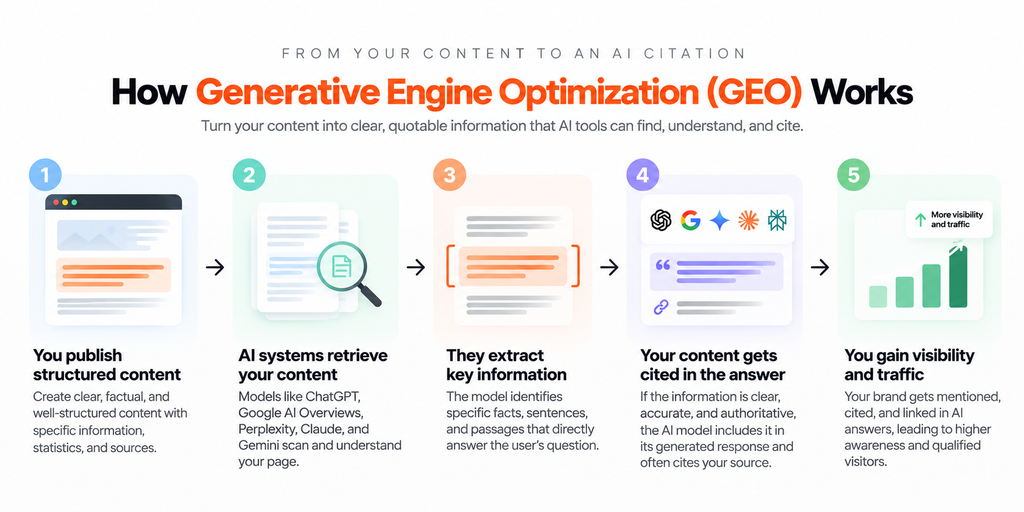
So what is generative engine optimization actually changing about your content? Mostly the sentences. AI tools don’t read your page like a person would, top to bottom. They cut it into chunks. Then they grab whatever bits match the question and stitch them into an answer. Whatever context sat around your paragraph usually gets left behind.
A few things follow from that:
- Make paragraphs stand on their own. A definition or key fact should still make sense if it’s the only thing quoted.
- Use real numbers with real sources. “Similarweb found X” is far easier for a model to trust than “many businesses see results.”
- Put the answer first. Say the point, then back it up. Don’t make people (or models) wait till the end. It’s the same 40 to 60 word answer first pattern that wins Google featured snippets.
- Write headings that say something. “Why AI traffic is growing” beats “Overview” every time, because it tells the AI exactly what’s underneath.
The original GEO researchers saw the same pattern. Citations, quotable structure and named statistics moved visibility. Repeating keywords and vague authority claims didn’t. Nearly three years on, I think that’s still the shortest answer to what is generative engine optimization: write like a source worth quoting, not like a page trying to rank.
How to Start Doing Generative Engine Optimization This Week
What is generative engine optimization going to cost you in time? Less than you’d expect. You don’t need a big team or a six month roadmap. A small business owner or a solo marketer can do a solid first pass over a weekend, and most of it is editing stuff you already have. Mid sized teams can split it up by product line. Agencies can run the same pass for each client and report citation share next to rankings.
- Run a free audit. See your current AI visibility and which pages are dragging you down. Spyro’s SEO and GEO audit, linked above, is a good place to start.
- Write down 3 to 5 real buyer questions. Full questions, the way people actually type into ChatGPT, like “what is generative engine optimization,” not two word keywords.
- Rewrite the top of your key pages. Give a straight 40 to 60 word answer to the question each page exists for.
- Add an FAQ section with schema using the questions from step 2, worded the way a buyer would really say them.
- Track citations every week across ChatGPT, Perplexity, Gemini and Claude. Otherwise you’re just guessing whether any of it worked.
Want more detail on steps 3 and 4? Our guide on how to get cited in ChatGPT and Perplexity goes deeper on crawlability, schema and freshness. And if you’re curious why AI engines pick one source over another, how AI search engines cite sources breaks down the ranking factors.
Key Takeaways
- What is generative engine optimization? Writing so an AI model can pull a fact from your page, trust it and repeat it. Not just so Google ranks you.
- SEO and GEO work together. A clean, clearly written page usually wins at both.
- AI referral traffic is still small but growing fast across ChatGPT, Gemini and Claude, and Google’s AI Overviews now show up on about 4 in 10 US desktop searches.
- No AI mentions, no clear answer at the top of your pages, and no FAQ schema are the three fastest signs you’re invisible to AI search.
- SMBs, mid sized companies, startups and agencies can all start this weekend with a free audit, a short list of real buyer questions, and a rewritten opening on their most important pages.
FAQ
What is generative engine optimization?
GEO (generative engine optimization) is shaping your content so ChatGPT, Google AI Overviews, Perplexity, Claude and Gemini can find it, get it right and cite it when someone asks them something. The name comes from a November 2023 paper by researchers at Princeton, Georgia Tech, the Allen Institute for AI and IIT Delhi, later presented at KDD 2024.
What is generative engine optimization for small businesses?
For a small business, it’s about getting AI tools to mention you when a relevant customer asks for a recommendation. Put a clear, direct answer at the top of your main service pages, add an FAQ section with schema, and check every month whether ChatGPT, Gemini and Perplexity name you.
What is generative engine optimization vs answer engine optimization (AEO)?
AEO is about winning one direct answer, like a featured snippet or a voice assistant reply. GEO is broader. It covers how large language model search tools pull from several sources, combine them and cite them. The tactics overlap, so most teams treat AEO as part of GEO.
Is SEO being replaced by AI?
No. SEO still decides whether you rank and get clicked on a normal results page. GEO decides whether an AI tool mentions you when the search ends inside a generated answer instead. Most sites need both.
SEO vs GEO: what is the difference?
SEO works on a whole page so it ranks, and you measure it by clicks and organic traffic. GEO works on individual facts and passages so they get cited in AI answers, and you measure it by how often you’re mentioned. Clear, accurate, well structured content helps with both.
Will SEO exist in five years?
Yes. Its share of search will probably keep shrinking as more questions get answered right inside AI tools, but rankings still matter for every search that ends in a click. That’s why it makes sense to run SEO and GEO together.
Can ChatGPT do SEO for you?
Partly. It’s handy for drafts, heading ideas and summarizing research. What it can’t do is audit your technical SEO, track your actual rankings, or tell you if AI engines are citing your brand over time. You’ll need a tool that checks your live site and watches AI answers regularly for that.
Still wondering what is generative engine optimization and whether it applies to you? It does, whatever your size. It’s not SEO with a new label, and it’s not a fad. It’s what decides whether your business is part of the answer when a buyer skips Google and just asks an AI. Now that you know what is generative engine optimization, run a free audit, find your three biggest gaps, and fix the first one this week.