


AI Content Optimization: How to Write Content AI Engines Cite


Quick Answer
- What is AI content optimization? It’s about writing a page so that ChatGPT, Gemini, Claude, Perplexity or Google’s AI Overviews can grab one clean passage from it, then name you as the source.
- It builds on SEO. It doesn’t replace it. Google says its AI features still run on SEO basics. So most of the work is dull, honestly. Crawlable pages. Something original to say. Facts a reader can check.
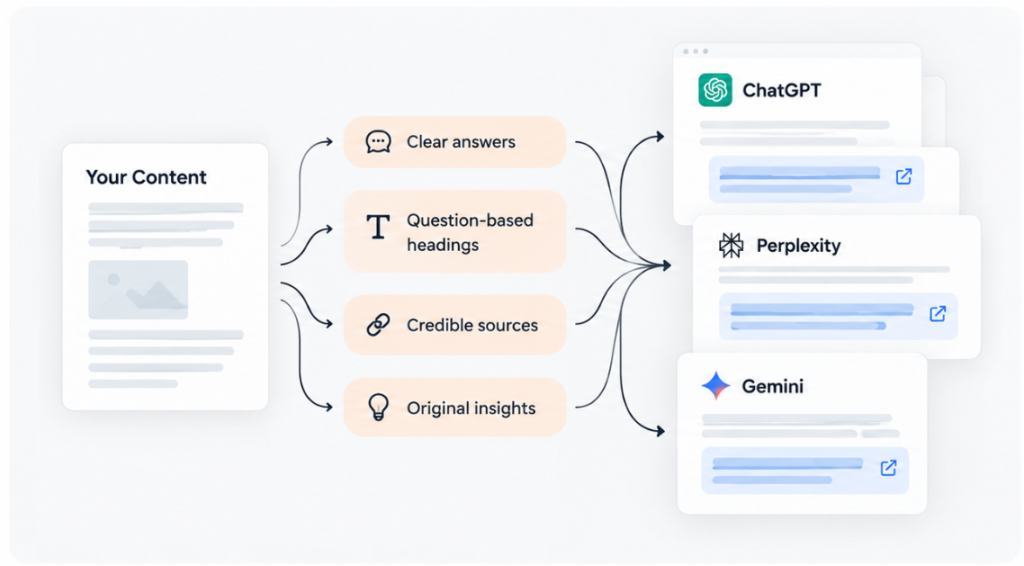
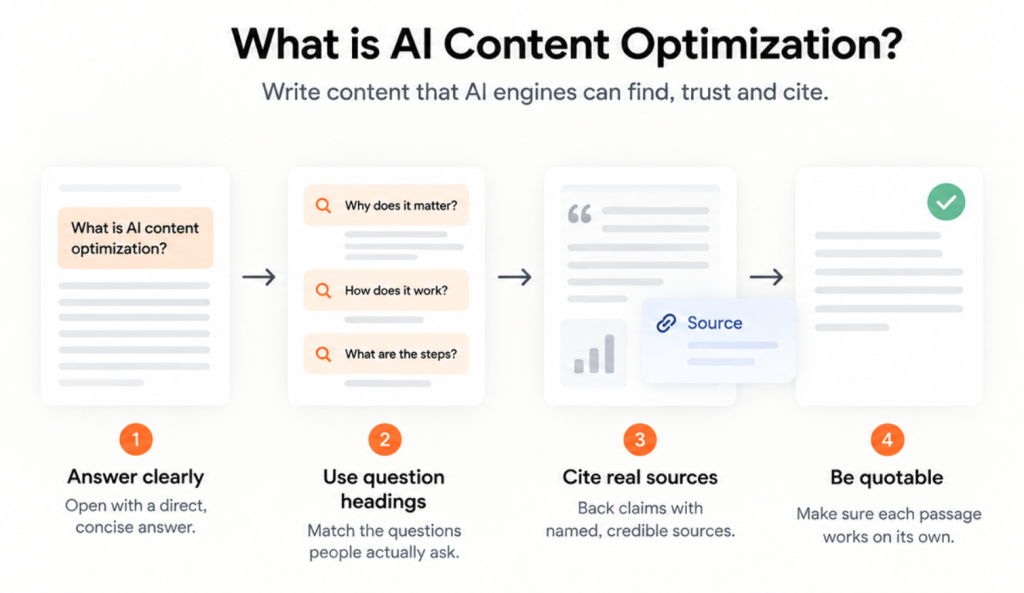
- Begin AI content optimization with three edits. Open with the answer. Turn headings into questions. Put a named source behind every big claim. And check that each passage still works if someone quotes just that bit. Where you can, add your own data or a real opinion.
- Startup, SMB, mid sized company or agency, it doesn’t matter. A first pass fits into this week, covering five to ten key pages. Then ask a few AI tools about your category. Who do they name?
Put simply, AI content optimization is writing in a way that lets an AI engine find you, trust you and quote you when someone asks a question. That’s the whole idea. No plugin. No secret tag. Just an editing habit.
People use the phrase for two different jobs, and they blur together. One crowd means using AI tools to polish their content. I mean the other one: shaping your content so AI engines cite it. This guide is about that second meaning, and I’ll point you to the first in one short section further down.
Who’s this for? Maybe you run a startup, a local business, a mid sized company with a pile of product pages, or an agency with twenty clients. Either way, your buyers are already asking AI tools for recommendations. The tool names a few sources in its answer. AI content optimization decides whether one of them is you.
One disclosure before we start. Spyro is our product. It shows up in one labeled section near the end, and I’ve tried to keep everything else useful with or without it. If you want the wider picture first, our guides on what is generative engine optimization and SEO vs GEO vs AEO sit right next to this one.
What Is AI Content Optimization?
In plain terms, AI content optimization is making your content easy for an AI engine to pull apart, trust and quote, so your brand gets named or linked in the generated answer. By “AI engine” I mean anything that writes you an answer in place of ten blue links. ChatGPT search, Perplexity, Gemini, Claude, Google’s AI Overviews and AI Mode all count.
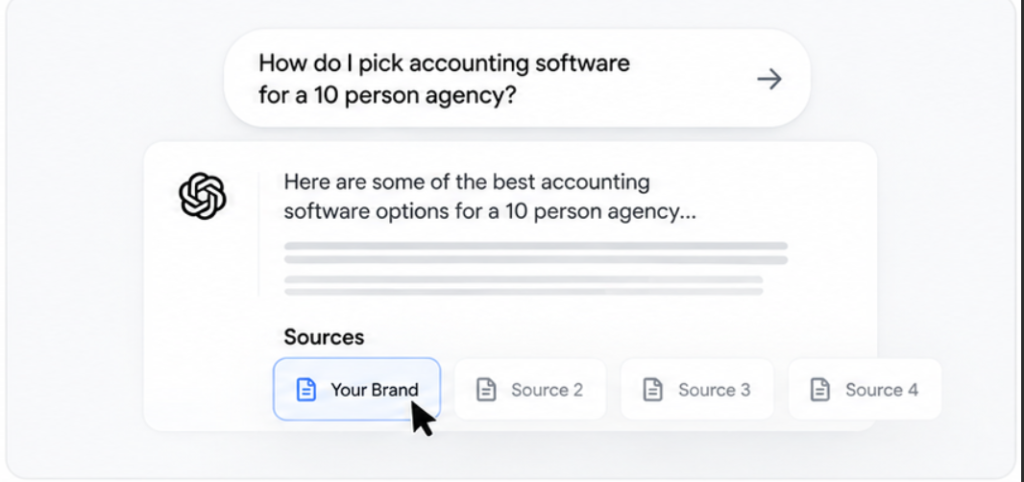
Say a buyer asks Perplexity, “how do I pick accounting software for a ten person agency?” It answers and cites four sources. AI content optimization is the work of becoming one of them.
Is it the same as GEO or AEO? They’re close cousins. GEO (generative engine optimization) is the wider umbrella for how AI tools describe your brand across everything they read. AEO (answer engine optimization) is about winning the direct answer. I think of AI content optimization as the writing and editing side of both: what’s on the page, and how it’s phrased. If you want those definitions in full, here’s our guide to what is answer engine optimization.
Which meaning of AI content optimization do you need?
Search the phrase and you’ll see two meanings mixed together. Meaning one is using AI to optimize content: tools that suggest keywords, score a draft or help you write faster. Meaning two is optimizing content for AI: making sure engines cite what you publish. Same words, different jobs.
Most of this guide covers meaning two, because that’s where the visibility is shifting. The tools side gets its own section below, since the two meet in the middle. You’ll likely use AI somewhere in your editing. You’ll still want engines to cite what comes out.
Why Does AI Content Optimization Matter in 2026?
Because people get their answer and leave. Short version, yes. And the numbers back it up.
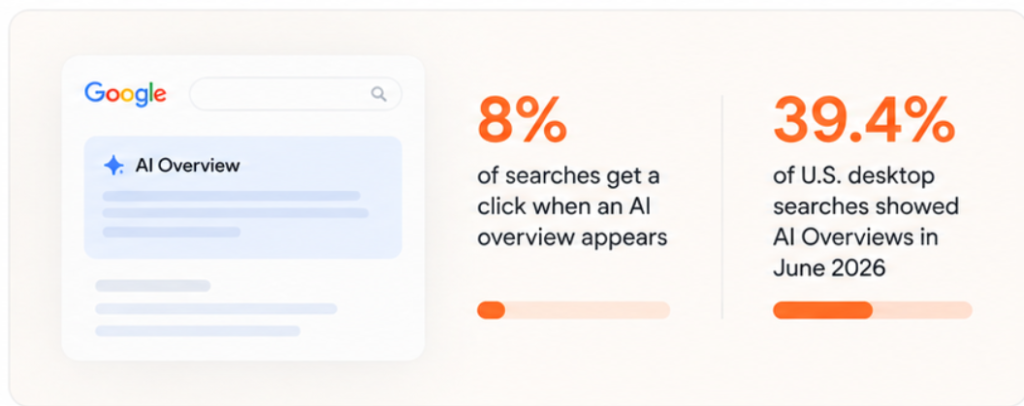
In March 2025, Pew Research Center tracked 900 US adults across 68,879 real Google searches. On visits where an AI summary showed up, people clicked a normal result link 8% of the time. Without one, it was 15%. And clicks on links inside the summary itself? About 1% of visits (Pew Research Center).
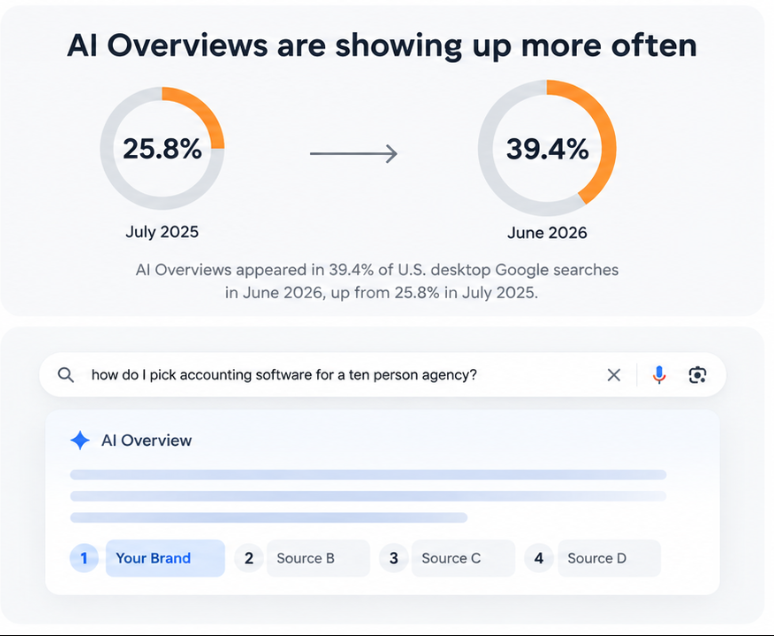
How often does that summary show up? Comscore’s Q2 2026 report, as covered by Search Engine Land, found AI Overviews on 39.4% of US desktop Google searches in June 2026, up from 25.8% in July 2025 (Search Engine Land). That’s roughly four searches in ten.
Put those two together. More searches end in an answer. Fewer end in a click. The brands named inside the answer get the attention, and everyone else gets what’s left.
It isn’t random which searches get an AI answer, either. Ahrefs analyzed 146 million search results and found AI Overviews on 57.9% of question queries, against 15.5% of non question queries (Ahrefs). Your headings should sound like the questions people really ask. That’s where the AI answers are.
I’m not saying organic search is dying. Lots of buying journeys still end in a click, and rankings still count. What it means is that you’re now writing for two readers: the person, and the engine that summarizes you for the person. AI content optimization is how you serve both with one page.
How Do AI Engines Decide What to Cite?
The full recipe? A secret. Every product retrieves and ranks in its own way, and the same prompt may come back different tomorrow. So I’m sticking to what’s documented or measured. Where it’s only a correlation, I’ll tell you. Any AI content optimization advice, this guide included, deserves a test on your own prompts.
Google says this is still SEO. Its guide to generative AI features, last updated July 10, 2026, explains that its systems ground AI answers in pages from its index. Google also says that, for its own features, optimizing for generative AI search is optimizing for the search experience (Google Search Central). That’s good news. It means most of AI content optimization is craft, not hacks.
Covering the neighboring questions helps. Google describes query fan out as the model running concurrent, related searches to gather more results. Ahrefs, working with Surfer, found that pages ranking across those fan out queries were 161% more likely to be cited in an AI Overview than pages ranking only for the main term (Ahrefs). One narrow page isn’t enough. Cover the follow ups.
Rankings help, but they aren’t the whole story. In a March 2026 update covering 863,000 keyword searches and about 4 million AI Overview URLs, Ahrefs found that only 38% of cited pages came from the top 10, down from 76% a year earlier. And 31% of cited pages weren’t in the top 100 for the original query at all (Ahrefs). You can’t rank your way into every answer. You can’t ignore ranking either.
Being talked about seems to matter. In a 2025 study of 75,000 brands, Ahrefs found that web mentions of a brand correlated with its AI Overview visibility at 0.664, while backlinks sat at 0.218. The authors say plainly that correlation isn’t causation (Ahrefs). Google, for its part, warns that seeking inauthentic mentions across the web isn’t helpful. So earn mentions by being worth quoting.
Fresher content gets cited more, on average. Ahrefs looked at about 17 million cited URLs. The pages AI assistants cited averaged 1,064 days old. Google’s organic results averaged 1,432 days. That’s about 25.7% fresher. Still, the average cited page is 2.9 years old, and the authors warn against assuming that updating a page causes citations (Ahrefs). Respect content freshness as a signal. Don’t turn it into a trick you run on a calendar.
Writing style moves the needle on a benchmark. The research paper that gave us the term GEO, first posted in November 2023 and presented at KDD 2024, reported visibility gains of up to 40% in generative engine responses from changing how content is written (arXiv). In its results table, adding quotations, statistics and cited sources were among the stronger methods. Keyword stuffing scored below doing nothing. Treat that as a benchmark result and not a promise for your site. Still, it points the same way as everything else here. Clearer writing with better support wins.
What Content Works Best in AI Search?
A clear answer. Something checkable behind it. And a point other pages don’t make. Format matters less than people think. Here’s what I’d put in every page that matters for AI content optimization.
- A direct answer near the top. Get to the point in your first sentence or two. A definition runs about 40 to 60 words. Then add the detail. It’s the pattern that wins Google featured snippets too, and it hands an engine a clean passage to lift.
- Original information. Google’s guide asks for a unique point of view, plus expert or experienced takes that go past common knowledge. It sets that against recycled information. Your numbers, your process and your opinions are the bits nobody can copy.
- Named statistics, quotes and sources. “Pew Research found 8% of visits” is easier for a model to repeat, and easier for a person to trust, than “studies show clicks are down.” The GEO research above points the same way.
- A shape that matches the question. Use a definition for a “what is” question, numbered steps for a “how to,” and a table for a comparison. I’d match the format to the question and not copy one format everywhere. Be wary of any claim that one format, listicles say, wins on every engine. Engines retrieve differently, so test your own prompts.
- A visible FAQ for real follow ups. Readers like a FAQ, and it hands you tidy question and answer pairs. Add FAQ markup if your CMS makes that easy. Google does say structured data isn’t required for generative AI search, though. Treat it as housekeeping.
And what doesn’t work? Padding. Think of a page that spends three paragraphs clearing its throat and then hedges every claim. An engine can’t quote that. Could your intro open any article on any site? Then cut it.
How Is AI Content Optimization Different From Writing for SEO?
Mostly in what you’re aiming at. Classic SEO copy tries to rank a whole page. AI content optimization tries to make one passage survive being pulled out of the page and pasted into somebody else’s answer. Here’s the comparison as a table.
| Area | Classic SEO copy | AI content optimization |
|---|---|---|
| Opening | A warm up, then the point | The direct answer in the first one or two sentences |
| Headings | Keyword labels such as “Pricing” | Questions people really ask |
| Unit you work on | The whole page | The passage an engine might quote |
| Proof | “Studies show” | A named, linked source and a real figure |
| Coverage | One main keyword per page | The main question plus its fan out follow ups |
| Success signal | Rankings, clicks, traffic | Citations, mentions and accurate descriptions |
They overlap heavily. Plenty of AI search optimization advice is ordinary SEO wearing a new badge, and I don’t think that’s a bad thing. Fast pages and correct facts help in both. Where they split is smaller than a page. Think paragraph. Quote one of yours, alone, to a stranger. Does it land? That’s the extra test.
How Do You Do AI Content Optimization? Eleven Steps
You don’t need a big team or a six month roadmap. One marketer can finish a decent first pass in a week, mostly by editing pages that already exist, and I’d work through it in this order.
- Collect real questions. Your sales team hears them daily. Support tickets are full of them. Google shows them in People Also Ask boxes, and customers type them into chat tools. Write them down the way people say them. They’re your headings.
- Plan the follow ups too. Every page needs one main question, but an engine runs related searches behind it, which is query fan out. A page that also answers the two or three neighbors beats a thin page that covers one. Jot the follow ups down before you write a word.
- Answer in the first sentence or two. Right under the heading. Then explain, qualify, add examples. If I could make only one edit to a page, it’d be this one. It’s the heart of answer first content.
- Make headings say something. A heading like “Pricing” tells nobody much. Compare it with “How much does a roof replacement cost in 2026?” A reader knows what’s coming. So does a machine.
- Let every passage stand alone. AI tools tend to lift a piece of a page, not all of it. A paragraph that only works after the three before it will get skipped. So drop the “as mentioned earlier” lines, and say the actual subject where you’d have written “it.” (Google says you don’t need to chop content into tiny pieces for its systems. I’m talking about plain readability here, not a formatting trick.)
- Back each key claim with a number, a quote or a named source. Link it. Can’t find one? Soften the claim, or cut it.
- Say something nobody else has said. Your own numbers work. So does a teardown, a benchmark, a screenshot walkthrough or an opinion you can defend. Repeat what everyone else says and an engine can summarize you. Add something new and it has a reason to cite you.
- Say who you are the same way everywhere. One plain sentence about what you sell and for whom. Reuse it on your homepage, About page, listings and profiles. If every source agrees, an engine can connect you to your topics with less guesswork.
- Show who wrote it and when, and keep both honest. A named author and a visible updated date help readers judge a page. Update when something changes. Don’t touch the date just to look fresh.
- Keep the technical basics clean. Pages need to be crawlable and indexed, with the key text in the HTML your server sends back. Make sure a firewall isn’t quietly blocking AI crawlers that your robots.txt welcomes. Our free AI Crawler and robots.txt Checker tests that, and our SEO vs GEO vs AEO guide explains which bots do what.
- Earn mentions off your site. Reviews, community threads, partner pages, original research other people cite, a useful video. Real mentions take time. Fake ones are a bad bet, because Google says seeking inauthentic mentions isn’t helpful.
That’s the list. Eleven habits, and not one of them needs a developer. Do steps 3, 4 and 6 on your ten most important pages and you’ve already done more AI content optimization than most of your competitors. Want more on the citation side? Try our guide on how to get cited in ChatGPT and Perplexity, and how AI search engines cite sources for the ranking factors behind it.
What Does AI Content Optimization Look Like in Practice?
Here’s a before and after I made up, so AI content optimization looks like an actual edit. It’s an illustration. It isn’t a client result.
Before: a page headed “Our Story” opens with: “Hi, we’re Acme Books! We love spreadsheets, coffee and happy clients, and we can’t wait to meet you.”
An engine learns nothing from that. Is Acme Books software or a service? Who’s it for? No idea.
After: the same page, retitled “What is Acme Books?”, now opens: “Acme Books is accounting software in the cloud for companies of 5 to 50 people, with invoicing, expenses and payroll under one roof. You pay per user.”
Then add a plan table, a byline, a last updated date and three FAQs. Now an engine has something to quote. Before, it had nothing. The company and the facts haven’t changed, only the page.
Which Pages Should You Optimize First?
Don’t overhaul the whole site. That’s weeks of work for little learning. AI content optimization pays off fastest where a buyer’s question meets your offer, so begin there.
Product and service pages come first, along with pricing, comparisons and “how to choose” guides, since that’s where the money is. Then look at what your sales team keeps getting asked. Buyers put those same questions to chat tools. Finally, check for stale facts, like a price that changed or a feature you dropped.
Write out your top ten pages. For each, answer four questions:
- Which one question is this page really for?
- Do the first two sentences answer it?
- Is there a named source or a real figure behind the main claim?
- Is there a visible author and a date that’s actually current?
Fail two or more checks and the page makes your first batch, which is about a week of editing. Got hundreds of pages at a mid sized company? Take one product line at a time and give each an owner. Run an agency? Ask the four questions of each client’s top ten pages and deliver the answers as a baseline report.
How Do You Optimize for AI Search Visibility Beyond Your Own Pages?
Your site is only part of what an AI engine reads about you. The rest is everything else on the web: reviews, directories, community threads, partner pages, press, videos and other people’s articles. AI content optimization on your own pages gets you quotable. Off site work gets you talked about.
That’s why the brand mention numbers matter. In the Ahrefs study above, mentions across the web tracked AI Overview visibility much more closely than backlinks did, though it’s a correlation and not proof. I’d read it as a nudge to spend an hour on being genuinely useful in places your buyers already gather.
What does that look like? A few things I’d do:
- Keep your facts consistent. Same business name, same one line description, same product names on your site, your listings and your profiles. When an engine reads five sources and they agree, it’s safer for it to repeat you.
- Publish something others can cite. A small survey, a benchmark, a pricing range you track, a clear process diagram. Original information is what earns links and mentions without begging for them.
- Answer questions where buyers ask them. Community threads and forums, honestly and with your real name. Not link drops.
- Collect real reviews. On the sites your customers already use.
- Don’t fake it. Google’s guide says seeking inauthentic mentions across the web isn’t helpful, and its spam systems are built to catch that kind of thing.
Engines don’t all pull from the same places. What nudges one may do nothing for another. So test: ChatGPT, Gemini, Claude, Perplexity, Google. Write down which sources each one cites for your topic. Those sources are a map. They show where your category actually gets discussed, and that’s where you want to turn up. Our guide on how AI search engines cite sources covers the factors in more detail.
Do You Need Schema Markup or llms.txt for AI Content Optimization?
No. Google’s guide says plainly that generative AI search doesn’t need structured data. It also says Google Search doesn’t use llms.txt files, and that they neither help nor hurt you there. So there’s no switch to flip.
Structured data isn’t useless, though. It describes your page to machines, and some rich results still depend on it. Keep it honest: the markup should match what readers can see on the page. Our free Schema Markup Validator will check yours.
Here’s a detail that catches people out. According to Google’s documentation, the FAQ rich result stopped showing in Search on May 7, 2026 (Google Search Central). So don’t add FAQ markup hoping for expandable boxes in Google. I’d still keep a visible FAQ section on key pages, because it gives readers and engines clean question and answer pairs. If you’re curious about llms.txt, the full picture is in our SEO vs GEO vs AEO guide.
How Often Should You Refresh Content for AI Search?
Often enough that your facts stay true, and no more. Content freshness shows up as a signal in the Ahrefs data, but the study’s own authors caution that the link between updates and citations is a correlation, and that average cited pages are still nearly three years old.
Here’s what I’d do. Every quarter, go back through your ten key pages. Correct the prices, features, screenshots and stats that have moved, and add the new question people keep asking. Only then change the visible date, because now it’s true. A page you haven’t touched keeps its old date. Faking it misleads readers, and the Ahrefs study notes that Google’s guidance discourages it.
Could a brand new page do more than another refresh? Sometimes. When a page is badly out of date, or answers the wrong question entirely, patching won’t cut it. Rewrite it. Your gut will tell you which pages those are.
What Does AI Content Optimization Mean for SMBs, Startups, Mid Sized Companies and Agencies?
The basics don’t change with company size. Where you start does.
- Small and medium businesses: Choose five to ten pages that say what you sell and where. On each, answer your top customer question in plain words before anything else. A short FAQ after that finishes the job. Plenty of local competitors won’t have done this.
- Startups: Nobody knows your brand yet, so you can’t win on authority. What you can do is publish clear, quotable, well sourced content, plus one piece of original data. It’s one of the few ways to land in the same AI answer as bigger names.
- Mid sized companies: Consistency is the headache here, with lots of product lines and lots of writers. Make “answer first” a house rule. Give each product line an owner. Then put AI mentions beside organic traffic in the monthly report.
- Agencies: Your clients are asking about this already. Give them something to buy: a baseline check, a short fix list and a monthly citation report. Promise the work and the reporting, never a citation.
What About AI Tools for Content Optimization?
That’s meaning one from earlier: using AI to help you optimize. Tools that score a draft, suggest related terms or speed up writing can genuinely save time. Treat their scores as a hint. Google’s guide says no third party tool can see its internal ranking or AI systems, so a tool that claims to predict a citation is guessing.
Drafting with AI? Google’s guidance on generative AI content flags two problems. Publishing lots of pages that add no value may run into its scaled content abuse policy. And AI output can contain hallucinations, so Google says to fact check it before publishing, titles and meta descriptions included (Google Search Central). Both come down to editing. Somebody on your team still has to add the original part and check every fact.
We’ve compared the options in more detail. Spyro is one of the products involved, so keep that in mind. See AI powered writing assistant vs traditional SEO copywriting and Spyro vs Jasper vs Surfer.
How Do You Measure AI Content Optimization?
Clicks won’t tell you much here, since a win can happen with no click at all. Here’s what I’d track instead:
- Citation rate: pick a fixed list of buyer prompts. How often do AI citations point to your site?
- Mention rate: how often is your brand named, linked or not?
- Accuracy: when a tool describes you, are the product, pricing and location right?
- Referral traffic: visits from chat tools, tagged in your analytics.
- Google’s own report: Search Console now has AI performance reports for AI Overviews and AI Mode. They show impressions by page, country, device and date. No clicks, though (Search Engine Land).
Measuring AI content optimization is easiest by hand at first. Say you’ve got ten questions a buyer might ask. Paste each into ChatGPT, Gemini, Claude, Perplexity and Google. Who shows up? Jot it down. Answers change between runs. Ask each prompt a few times and log how often you appear, like “mentioned in 3 of 5 checks.” Slow? Yes. But it teaches you quickly. Our free AI Visibility Checker gives a quick read on whether the big engines mention your brand.
What Are the Most Common AI Content Optimization Mistakes?
The same five mistakes come up again and again. Each one hurts AI search optimization about as much as it hurts SEO.
- Burying the answer. Three paragraphs of throat clearing, then the point. The engine quotes whoever got there first.
- Stuffing keywords. The GEO research ranked it below doing nothing at all. Say it once, plainly.
- Publishing AI text nobody checked. Google warns about made up statistics and confident errors for a reason. Engines will quote a wrong number as happily as a right one.
- Aiming at one engine. Each of ChatGPT, Gemini, Claude, Perplexity and Google picks sources its own way. Test all of them.
- Treating it as a one time project. Sources shift and models update, and competitors catch up. A quick monthly check will do more for you than one heroic rewrite.
What Does a Four Week AI Content Optimization Plan Look Like?
This rollout works whether you’re one marketer or twenty. One warning: if your pages can’t be crawled, tracking is pointless, so sort that out before anything else.
- Week 1, audit and prompts. Pick ten pages. The free SEO and GEO Audit will show whether they have crawl or indexing problems, and you fix those first. Then comes the fun part: 10 to 20 real buyer questions, each one tried in ChatGPT, Gemini, Claude, Perplexity and Google. Who gets named? Write it down. That’s your baseline.
- Week 2, openings and headings. Start on five of those pages. If an opening takes longer than two sentences to answer the main question, rewrite it. Weak headings become questions. Then read each key passage on its own and ask whether it still works.
- Week 3, proof and originality. Put a named source or figure behind every main claim, and add one original thing per page, even something small. Then add a short visible FAQ, a named author and a current date.
- Week 4, recheck and plan. Run the same prompts a second time and lay the results beside week 1. Did anything move? Which engines cite someone else, and who? Let that decide your next five pages.
Think of month one of AI content optimization as groundwork. Results in month one tend to be small and patchy, so don’t judge it harshly. AI answers shift between runs, and engines are slow to notice edits. Citations won’t spike yet. You’ll have a baseline, five better pages and a routine, which is the point.
Where Spyro Fits Into AI Content Optimization
Spyro is our product, so weigh this section accordingly. I’ll stick to what it does today for AI content optimization and say where it doesn’t help.
- Check your pages first. Run the free SEO and GEO Audit on a page. It checks the opening, the headings, FAQ and HowTo schema, any statistics, freshness dates and bylines, plus whether content reads without JavaScript and whether an llms.txt file exists. No signup.
- Track whether engines name you. Add your buyer questions as tracking prompts. From there Spyro looks for your brand in ChatGPT, Gemini, Claude, Perplexity and Google AI Overviews. Results come as a frequency, like “mentioned in 3 of 5 checks,” and a competitor view sits alongside.
- Draft and publish. The AI writer has a GEO mode and publishes to WordPress, Shopify or anything else through webhooks. Original ideas and fact checking are still on you.
Now the limits. Check your plan first, because Starter covers only two of the five engines, ChatGPT and Google AI Overviews. Prompt checks run weekly, not daily. Spyro doesn’t track Microsoft Copilot, Google AI Mode or Grok, and no tool, ours included, can promise a ranking or a citation. If you’d like to try the tracking, sign up for Spyro. There’s a 3 day free trial.
Key Takeaways
- AI content optimization means writing pages an engine can pull a fact from, trust and credit by name.
- It builds on SEO. For its own AI features, Google says this is still SEO, so crawlable, indexed, honest pages come first.
- The highest return AI content optimization edits are answer first content, question style headings, named sources and passages that stand alone.
- Cover the follow ups, not just one keyword. In Ahrefs’ study, pages ranking for the related searches behind a query were far more likely to be cited.
- Check AI citations and mentions across engines every month, by hand at first. Clicks alone will mislead you about AI content optimization.
Frequently Asked Questions
What is AI content optimization?
AI content optimization is how you get an AI answer to quote you. You edit your pages so engines like ChatGPT, Gemini, Claude, Perplexity and Google AI Overviews can find them, understand them and cite them, and the prize is a mention inside the answer itself. The phrase also gets used for AI editing tools, but that’s a separate job.
How do you optimize content for AI search in 2026?
Write your headings as real questions and answer each straight away. Name your sources. Throw in something original, because that’s what gives an engine a reason to pick you. Then make sure crawlers can read the pages, and check your prompts across several engines once a month. Basic, yes, but that’s AI content optimization in a nutshell.
How can I optimize content to get cited by AI search engines?
Make it easy to quote you. That’s really all of AI content optimization. Answer each question heading in the first line, back it with a statistic or a named source, and cover the follow ups on the same page. Crawlable pages, visible authors and dates, and mentions on other sites all help. A guarantee? Nobody can give you one.
What content works best in AI search?
Pages that answer straight, show checkable facts and say something new. Let the question pick the format for AI content optimization. “What is” wants a definition, “how to” wants steps, and a comparison wants a table. Don’t trust anyone who says a single format wins on every engine. Test your own prompts.
How do I get my business to show up on AI searches?
Take your five to ten most important pages. If each opens by answering your main customer question in plain words, you’ve done the core of AI content optimization for a small business. Next, add a short FAQ, describe yourself the same way everywhere and gather reviews. Then ask ChatGPT, Gemini, Claude, Perplexity and Google ten buyer questions and see who they name.
Is AI content optimization the same as SEO?
Not quite, although they share a lot. SEO is about ranking and getting clicked. AI content optimization is about getting a passage quoted inside an AI answer. Google says its own AI features are still SEO, and a clear, crawlable, well sourced page usually helps with both.
Can AI generated content get cited by AI engines?
It can, as long as a person is in charge. Google’s guidance on generative AI content warns about piles of pages that add no value, and about errors, since AI output can contain hallucinations. Check every fact. Add original information and a real point of view. Then let a human sign off.
Conclusion
AI content optimization isn’t a trick. It’s what you get when a page works for a person skimming and an engine quoting. The answer comes first, the facts have names, the follow ups are covered and the basics are healthy. And you’ll mostly be editing pages that already exist.
So this week, pick your ten most important pages. Rewrite each opening, turn headings into questions and put a named source behind the claims that matter. Then see whether AI tools start naming you. The free SEO and GEO Audit is a quick way to see where each page stands.