Best GEO Tools in 2026 for Tracking, Content and Technical Fixes



Quick Answer: What Are the Best GEO Tools in 2026?
The best GEO tools in 2026 are the ones that cover the job you’re missing: tracking what AI engines say about you, improving the content they read, or fixing the technical issues that stop them reading it at all. Few products do all three well. Here’s how I’d sort the best GEO tools by job:
- Tracking AI answers: Spyro AI, Profound, Peec AI, Otterly.ai, AIClicks, the Semrush AI Visibility Toolkit and Ahrefs Brand Radar.
- Improving content for AI answers: Rankability, Frase, Surfer, Clearscope, Writesonic and MarketMuse.
- Finding technical blocks: Google Search Console, audit features inside Spyro AI, Peec AI, Frase and Semrush, plus your own server and CDN logs.
- On a tight budget: pair a $29 to $49 tracker with free technical checks, then add a content tool once you know which pages to fix.
This guide is for SMBs, in house marketing teams, SEO professionals and agencies building a GEO stack. It isn’t a ranking, and no tool here wins every job.
Prices and plan limits come from each vendor’s own pricing pages and documentation, checked in 2026. They change often, so confirm before you pay.
What Are GEO Tools, and What Do They Actually Do?
GEO tools (short for generative engine optimization tools) are software that help your brand and pages get found, understood, cited and recommended by generative AI systems such as ChatGPT, Gemini, Claude, Perplexity and Google AI Overviews. That’s the short version. If you want the long one, start with the guide on what generative engine optimization is.
The term comes from a research paper. Princeton and partner researchers coined “generative engine optimization” and reported that some content changes could boost visibility in generative engine responses by up to 40% in their tests. A lab result isn’t a promise for your site. But it explains why a whole tool category appeared.
Most of the best GEO tools do one of three jobs:
- Measure. Run a fixed set of prompts on a schedule and record brand mentions, citations of your pages and any competitors named instead.
- Improve. Help you write or rewrite pages so they answer questions clearly, cover the right entities and stay fresh.
- Unblock. Check that AI crawlers can actually reach and read your pages.
How are they different from traditional SEO tools? A rank tracker reports a position on a results page. GEO tracking tools report presence inside a generated paragraph, which shifts from run to run. Technical checks overlap heavily, though, and content advice often looks a lot like good SEO advice. Google’s own guidance treats GEO and AEO as SEO under another name and says no third party tool has access to its internal ranking or AI systems.
So keep expectations sane. These tools measure and advise. None of them can guarantee a citation. If you’re still mapping how the three disciplines connect, the SEO vs GEO vs AEO guide is the place to start.
GEO vs AEO: What’s the Difference When You’re Buying Tools?
The honest answer: less than vendors suggest. GEO vs AEO is mostly a difference in emphasis, and many products do both.
| Aspect | GEO (generative engine optimization) | AEO (answer engine optimization) |
|---|---|---|
| Main goal | Shape how AI systems describe, cite and recommend your brand | Get your content quoted as the direct answer to a question |
| Main question | Does AI mention us, and how? | Can engines lift a clean answer from this page? |
| Typical work | Prompt tracking, source analysis, brand and entity consistency, content and technical fixes | Question research, answer first writing, structured data, readiness checks |
| Typical tools | AI visibility trackers plus content and audit tools | Answer readiness checkers, content tools, citation trackers |
| Overlap | Citation tracking, crawler access, clear page structure | Same |
I’d treat AEO as one slice of GEO. If you mostly need pages that answer questions well, an AEO focused tool may be enough. If you need to know how assistants talk about your brand across many buyer prompts, you need GEO tracking too. For a tool by tool view from the AEO side, see the best AEO tools guide. And if you only care about monitoring, the best AI visibility tools comparison goes deeper on trackers.
How these three Spyro AI guides split the work: AI visibility tools monitor mentions and citations. AEO tools help pages become quotable answers. The best GEO tools cover the broader process, which includes both of those plus technical access. These are editorial lines, not industry definitions.
How Were These Best GEO Tools Evaluated?
This is a research based comparison, not a hands on test. I reviewed each vendor’s official pricing page and documentation in 2026, then checked each of the best GEO tools against the same criteria:
- AI engine coverage on the actual plan, not the top tier
- Brand mention tracking and citation monitoring
- Prompt tracking limits and check frequency
- Competitor analysis and share of voice
- Reporting, exports and history
- Content optimization features
- Technical auditing, including AI crawler checks
- Ease of getting started (trials, setup)
- Pricing, value and how costs scale
- Fit for SMBs, marketing teams and agencies
I did not run controlled accuracy tests, compare the same prompts across tools or interview users. Nothing below is a measured performance result. Where a vendor’s pages contradicted themselves, I say so. Where a price isn’t public, I write “not publicly listed.”
This article is published on the Spyro AI blog, and Spyro AI is one of the tools reviewed. Its details come from its own pricing page and homepage, and it’s held to the same criteria, gaps included.
Best GEO Tools in 2026 at a Glance
Thirteen of the best GEO tools, one table. Starting price is the lowest published entry point I found. On a phone, swipe sideways.
| Tool | Main category | AI engine coverage | Key GEO capabilities | Best for | Starting price |
|---|---|---|---|---|---|
| Spyro AI | Tracking plus content and audits | ChatGPT and Google AI Overviews on Starter; adds Claude, Gemini, Perplexity on Pro and Agency | Prompt and citation tracking, site audit, competitor gap analysis, GEO article writer | SMBs and agencies that want tracking and fixes in one login | $29/mo |
| Profound | Tracking (enterprise) | 3 on trial; up to 10 on Enterprise | Answer engine insights, prompt volumes, agent analytics, agents | Large brands | Free trial; Enterprise custom |
| Peec AI | Tracking | 3 active models you choose | Visibility and source analytics, crawlability audit, fact checks | Marketing teams that live in dashboards | $95/mo |
| Otterly.ai | Tracking | 4 of 7 engines | Brand and citation tracking, crawlability and content checks | Low cost daily monitoring | 29/mo (EUR shown) |
| AIClicks | Tracking plus articles | Choose 3, 4 or 6 models | Prompt tracking, citations, AI optimized articles | Teams that want drafts with tracking | $59/mo |
| Semrush AI Visibility Toolkit | Tracking add on | ChatGPT and Google AI Mode documented | Prompt tracking, brand performance, AI search site audit | Teams already in Semrush | $99/mo |
| Ahrefs Brand Radar | Tracking add on | 7 platforms listed, Claude on Custom Prompts | Mentions, citations, AI share of voice | Teams already in Ahrefs | From $50/mo |
| Rankability | Content plus tracking and audits | 11 on every plan | Content projects, AI query tracking, technical audits | Content teams and agencies | $97/mo |
| Frase | Content plus tracking | 2 on Starter; up to 5 on Scale | SEO and GEO scores, site audit, AI crawler monitoring | Writers who want a GEO score | $49/mo ($39 billed yearly) |
| Surfer | Content plus tracking | ChatGPT on Standard; 5 from Pro | Content editor, AI tracker | Editor focused teams | $49/mo billed yearly |
| Clearscope | Content plus tracking | ChatGPT and Gemini | Query tracking, drafts, content inventory | Editorial teams | $129/mo |
| Writesonic | Tracking plus content and audits | 3 on paid plans; 8 on Enterprise | Daily tracking, articles, site audits, AI bot analytics | Teams wanting daily data and articles | $79/mo billed yearly |
| Google Search Console | Technical and Google measurement | Google AI Overviews and AI Mode only | Generative AI impressions, indexing, Core Web Vitals | Every site | Free |
Look at the coverage column twice. A $29 plan with two engines and a $97 plan with eleven aren’t the same purchase, even if both say “GEO” on the homepage.
Which Best GEO Tools Are Strongest for AI Visibility Tracking?
GEO tracking tools run your prompts through AI engines and record mentions, citations, competitors and trends. That’s the measurement layer. Here are the best GEO tools for that job, each in the same format.
Spyro AI
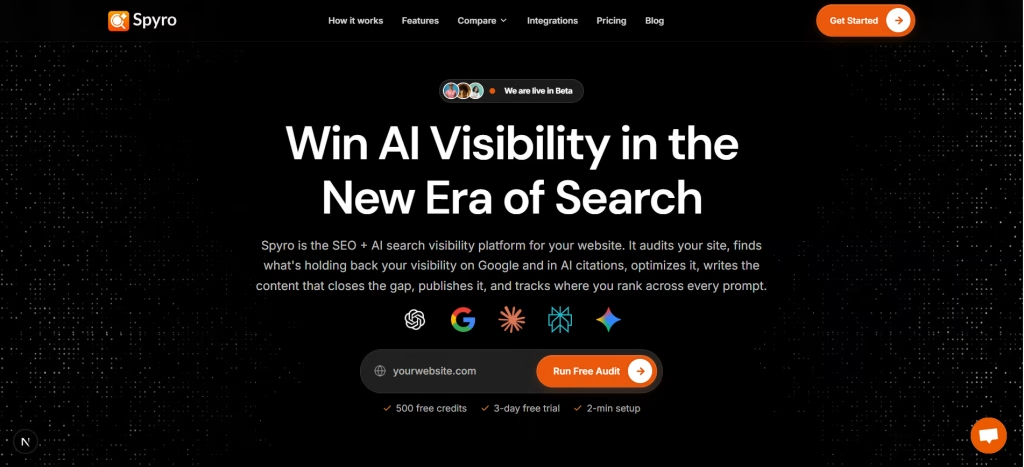
What it does. Spyro AI is an SEO and AI search visibility platform. It tracks whether ChatGPT, Claude, Gemini, Perplexity and Google AI Overviews mention or cite a brand, and adds a deep SEO audit, keyword rank tracking, competitor gap analysis and a GEO mode article writer that publishes to WordPress, Shopify, Webflow, Framer or webhooks.
- Engines: Starter covers ChatGPT and Google AI Overviews. Pro and Agency cover all five. There’s no Copilot, Grok or Google AI Mode tracking.
- Pricing: Starter $29 a month (4,000 credits, up to 2 brands, 15 prompts per brand), Pro $99 (15,000 credits, up to 10 brands, 50 prompts) and Agency $399 (80,000 credits, unlimited brands, 250 prompts). The trial is 3 days with 500 free credits. Prompt tracking costs 10 credits per prompt per engine.
- Strengths: Tracking, audits and content live in one account, so you can spot a gap, write the fix and watch the result. Competitor benchmarking covers up to five domains, and team members are unlimited.
- Limits: Starter’s two engines won’t suit teams that need Claude or Perplexity. Everything draws on one credit pool. Exports, white label reports and crawler log analytics aren’t documented. You can set prompt checks to daily or weekly, though the pricing page still says weekly, so confirm in your account. The yearly figures in the FAQ don’t match the stated 20% saving either.
- Best for: SMBs, content teams and agencies that want measurement and fixes together. See Spyro AI pricing for current plan limits.
Profound
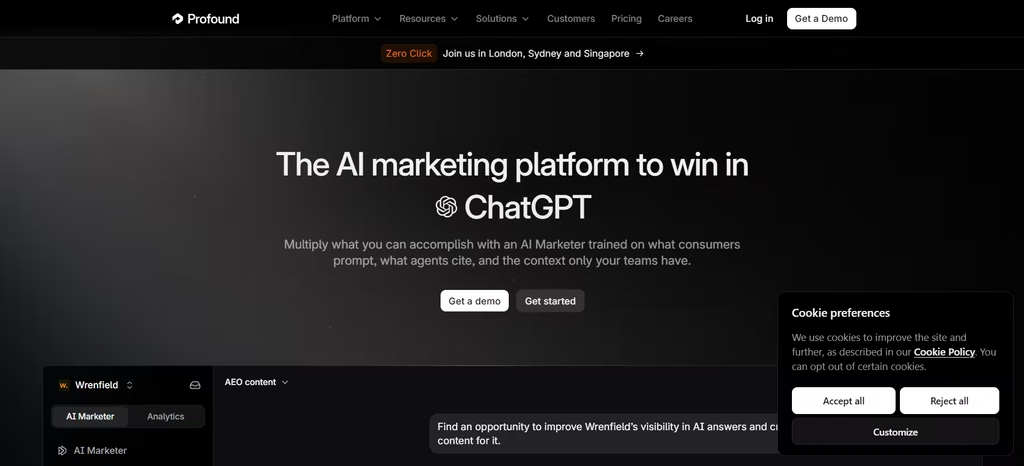
What it does. Profound is an enterprise AI visibility platform with answer engine insights, prompt volume data, agent analytics and AI agents for marketing tasks.
- Engines: The free trial covers ChatGPT, Gemini and Google AI Overviews. Enterprise lists up to 10, including Perplexity, Claude, Google AI Mode, DeepSeek and Qwen.
- Pricing: A free trial runs 50 prompts daily for 7 days. Enterprise is custom, and an Agency Growth plan (400 credits per client workspace) has no listed price.
- Strengths: Wide engine coverage, prompt demand data and AI traffic attribution tied to CDN and cloud integrations. Unlimited seats, with SSO on Enterprise.
- Limits: No public price. The trial has no exports, API or data history.
- Best for: Large brands with procurement processes.
Peec AI
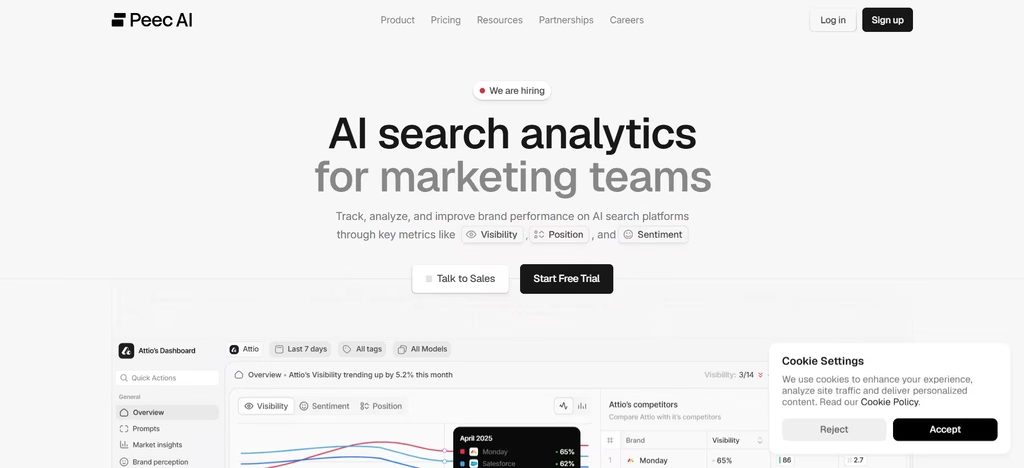
What it does. Peec AI is a visibility analytics platform. You choose prompts and models, and it reports mentions, sources, competitors and recommended actions.
- Engines: Three active models from a list that includes ChatGPT, Perplexity, AI Overviews, AI Mode and Gemini. Claude appears only among Enterprise API models.
- Pricing: Starter $95 a month (50 prompts, 1 country), Pro $245 and Advanced $495. Extra models cost from $30 a month. Annual billing saves 15%.
- Strengths: Unlimited users and competitors, a crawlability audit covering 40+ bots, AI referral data and a small fact checking allowance on every plan.
- Limits: Three models per plan, and API access starts on Advanced.
- Best for: Marketing and SEO teams that care about which sources AI cites.
Otterly.ai
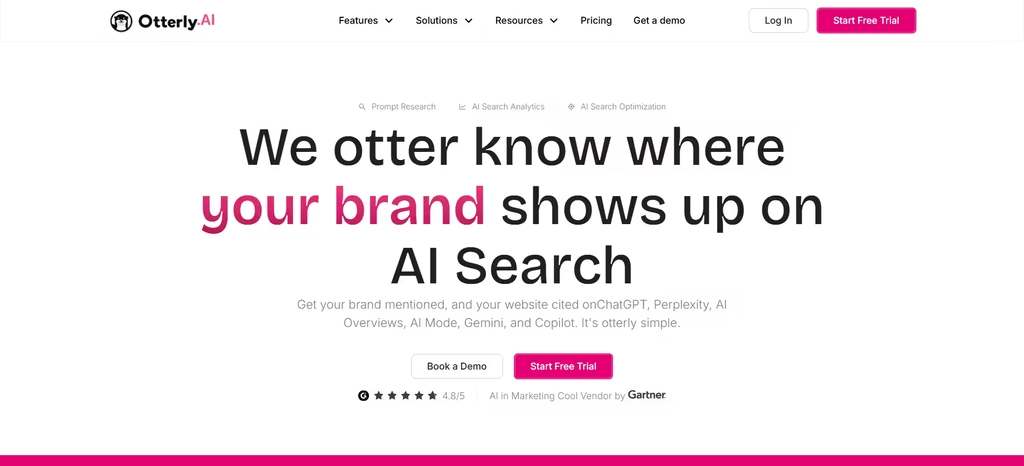
What it does. Otterly.ai is a self serve monitor for brand mentions and link citations, with daily checks.
- Engines: Four of seven on paid plans, picked from ChatGPT, Google AI Overviews, Perplexity, Copilot, AI Mode, Gemini and Claude.
- Pricing: Lite 29 a month with 16 prompts, Standard 189 and Premium 489. The page showed euros for me, while its meta tags list $29, $189 and $489 with slightly different prompt counts. Annual billing is 15% off.
- Strengths: A Crawlability Check and Content Check on every plan, plus the lowest entry price in this group.
- Limits: The page is inconsistent on engines and currency, and the jump from Lite to Standard is steep.
- Best for: Small teams that want to see where they stand before spending more.
AIClicks
What it does. AIClicks tracks AI visibility and includes a monthly allowance of AI optimized articles.
- Engines: Choose 3, 4 or 6 models by plan from a list that includes ChatGPT, Gemini, Copilot, AI Overviews, AI Mode, Claude and Perplexity.
- Pricing: Starter $59, Pro $189 and Business $499 a month, with 30, 150 and 300 prompts and 5, 15 and 30 articles. The 3 day trial needs a card.
- Strengths: Daily tracking and drafts from one vendor. GA4, API and MCP start on Pro.
- Limits: Plans don’t include audits (a free GEO audit tool sits separately on the site), and engine choice is capped.
- Best for: Teams that want articles bundled with tracking.
Semrush AI Visibility Toolkit
What it does. A $99 a month add on with Visibility Overview, Competitor Research, Prompt Research, Brand Performance, Prompt Tracking and an AI Search Site Audit.
- Engines: The help article documents ChatGPT and Google AI Mode.
- Pricing: $99 a month for 25 tracked prompts, with 50 more for $60 a month. No free trial for the toolkit.
- Strengths: It sits beside keyword and backlink data you may already use, and the site audit checks AI search issues on up to 100 pages.
- Limits: Two documented engines and add on costs that climb across domains.
- Best for: Teams already working in Semrush.
Ahrefs Brand Radar
What it does. Brand Radar tracks mentions, citations, AI share of voice and estimated impressions, with Custom Prompts for your own questions and an AI Visibility Index for market benchmarks.
- Engines: ChatGPT, AI Overviews, AI Mode, Gemini, Perplexity, Copilot and Claude on Custom Prompts. The page is inconsistent on Claude for the Index.
- Pricing: Custom Prompts start at $50 a month (5 prompts, 150 checks). The AI Visibility Index is $199 a month.
- Strengths: Market wide benchmarks that help with competitor research and pitches.
- Limits: Check based billing burns faster with every engine, and there’s no content writing.
- Best for: SEO teams already inside Ahrefs.
Which of the Best GEO Tools Help Most With Content Optimization?
Content optimization for AI answers comes down to habits more than tricks: answer first writing, clear definitions, full topic and entity coverage, named sources, fresh facts and headings that match real questions. The best GEO tools for content help you apply those habits at scale.
One distinction matters when you compare the best GEO tools for content. Some of these are dedicated content optimizers that added AI tracking. Others are trackers that added content features. Neither type can make a page citable on its own. Google says you don’t need to write in a specific way just for generative AI search, so treat any score as a guide, not a goal.
| Tool | Type | Content features | AI tracking included? |
|---|---|---|---|
| Spyro AI | Tracker with content | GEO mode articles with answer first summaries, Q&A blocks and schema | Yes, 2 to 5 engines |
| Rankability | Content optimizer with tracking and audits | Research, briefs, outlines, drafts, scoring | Yes, 11 engines |
| Frase | Content optimizer with tracking | SEO score and GEO score, articles, audits | Yes, 2 to 5 engines |
| Surfer | Content editor with tracking | Content Editor, coverage gaps, internal linking | Yes, from Standard |
| Clearscope | Content optimizer with tracking | Drafts, content inventory | Yes, ChatGPT and Gemini |
| Writesonic | Tracker with content | AI articles, site audits | Yes, daily |
| MarketMuse | Content planning | Topic model, briefs, site inventory | Not mentioned on pricing page |
Rankability
Rankability combines content projects, AI query tracking and technical audits. Each content project covers research, a brief, an outline, an AI assisted draft, optimization guidance and export.
- Pricing: Starter $97, Growth $297 and Pro $497 a month, with 100, 300 and 500 tracked AI queries and 20, 80 and 160 content projects. A 7 day trial needs a card.
- Strengths: Eleven engines on every plan and 2 to 25 technical site audits a month, each up to 1,000 pages.
- Limits: A higher entry price than most trackers.
- Best for: Content teams and agencies that want briefs, tracking and audits in one tool.
Frase
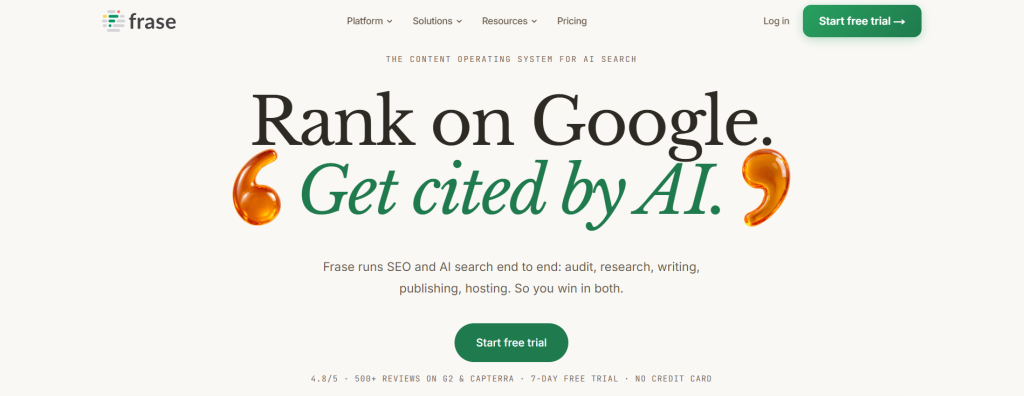
Frase scores drafts for both SEO and GEO, runs site audits and tracks AI visibility.
- Pricing: Starter $49 a month ($39 billed yearly), Professional $129 and Scale $299. A 7 day trial needs no card.
- Strengths: Two scores per draft, audits that flag issues like agent blocking firewall rules and low quotability, and AI crawler monitoring from Professional.
- Limits: Starter tracks only ChatGPT and Google AI with 20 prompts, and history is limited on lower plans.
- Best for: Writers who want one editor scoring for Google and AI answers.
Surfer
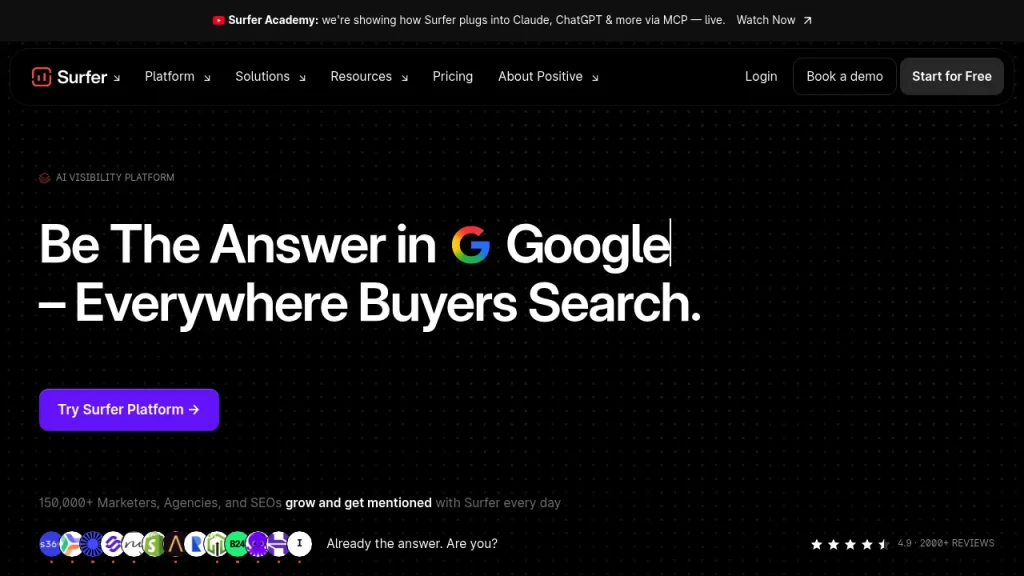
Surfer is a mature content editor with an AI tracker on most paid plans.
- Pricing: Discovery $49 a month billed yearly (no AI tracking), Standard $99 (25 prompts weekly, ChatGPT only) and Pro $182 (50 prompts daily across ChatGPT, Perplexity, AI Mode, AI Overviews and Gemini). A tracking only plan is $82.
- Strengths: Term guidance, coverage gaps and a cannibalization report on higher tiers.
- Limits: Prices shown are yearly, and Claude isn’t tracked.
- Best for: Teams whose writers already work in an editor. The Surfer SEO alternatives guide compares it in depth.
Clearscope
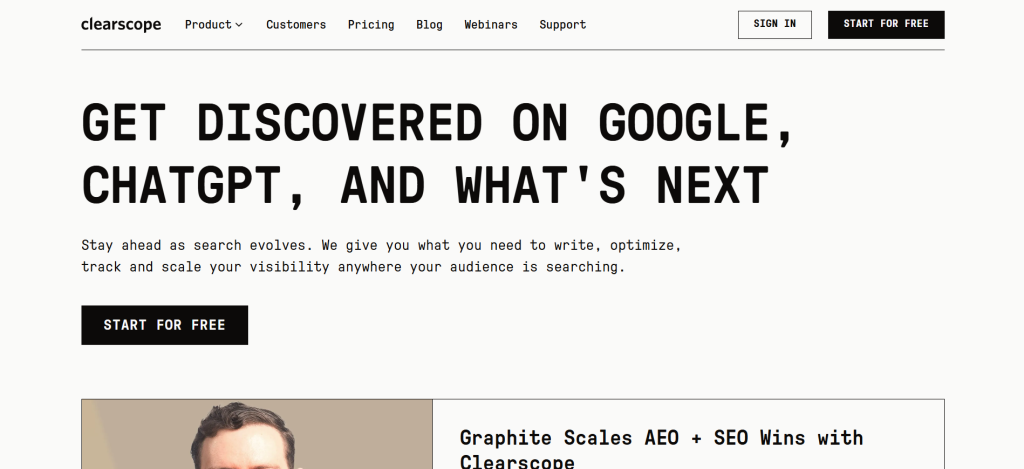
Clearscope is a content optimization tool for editorial teams that now includes query tracking in ChatGPT and Gemini.
- Pricing: Essentials $129 a month (50 tracked queries, 20 drafts) and Business $399 (300 queries). A 14 day trial is offered.
- Strengths: Unlimited users, which suits large writing teams.
- Limits: Two tracked engines, and the pricing page doesn’t describe its grading features in detail.
- Best for: Editorial teams that want one standard across many writers.
Writesonic
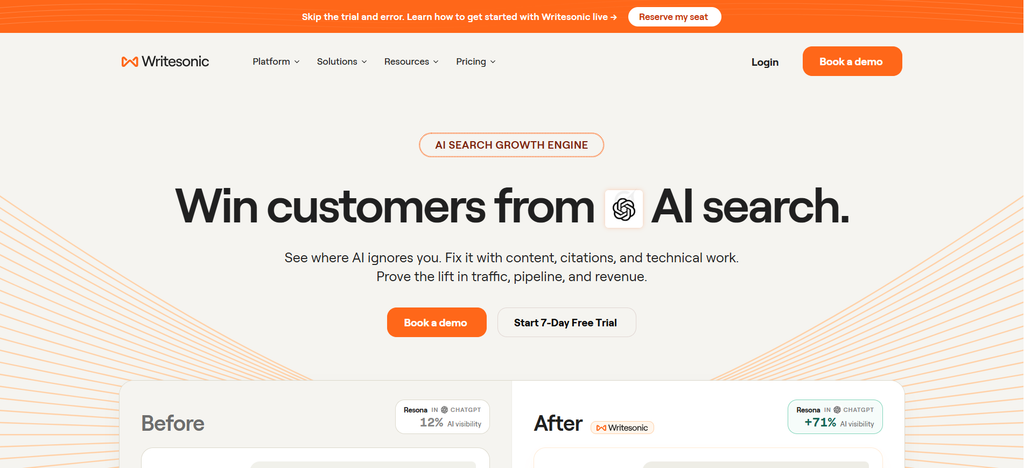
Writesonic now leads with AI search visibility, alongside article generation and site audits.
- Pricing: Starter $79, Basic $199 and Growth $399 a month, billed yearly, with 50, 100 and 200 prompts tracked daily.
- Strengths: Daily tracking, 15 to 50 articles a month, and site audits with AI bot analytics.
- Limits: Paid plans track only ChatGPT, Gemini and Google AI Overviews. Claude and Perplexity need Enterprise.
- Best for: Teams that put AI visibility first and content second.
MarketMuse
MarketMuse is a content planning tool built on topic modeling, briefs and site inventory.
- Pricing: A free plan allows 10 queries a month. Paid prices aren’t publicly listed.
- Strengths: Strong topic research for planning clusters and spotting coverage gaps.
- Limits: The pricing page doesn’t mention AI visibility tracking or generative engine optimization features.
- Best for: Strategists who plan topics and pair MarketMuse with a separate tracker.
Which of the Best GEO Tools Find Technical Problems and AI Crawler Blocks?
If a crawler can’t fetch a page, no amount of content work will get it quoted from a fresh visit. OpenAI says sites that opt out of OAI-SearchBot won’t be shown in ChatGPT search answers, apart from navigational links. So technical access comes first, whatever mix of the best GEO tools you end up using.
Here’s what to check and which kind of tool catches it:
| Problem | What to check | Where it shows up |
|---|---|---|
| AI crawler blocked by robots.txt | Rules for GPTBot, ClaudeBot, PerplexityBot and OpenAI’s search crawler | Any robots.txt checker, GEO platform audits |
| Blocked by CDN or firewall | 403, 429 or challenge pages for bot requests | Server and CDN logs, Frase and Peec AI crawl features |
| Page not indexed | Indexing status, noindex, canonical | Google Search Console URL Inspection |
| Content hidden behind JavaScript | Raw HTML vs rendered page | URL Inspection, desktop crawlers with rendering |
| Invalid or missing structured data | Schema errors, mismatch with visible content | Rich Results Test, schema validators |
| Weak internal linking | Orphan pages, deep pages | Site audits in SEO and GEO platforms |
| Sitemap problems | Missing or broken URLs | Search Console sitemaps report, site audits |
| Slow pages | Core Web Vitals | Search Console, PageSpeed Insights |
Free Google tools
Google Search Console is still the best free technical GEO tool for Google surfaces. In 2026 Google added Search Generative AI performance reports showing how pages appear in AI Overviews and AI Mode. Be clear on the limit, though. Search Engine Journal notes the report shows impressions but no queries or clicks, and it covers only Google.
Use URL Inspection to confirm indexing and see rendered HTML. Google’s JavaScript guidance still recommends server side rendering or prerendering, because not all bots can run JavaScript. That applies well beyond Googlebot. And check speed against the three Core Web Vitals: LCP of 2.5 seconds or less, INP of 200 milliseconds or less and CLS of 0.1 or less.
Audit features inside GEO platforms
Several of the best GEO tools audit technical readiness directly, which saves a separate crawler for small sites:
- Spyro AI runs a deep SEO audit (redirects, duplicate meta tags, heading structure, crawl blockers). Its free AI Crawler and robots.txt Checker reports which rule allows or blocks each AI bot, and the Schema Markup Validator checks structured data.
- Peec AI includes a crawlability audit for 40+ bots and crawl insights on bot visits.
- Frase monitors AI crawlers from Professional and flags agent blocking firewall rules in audits.
- Semrush adds AI search checks to its site audit for up to 100 pages.
- Writesonic lists AI bot analytics alongside site audits.
- Rankability includes 2 to 25 technical audits a month.
These are guidance and reports. A tool that reads your robots.txt from outside can’t see your firewall dashboard or prove the real GPTBot visited.
What needs a dedicated crawler or your own logs?
Larger sites need a desktop or cloud crawler that can switch user agents and render JavaScript, such as Screaming Frog. And only your server and CDN logs show whether a verified AI crawler actually received a 200 or a 403. The AI crawler checker guide walks through that process step by step.
Where does llms.txt fit?
llms.txt is a proposed Markdown file that points AI agents to your key pages. It’s optional. Google says Search ignores these files, so they neither help nor hurt rankings, and no major AI provider documents using it to choose sources. The llms.txt guide covers when it’s worth the ten minutes. Don’t buy a tool because it generates one.
How Do You Choose the Best GEO Tools for Your Team?
Match the tool to the team. The best GEO tools for a three person shop aren’t the best GEO tools for an enterprise.
- Small businesses: Start with free checks (Search Console, a robots.txt checker), then one low cost tracker. Spyro AI Starter ($29) or Otterly.ai Lite (29 in euros or dollars, depending on the page you see) keep costs low. Check the engines first.
- In house marketing teams: Peec AI or Spyro AI Pro give dashboards and competitor views you can report upward.
- SEO professionals: Try the AI module in Semrush or Ahrefs before adding a vendor. Add a dedicated tracker when prompt limits pinch.
- Content marketing teams: Rankability, Frase or Surfer, where content work sits beside tracking.
- Digital marketing agencies: Spyro AI Agency (unlimited brands) or Rankability (shared allowances across clients). Price both at next year’s client count.
- Enterprise organizations: Profound for engine coverage, SSO and exports. Run the trial before the contract.
- Technical SEO teams: Search Console, a crawler with rendering, your logs, plus the crawl features in Peec AI or Frase.
Do You Need Separate GEO Tools for Tracking, Content and Technical SEO?
Sometimes one of the best GEO tools is enough. Often it isn’t. A combined platform saves logins, but its weakest module sets the ceiling.
Three example stacks, built from the prices above (examples, not recommendations for every site):
- Lean SMB stack: Spyro AI Starter for tracking, audits and drafts, plus Google Search Console. About $29 a month.
- Content team stack: Surfer Pro or Frase Professional for editing and tracking, plus Search Console and a robots.txt check. From about $129 to $182 a month.
- Agency stack: Spyro AI Agency or Rankability for tracking, content and audits across clients, plus a desktop crawler for big sites.
Should you buy a tool or a generative engine optimization service? A tool shows the gap. Someone still has to write, fix and measure. If your team lacks time for that, a service or a done for you setup may cost less than unused software. Spyro AI’s Pro plan includes a done for you setup that plans 30 days of content and picks prompts to track. Most other vendors here are software only.
What Mistakes Do Teams Make When Choosing the Best GEO Tools?
- Counting engines and nothing else. Eleven engines with 100 prompts may tell you less than five engines with 250. Check prompts, frequency and engines together.
- Confusing tracking with optimization. A tracker shows you’re missing. It doesn’t fix the page.
- Treating mentions as citations. A mention names your brand. A citation links your page. Track both.
- Expecting llms.txt to rank you. Google ignores it for Search.
- Ignoring technical access. A firewall rule can silently block the crawlers you’re paying to track.
- Comparing the best GEO tools on different prompt sets. Run the same prompts in both trials or the comparison means nothing.
- Assuming answers stay put. AI answers change between runs. Judge trends over weeks.
- Treating one metric as proof. Pair tracker data with Search Console impressions and real referral traffic.
Final Verdict: Which of the Best GEO Tools Should You Choose in 2026?
There’s no single winner among the best GEO tools, so pick by the job you’re missing:
- Enterprise tracking with wide engine coverage: Profound.
- Source analytics for marketing teams: Peec AI.
- Cheapest daily monitoring: Otterly.ai.
- Tracking plus audits and content on a small budget: Spyro AI.
- Content teams that also want tracking and audits: Rankability or Frase.
- Writers who live in an editor: Surfer or Clearscope.
- Teams already paying for an SEO suite: Semrush or Ahrefs Brand Radar.
- Technical access, for everyone: Google Search Console plus your own logs, before anything else.
Key Takeaways
- The best GEO tools split into three jobs: tracking AI answers, improving content and fixing technical access.
- Before buying any of the best GEO tools, check engines, prompts and check frequency on your actual plan, not the top tier.
- Content scores and GEO scores are guides. No tool can guarantee a citation.
- Technical access comes first, and much of it is free through Search Console and your logs.
- Shortlist two of the best GEO tools for your weakest job, run the same prompts in both and compare.
Frequently Asked Questions About the Best GEO Tools
What are the best GEO tools in 2026?
The best GEO tools in 2026 include Spyro AI, Profound, Peec AI, Otterly.ai, AIClicks, Semrush AI Visibility Toolkit and Ahrefs Brand Radar for tracking; Rankability, Frase, Surfer, Clearscope, Writesonic and MarketMuse for content; and Google Search Console for technical checks. The right pick depends on which job you’re missing.
What is a GEO optimizer?
“GEO optimizer” usually means a tool that improves content or pages for generative AI answers, such as a content scorer, a page audit or broader generative engine optimization software. The phrase is also used for unrelated products, including WordPress plugins and local SEO tools, so check what any product called that actually measures.
What is the difference between GEO and AEO tools?
AEO tools focus on getting a page quoted as a direct answer. GEO tools cover how AI systems describe and recommend your brand overall, including tracking, content and technical access. Most products do some of both, so compare features, not labels.
Can the best GEO tools improve ChatGPT citations?
Not directly. The best GEO tools show whether ChatGPT cites you and suggest fixes, such as clearer answers or opening access for OpenAI’s search crawler. Whether citations rise depends on your content and on ChatGPT’s own systems. No tool can guarantee one.
Is there a free GEO tool?
Yes, for parts of the job. Google Search Console is free and now reports AI Overviews and AI Mode impressions. Spyro AI offers a free AI Visibility Checker, SEO and GEO Audit and AI Crawler and robots.txt Checker. Profound has a free trial. Ongoing multi engine tracking is paid.
How much do the best GEO tools cost?
Published entry prices run from about $29 a month (Spyro AI Starter, Otterly.ai Lite) to $129 (Clearscope), with higher tracking tiers running up to about $500. Profound and MarketMuse don’t publish paid prices. Extra engines, prompts, seats and domains raise the real bill.
Is llms.txt necessary for GEO?
No. llms.txt is an optional proposal. Google says Search ignores it, and no major AI provider documents using it to pick sources. Crawler access, indexable pages and clear content matter far more.
Start With the Job Your GEO Stack Is Missing
Write down which job hurts most right now: knowing where you stand, fixing pages or getting crawlers in. Shortlist two of the best GEO tools for that job and trial both on the same prompts.
Want a free baseline first? Run the AI Visibility Checker to see whether ChatGPT and Google AI Overviews mention your brand, then the SEO and GEO Audit to find page level fixes. If tracking, audits and content in one place suits your team, Spyro AI has a 3 day trial.