How to Rank in Google AI Overviews: What Small and Mid Sized Sites Can Control


Quick Answer: Can a Small Site Rank in Google AI Overviews?
Yes, but nobody can guarantee it. AI search optimization for Google AI Overviews comes down to what Google already rewards: pages it can crawl and index, content that answers a real question well, and evidence a reader can check. Google says there are no additional requirements to appear in AI Overviews or AI Mode.
- What you control: crawling and indexing, how clearly a page answers the question, the evidence behind it, internal links, structured data that matches the page, and how you measure.
- What you don’t control: whether Google shows an AI Overview for a query, which sources it picks, and how the answer shifts from one search to the next.
- How to measure it: Search Console now has a generative AI report showing impressions in AI Overviews and AI Mode. Pair it with your normal search and conversion data.
- What to skip: special “AI schema”, llms.txt for Google, word count targets, and anyone selling guaranteed citations.
I wrote this AI search optimization guide for small business owners, in house marketing teams, SEO consultants, agencies and WordPress site owners. For the bigger picture of how classic SEO, generative engine optimization and answer engine optimization fit together, start with the SEO vs GEO vs AEO guide.
What Is AI Search Optimization?
AI search optimization is the work of making your pages easy for AI search features to find, understand, trust and cite. On Google, that means AI Overviews and Google AI Mode. Elsewhere, it means assistants like ChatGPT, Perplexity, Gemini and Claude.
Most of it is plain SEO, the same work that builds organic search visibility. Google says so in its guide to generative AI features in Search: “optimizing for generative AI search is optimizing for the search experience, and thus still SEO.”
I’d take that at face value. AI SEO optimization isn’t a separate discipline with secret rules. It’s SEO plus one question: when an AI system writes an answer, can it quote your page accurately?
The labels overlap, and vendors use them loosely:
| Term | What it focuses on | Where you see results |
|---|---|---|
| Traditional SEO | Crawling, indexing, relevance and quality for ranked results | Blue links, snippets, rich results |
| AI search optimization | The same foundations, plus clear answers and evidence that AI features can quote | AI Overviews, AI Mode, AI assistants |
| Generative engine optimization (GEO) | Being cited or recommended inside AI generated answers | Mentions and citations across AI engines |
| Answer engine optimization (AEO) | Direct answers to specific questions | Featured snippets, voice answers, AI answers |
| AI visibility tracking | Measuring mentions and citations over time | Reports, not rankings |
Nobody owns these definitions. Google describes AEO and GEO as terms “you may see used” and doesn’t ask anyone to adopt them or follow a special GEO checklist. More on the label in what is generative engine optimization.
How Do Google AI Overviews Work, and What’s Still Uncertain?
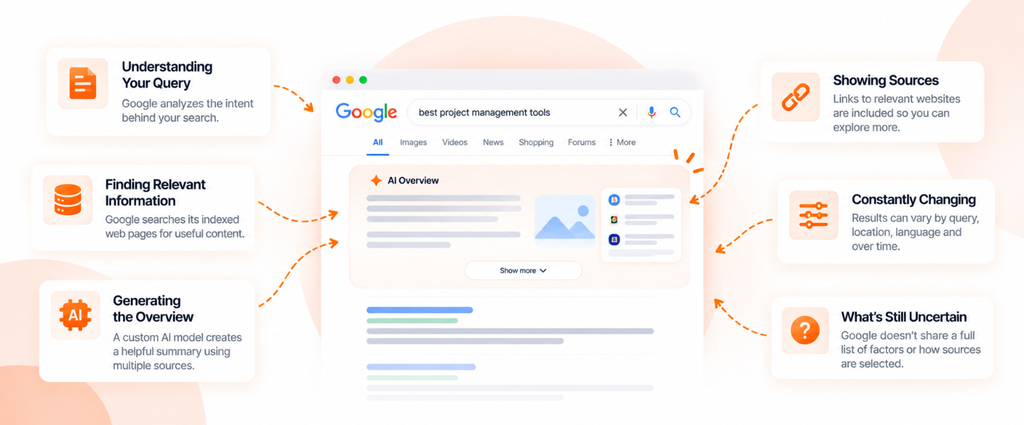
Most AI search optimization advice mixes up what Google documents, what researchers have measured and what nobody outside Google knows. Let’s pull them apart.
What Google Officially Documents
From Google’s page on AI features and your website:
- Eligibility is ordinary eligibility. A page has to be indexed and eligible to show in Search with a snippet. “There are no additional technical requirements.”
- AI Overviews are selective. Google shows them when it decides they’re additive to classic Search. Not on every query.
- One answer can draw on many searches. Both features may use a query fan out technique, “issuing multiple related searches across subtopics and data sources” to build a response.
- The controls are the usual ones. Googlebot rules in robots.txt manage crawling. The
nosnippet,data-nosnippet,max-snippetandnoindexrules limit what Search shows.
Underneath all of it, Google says these features are “rooted in our core Search ranking and quality systems.” There’s no documented AI Overview ranking score.
Google also added a Search Console setting in 2026 that lets a site opt out of AI Overviews and AI Mode. Its help page for the Search generative AI control says the setting isn’t a ranking signal for the rest of Search. Most small sites won’t want it, but the switch exists.
AI Overviews vs AI Mode vs Featured Snippets
Related features. Not identical ones.
| Feature | What it is | How sources show up | What you can influence |
|---|---|---|---|
| Classic organic result | A ranked link with a title and snippet | One page per listing | Relevance, quality, titles, snippets |
| Featured snippet | One page’s snippet shown first, above its link | A single quoted source | Clear answers; Google says you can’t mark up a page to get one |
| AI Overview | A generated summary at the top of some results | Several supporting links, often from different sites | Being indexed, relevant and easy to quote |
| AI Mode | A conversational search experience for deeper questions and comparisons | Links beside a longer answer, with follow up questions | Same foundations; Google says it may use different models and techniques |
The two are getting closer. At Google I/O 2026, Google said AI Mode had passed one billion monthly users and that a follow up question asked from an AI Overview now carries into AI Mode. Still, the links each one shows can vary, so a citation in one doesn’t mean a citation in the other.
What Independent Research Has Observed
Researchers at Washington University in St. Louis tracked 55,393 trending US queries over 40 days in 2026. Three findings matter for small sites:
- AI Overviews appeared on 13.7% of those queries. Queries phrased as questions triggered one 64.7% of the time, versus 9.5% for everything else.
- 29.8% of the domains cited in AI Overviews didn’t appear on the first page of results for the same query.
- About 89% of the claims they checked were consistent with the cited sources.
A separate field study from the Indian School of Business and Carnegie Mellon University, covered by Search Engine Journal, followed 1,065 US desktop Chrome users. AI Overviews showed on 42% of their searches, and organic clicks fell 38% on queries where one appeared. It’s a working paper and hasn’t been peer reviewed.
Notice the gap between 13.7% and 42%. Different samples, very different answers. For AI search optimization on a small site, that’s the real lesson: measure your own queries rather than trust any headline number (these two included).
What Nobody Outside Google Knows
Google doesn’t publish how it picks which pages to cite, how much any signal weighs for AI features, or why a source shows up today and vanishes tomorrow. Results vary by query wording, location, device and time, and AI Mode now adds personal context for people who opt in. Anyone claiming to know the AI Overview algorithm is guessing.
What Can Small and Mid Sized Sites Actually Control?
More than you’d think. For a small business SEO budget, AI search optimization means working on these eight areas:
| Area | What you can control | Practical first step | How to verify |
|---|---|---|---|
| Technical accessibility | Crawling, indexing, status codes, canonical tags | Check your 10 most important URLs | Search Console page indexing report and URL Inspection |
| Content usefulness | Specific, accurate answers | Improve your most important page first | Compare the page with what the searcher needs |
| Topic coverage | Related questions and supporting pages | Map one topic cluster | Internal link and content audit |
| Evidence and expertise | Sources, examples, author context | Back up every important claim | Editorial review |
| Page structure | Descriptive headings and a logical order | Put the answer where people look first | Manual page review |
| Internal links | Contextual paths between related pages | Link supporting pages to the key page | Crawl or site audit |
| Structured data | Valid schema that matches visible content | Validate the markup you already have | Rich Results Test or a schema validator |
| Measurement | Search performance and dated content changes | Record a baseline before you edit | Search Console and analytics |
Start with technical SEO. Every AI search optimization plan starts here. Google lists three technical requirements for Search: Googlebot isn’t blocked, the page returns HTTP 200, and the page has indexable content. Even then, Google says “indexing isn’t guaranteed.” The URL Inspection tool shows whether Google has indexed a URL and runs a live test. If crawlers from OpenAI, Anthropic or Perplexity matter to you as well, the AI crawler checker guide covers robots.txt, firewall and log checks.
Then internal linking. Google can generally only follow links that are real <a href> elements, and its link best practices say “Every page you care about should have a link from at least one other page on your site.” Orphaned pages are easy to fix. And easy to miss.
Clean up duplicates. Canonicals matter when you have near copies of a page (tracking parameters, print versions, location pages that differ by one word). Google’s canonicalization guide treats redirects and rel="canonical" as strong signals and sitemap inclusion as a weak one.
Use structured data where it fits. Google’s structured data policies say “Don’t mark up content that is not visible to readers of the page,” and that Google “does not guarantee” your markup will appear in results. Its AI guide adds that structured data “isn’t required for generative AI search.” Useful for rich results. Not a key to AI Overviews.
How Do You Improve One Page for AI Search Optimization?
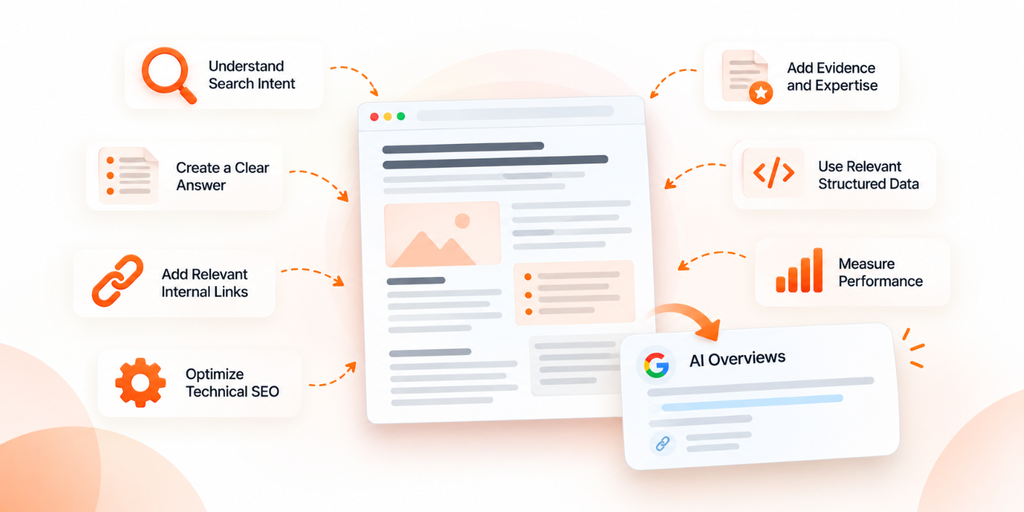
Start with one page. Not fifty. This sequence works without enterprise software:
- Pick a page that matters. A service page that brings in leads, or a guide buyers read before they buy.
- Confirm it can be crawled and indexed. Run it through URL Inspection. Fix blocks,
noindextags, wrong canonicals and redirect chains first. - List the real questions. Pull them from Search Console queries, sales calls, support tickets and the People also ask box. Write them in your reader’s words, since that’s the search intent you’re serving.
- Answer the main question near the top. One or two plain sentences, before any background.
- Add context and evidence. Prices, ranges, steps, exceptions. Link sources for anything a reader might doubt.
- Turn questions into headings. “How long does a kitchen remodel take?” beats “Our Process.”
- Add what only you know. Your own data, photos and examples. Google’s helpful content guidance asks whether a page provides “original information, reporting, research, or analysis.”
- Link to supporting pages. And link back from them, with descriptive anchor text.
- Check the trust details. Author name and role, source citations, a real update date, facts that are still true.
- Validate any structured data. Make sure it matches what’s visible.
- Record a baseline. Clicks, impressions, AI impressions, conversions, and the date you published the changes.
- Measure over weeks, then iterate. One good week isn’t a trend.
A Worked Example (Illustrative)
This is a made up scenario, not a client result.
A small bookkeeping firm’s service page opens with “We provide professional, reliable bookkeeping for businesses of all sizes.” No price. No process. Meanwhile, a buyer searches “how much does monthly bookkeeping cost for a small business?”
The improved page:
- Opens with the answer: “Monthly bookkeeping for a small business with up to [X] transactions usually costs [your real range] with us. The price depends on transaction volume, the number of accounts and whether payroll is included.”
- Adds a short table showing the three things that change the price.
- Answers the next questions under their own headings: what’s included and how the first month works.
- Shows evidence: the bookkeeper’s name and qualifications, plus [ADD REAL EXAMPLE] of a typical monthly close timeline.
- Links to a guide on choosing between a bookkeeper and an accountant, and that guide links back.
Will Google cite it in an AI Overview? Maybe. But it now answers the question someone actually typed. That’s the part of AI search optimization you control.
Which Content Practices Help, and Which AI SEO Optimization Myths Should You Ignore?
Practices That Help
- Answer the reader’s question early, then give details a generic summary can’t: numbers, conditions, local specifics.
- Back important claims with reliable, linked sources.
- Keep facts current. Content freshness means updating the content, not just the date, which Google’s helpful content page flags as a warning sign.
- Use descriptive headings, short sections and tidy internal links.
- Use the same names for your products, services and people everywhere. That’s entity clarity, and it’s cheap.
- Cut filler and claims you can’t support.
- Put important information in crawlable text, not only in images, PDFs or scripts. Content accessibility applies to bots too.
For a deeper look at writing pages that AI engines quote, see the AI content optimization guide.
Seven AI Search Optimization Myths to Ignore
“A special AI Overview schema guarantees citations.” No such schema exists. Google’s AI guide says there’s “no special schema.org markup you need to add.” Schema also changes under your feet: Google stopped showing FAQ rich results for every site in 2026, as Search Engine Journal reported.
“Every article needs a specific word count.” Google’s helpful content page lists writing to a particular word count as a warning sign and says it has no preferred length.
“More keywords means more AI visibility.” Stuffing makes pages worse to read. Google’s AI guide warns that overdoing content mainly to manipulate rankings or AI responses goes against its spam policies.
“Publishing hundreds of AI generated articles is a shortcut.” Google’s spam policies name “using generative AI tools or other similar tools to generate many pages without adding value for users” as scaled content abuse.
“An llms.txt file is mandatory for Google AI Overviews.” Google says Search ignores llms.txt files, and that keeping one “will neither harm nor help” your visibility in Google Search. Other services may read it. Google doesn’t.
“A tool’s GEO score predicts whether Google will cite a page.” A score measures a tool’s own checklist. Google’s AI guide warns readers to be wary of tools that promise ranking success or claim to use internal Google metrics. That applies to every scoring tool, the free Spyro AI checkers included. Use scores to find fixes, not to forecast citations.
“You can pay to guarantee a spot in AI answers.” There’s no documented way to buy an organic citation in AI Overviews. Ads can appear on the same page, but that’s advertising, not a source link.
Technical SEO Checklist for Small and Mid Sized Sites
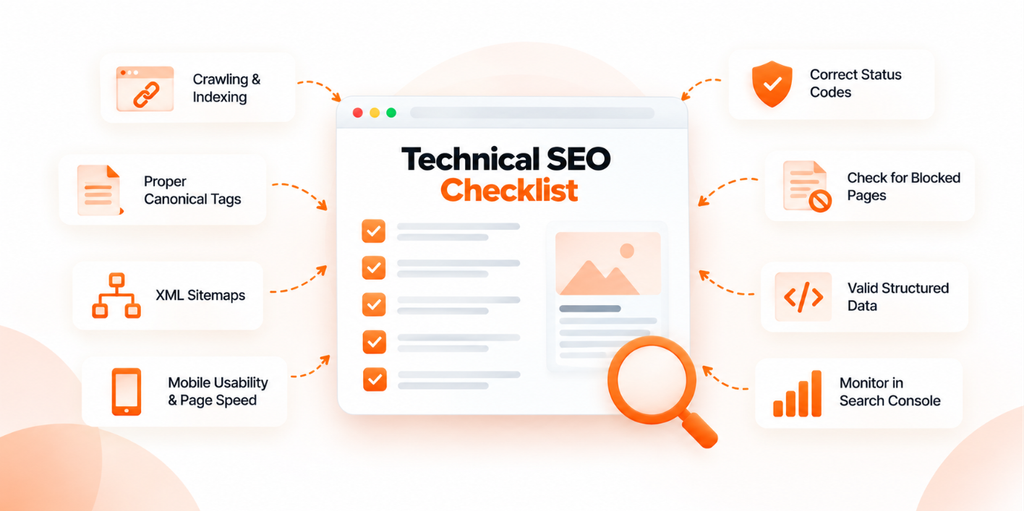
Run it once a quarter as part of your AI search optimization routine. Passing doesn’t guarantee AI Overview visibility. Failing can rule you out.
- Important URLs return the right status code (200 for live pages)
- Pages meant for search aren’t blocked by robots.txt,
noindexor a login - Canonical tags point to the version you want indexed
- The XML sitemap is valid, current and submitted in Search Console
- Internal links point to final URLs, not redirects
- Mobile usability and page speed are reasonable
- Main content is in the HTML crawlers receive, not loaded only by scripts
- Meaningful images have descriptive alt text
- Structured data is valid and matches visible content
- No important page is orphaned
- Redirect chains and broken links are fixed
- Search Console reports get reviewed regularly
The free SEO and GEO Audit from Spyro AI checks many of these in one pass with no signup, and the Schema Markup Validator tests JSON-LD against schema.org and Google’s rich result requirements. Google’s own Search Console and Rich Results Test stay the reference.
How Do You Measure AI Search Optimization?
AI search optimization without a baseline is guesswork. Measure before you change anything, then measure the same things after.
- Search Console clicks and impressions for the pages you edited, plus their queries.
- AI impressions. The generative AI performance report in Search Console counts how many times links to your site were shown in AI Overviews and AI Mode, by page, country, date and device. It reached all sites worldwide in 2026, though a site needs enough AI impressions before the report appears.
- Organic traffic, conversions and indexing issues in your analytics and the Page indexing report.
- Referral traffic from AI assistants like ChatGPT or Perplexity, where analytics can identify it. Google counts AI feature traffic inside overall Search traffic, so AI Overview clicks won’t show as their own referrer.
- Mentions and citations in the AI engines you care about, checked repeatedly on the same prompts.
Read that report carefully, because it’s the one official AI search optimization metric Google gives you. Its help page doesn’t list clicks or average position. Search Engine Journal’s guide to reading AI impressions makes a useful point: AI impressions aren’t the same as organic impressions, so don’t add them together or calculate a blended click through rate.
Here’s how the main data sources compare for search performance measurement:
| Data source | What it tells you | Who produces it | Main limitation |
|---|---|---|---|
| Search Console Performance report | Clicks, impressions, CTR and position, with AI feature traffic inside Web totals | AI features aren’t broken out here | |
| Search Console generative AI report | Impressions in AI Overviews and AI Mode by page, country, date and device | Impressions only; needs enough volume | |
| Analytics | Visits, engagement and conversions | Your analytics tool | Hard to attribute visits to a specific AI answer |
| AI visibility tracking | Whether AI engines mention or cite you for chosen prompts | Third party tools or manual checks | A sample of prompts; answers vary between runs |
And remember that AI generated answers change from run to run. One screenshot proves little. Repeat the same prompts on a schedule and track the share of checks where you appear.
Which AI Search Optimization Tools Do Small Websites Need?
Fewer than vendors suggest. Start free. Add paid AI search optimization tools when a specific job gets painful.
| Tool category | What it’s for | Do you need to pay? |
|---|---|---|
| Google Search Console | Indexing, queries, clicks, AI impressions | No, it’s free |
| Website crawler or technical audit | Status codes, canonicals, broken links, orphan pages | Free tools cover small sites; paid helps at scale |
| Content research and optimization | Questions, topic gaps, briefs | Optional; your own customer questions are often better |
| Analytics | Traffic, engagement, conversions | Free options exist |
| AI visibility tracking | Mentions and citations across AI engines over time | Usually paid, or done by hand |
| Reporting and monitoring | Turning data into decisions | A spreadsheet works to start |
Keep two jobs apart. Content optimization improves a page before it goes live. AI visibility tracking tells you afterward whether AI engines mention you. Plenty of AI search optimization tools only do one of those, whatever the homepage says.
So where does Spyro AI fit? Spyro AI is an SEO and AI search visibility platform. According to its product documentation, it includes a site audit, keyword rank tracking, a Google Search Console integration that shows real clicks, impressions, CTR and average position, and AI visibility tracking. That tracking asks buyer questions in ChatGPT, Gemini, Claude, Perplexity and Google AI Overviews and reports results as frequencies (“mentioned in 3 of 5 checks”) rather than a yes or no. The Spyro AI pricing page lists plans from $29 a month, with ChatGPT and Google AI Overviews on Starter and all five engines on Pro.
Like any tracker, it samples the prompts you choose. It can’t tell you how Google decides.
When Are AI Search Optimization Services Worth It?
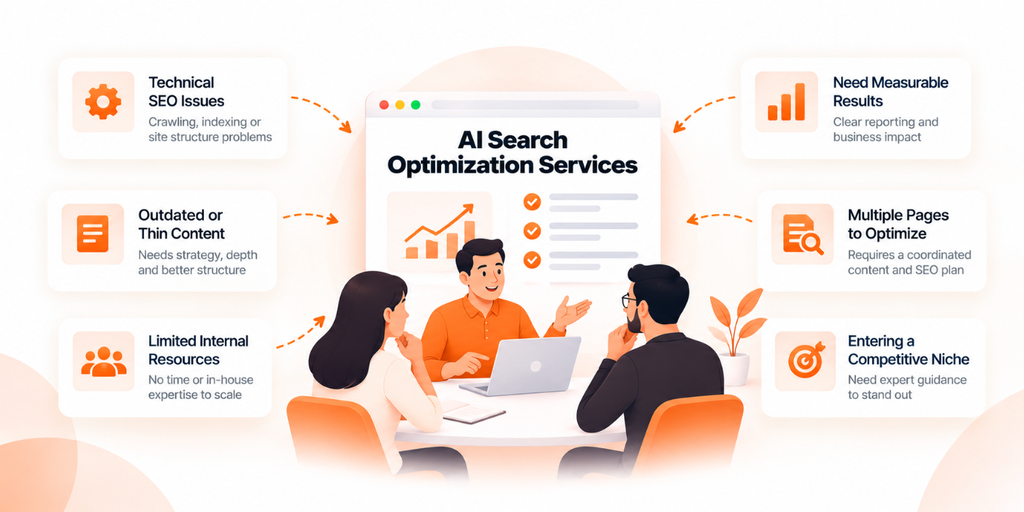
Outside help makes sense when:
- the site has indexing problems you can’t diagnose
- nobody on the team owns SEO as an ongoing process
- content is outdated or poorly structured across many pages
- you don’t have time to monitor results
- several pages need coordinated fixes, like a migration
- leadership wants reporting that ties SEO work to leads and revenue
You can probably begin AI search optimization yourself if you have a manageable set of priority pages, someone with a few hours a week, and access to Search Console. Fix the technical basics, improve three pages, measure for a month. Then decide.
Shopping for AI search optimization services? Ask every provider:
- Can they explain the work in plain language?
- Are recommendations based on evidence from your site, or a generic checklist?
- Does the proposal separate SEO work from AI visibility monitoring?
- Are deliverables and measurement periods written down?
- Are their claims about citations and rankings realistic? (A promise of AI Overview placement is a red flag.)
- Are they open about tools, costs and limitations?
A Realistic 30 Day AI Search Optimization Plan
Thirty days is a practical starting period, not a promise of ranking changes or AI Overview citations.
Week 1: Establish the Baseline
- Check Search Console for indexing and crawl problems.
- Pick 3 to 5 important pages.
- Review technical issues on those pages.
- Record clicks, impressions, AI impressions (if you have the report) and conversions.
Week 2: Improve Content
- Update 1 to 3 priority pages.
- Answer the main questions directly.
- Add evidence, context and real examples.
- Improve headings and internal links.
Week 3: Validate and Publish
- Check structured data where you use it.
- Fix broken links and canonical issues.
- Publish the updates and write down the dates.
- Confirm the pages are still accessible and indexable.
Week 4: Measure and Prioritize
- Compare impressions, clicks and conversions with the baseline.
- Check AI impressions and any AI referral or visibility data.
- Note what changed and what didn’t.
- Choose the next pages to improve.
Key Takeaways
- Google says there are no extra requirements for AI Overviews or AI Mode, so AI search optimization starts with ordinary SEO: crawlable, indexable, useful pages.
- You control technical access, clear answers, evidence, internal links, structured data accuracy and measurement. You don’t control when AI Overviews appear or which sources Google picks.
- Specific, original content beats generic AI filler, and Google’s spam policies treat mass produced pages as scaled content abuse.
- Measure with Search Console’s AI impressions, your normal search and conversion data, and repeated checks of AI answers over time.
- No schema, file, score, tool or service guarantees a citation. Pay for help only when a specific gap justifies it.
Frequently Asked Questions
What is AI search optimization?
AI search optimization is the practice of making web pages easy for AI search features, such as Google AI Overviews, AI Mode and AI assistants, to find, understand and cite. It builds on traditional SEO, with extra attention to clear answers, evidence and measuring mentions in AI answers.
How do you rank in Google AI Overviews?
You can’t force it, but you can improve your chances. Make sure the page is indexed and eligible to show a snippet, answer the searcher’s question directly near the top, support claims with evidence, link related pages together and keep facts current. Google says there are no additional requirements or special optimizations for AI Overviews.
Do small websites have a chance of appearing in AI Overviews?
Yes. Google documents no size threshold, and independent research found that many domains cited in AI Overviews didn’t appear on the first page of results for the same query. A small site with a clear, specific, well supported answer can be cited. It still isn’t guaranteed, and results vary by query and over time.
Which AI search optimization tools should a small business use?
Start with Google Search Console, which is free and reports impressions in AI Overviews and AI Mode. Add a technical audit tool, your analytics and a way to check AI answers repeatedly. Paid AI search optimization tools for visibility tracking help once you need regular reports across several AI engines.
Are AI search optimization services worth the cost?
They can be when your site has technical problems you can’t diagnose, many pages need coordinated work, or nobody has time to monitor results. If you have a few priority pages and Search Console access, you can start yourself. Avoid any provider that guarantees AI Overview citations.
Does schema markup help a page appear in Google AI Overviews?
Not directly. Google says structured data isn’t required for generative AI search and there’s no special markup for it. Valid schema that matches visible content still supports rich result eligibility.
Can anyone guarantee a citation in Google AI Overviews?
No. Google decides when to show an AI Overview and which sources to link, and answers change between searches. Anyone promising guaranteed placement is overselling. You can improve eligibility and usefulness, then measure what happens.
Start With What You Can Control
There’s no secret route into Google AI Overviews. What works is the same short list: pages Google can crawl and index, clear answers near the top, evidence people can check, sensible internal links, structured data that tells the truth, and steady measurement.
That’s AI search optimization for a small or mid sized site. Not glamorous. Very doable.
If you’d like a starting point this week, run the free SEO and GEO Audit on your most important page and fix what it flags. It won’t guarantee a citation. It will show you what to fix first.