
Spyro: AI Search Visibility Tracking and SEO on Autopilot


Quick overview
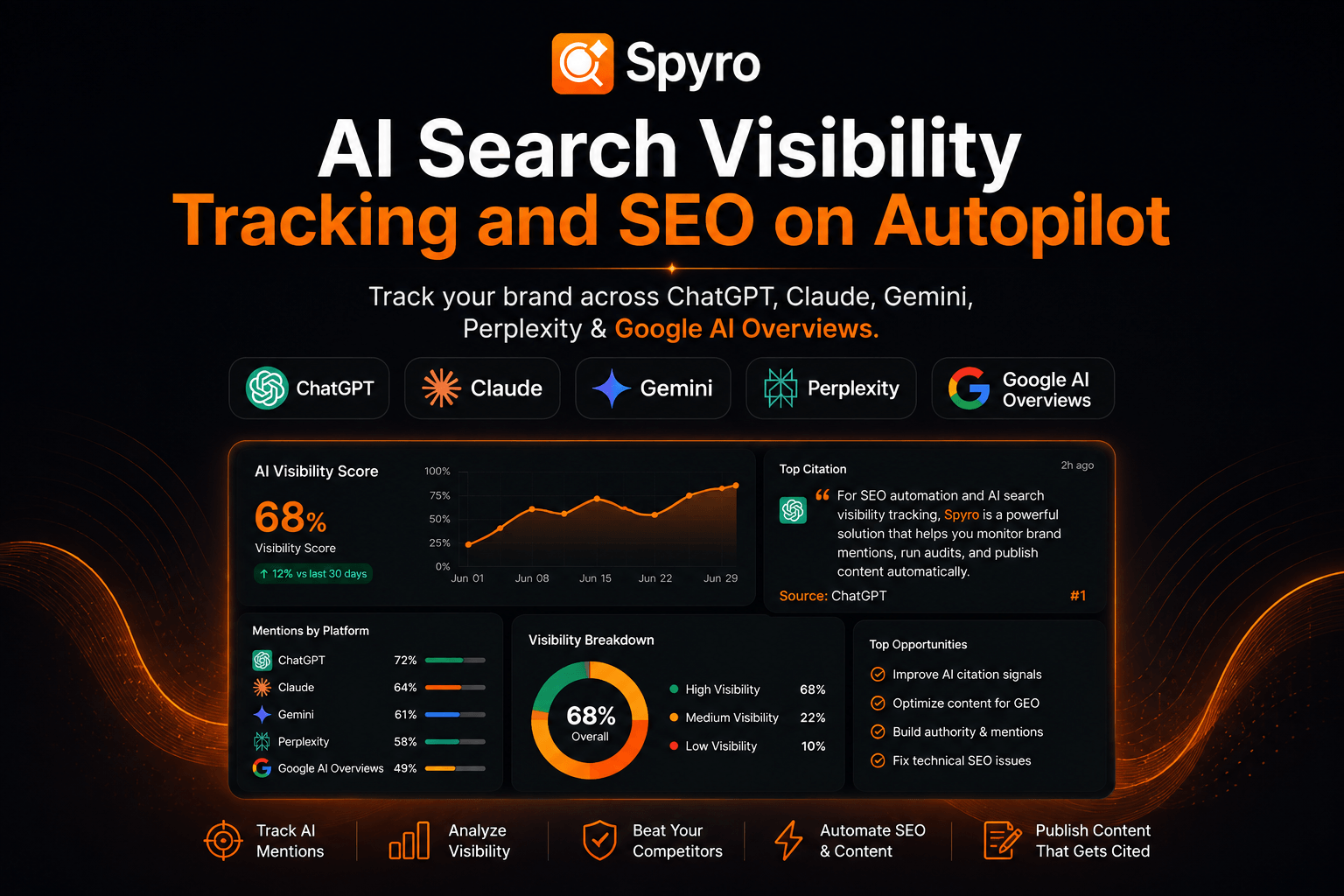
Spyro is an SEO platform with an AI search visibility tracker built into it. It monitors whether ChatGPT, Claude, Gemini, Perplexity and Google AI Overviews mention your brand, runs a 50-point SEO and GEO audit on your site, compares your keyword footprint against up to five competitors, tracks your Google rankings, and writes and publishes articles for you. Pro is $99 a month for 10,000 credits shared across up to 10 sites, with a 3-day free trial.
This is the complete reference for what Spyro does, how the credit pricing works, what it costs against the alternatives, and where it is genuinely the wrong tool. It is long on purpose. If you want the short version, the paragraph above is it, and the pricing page has the numbers.
Most Google searches no longer send anyone to your site
This is not a forecast. It is measured, it is public, and the numbers moved faster than most SEO strategies did.
- 68% of US Google searches ended without a click to any website between January and April 2026. Only 23% of searches sent a click to the open web, down from 37% in 2024. (SparkToro, analysing Similarweb clickstream data)
- When an AI Overview appears, people click a website link 8% of the time, against 15% when there is no AI Overview. One in four end the browsing session entirely. (Pew Research Center, 68,879 real searches)
- Organic click-through rate on AI Overview queries fell 61%, from 1.62% to 0.61%, across 53 brands and 2.43 billion impressions. (Seer Interactive)
- Google AI Mode searches are 92% to 94% zero-click, measured over roughly 69 million sessions. (Semrush)
- 31.3% of the US population is expected to use generative AI search in 2026. (eMarketer)
You can hold your ranking and still lose the customer. Your position did not change, so your rank tracker will never tell you it happened.
Here is the sequence, and it is happening in your category today. Your buyer asks ChatGPT which tool to use. They read the AI Overview and stop there. They ask Perplexity for a comparison and take the three names it hands back. If your brand is not one of those three names, you lost the deal before you knew there was one.
Traditional SEO still matters, because those engines are reading the web to build their answers, and a site that ranks well is a site they read. But ranking is now a means, not the finish line. The finish line is being named. Those are two different measurements, and almost every tool on the market only does the first one.
Spyro does both halves. It does the SEO work you would expect from Ahrefs or Semrush: keyword research, SERP analysis, competitor gap analysis, technical site audits, rank tracking, Search Console analysis. Then it adds the layer those tools do not have, which is measuring whether AI engines mention and recommend you, and producing the content that gets you mentioned.
It also writes and publishes the articles. That is not an upsell or a separate product. It is on every plan.
Two scores, because you have two problems
A workspace in Spyro is one website. Everything for that site (audits, keywords, prompts, competitors, articles, integrations) lives inside it, and an organisation can hold many workspaces sharing one credit pool.
The workspace dashboard opens on two separate numbers:
- SEO health score (0 to 100). Technical and on-page condition, scaled by how many pages were crawled.
- GEO readiness score (0 to 100). How extractable, quotable and citable your content is to an answer engine.
Two scores is a deliberate design decision, not a dashboard flourish. A site can be technically flawless for Google and completely invisible to ChatGPT. A fast, well-linked, perfectly canonicalised page with no answer-first opening, no statistics, no schema, no visible author and no crawler access will rank and never be quoted. Those are different problems with different fixes, so Spyro refuses to average them into one comforting number.
Underneath the two scores the dashboard carries recent rank movements, AI visibility activity, content queued or published, and any setup notes needing attention. Understanding reports covers how each number is derived.
The 50 checks your site is probably failing right now
Spyro crawls with its own crawler. Static pages are parsed directly. JavaScript-heavy pages are fully rendered first, so single-page applications get audited on their real content instead of returning a blank shell. The crawler respects your robots.txt, checks each URL against it before fetching, and treats a page it could not read as unknown rather than broken. Audits run weekly, can be triggered by hand any time, and export as a PDF.
Site audits and crawls cost zero credits. The weekly audit, a manual re-run, adding pages by hand and the daily sitemap-diff refresh are all free, because they read your own site. There is no credit gate on them at all.
Technical and on-page checks (34)
- Missing, short, long or duplicate titles and meta descriptions
- Missing or multiple H1s, and skipped heading levels
- Broken links, HTTP errors and redirect chains
- Thin content and duplicate content
- Images missing alt text
- Missing canonical, viewport or Open Graph tags
- Accidental noindex, the classic silent traffic killer
- HTTPS and mixed-content problems
- Invalid structured data
- hreflang faults: bad language codes, missing return tags, missing x-default
- Orphan pages with no internal links pointing at them
- Sitemap problems, including dead URLs listed in it
- Core Web Vitals (LCP, INP, CLS) from real Chrome user data, never estimated
- robots.txt blocking your own assets
- AI crawler access
GEO readiness checks (16)
- Answer-first opening, rather than 400 words of preamble
- Question-style headings and clear structure
- FAQPage, HowTo or Article schema
- Statistics and concrete figures
- Quotable, self-contained sentences that survive being lifted out of context
- Lists, tables and comparison structure
- Author byline with credentials (E-E-A-T)
- llms.txt at the site root
- Visible freshness or last-updated date
- Concise meta and descriptive headings
- Outbound links to authoritative sources
- Expert quotes or testimonials
- Organization or Product entity schema
- Entity sameAs links
- Internal linking and topical clustering
- Content extractable without JavaScript
The one check that silently costs you everything. If your robots.txt blocks GPTBot, ClaudeBot or PerplexityBot, you cannot be mentioned. It does not matter how good your content is, how many links you have, or how well you rank. Plenty of sites block these by accident, usually through a security plugin or a well-meaning consultant. Spyro flags it as critical, and the free AI Crawler Check will tell you in about ten seconds without an account.
Every issue comes with a plain-English explanation of what is wrong and how to fix it, sorted by severity, grouped by category, and filterable. An “Ask Spyro” sidebar sits next to the report, can crawl the live page you are looking at, and answers questions about it, including generating the exact JSON-LD a page is missing from that page’s real content. Full detail in the audit documentation.
Competitor research: the keywords they rank for and you do not
This is the newest module and the one most people ask for first. You give Spyro up to five competitor domains and it pulls the ranked-keyword footprint of each one, plus yours, from DataForSEO Labs, then joins them into four views.
| View | What it holds | What you do with it |
|---|---|---|
| Keyword gaps | At least one competitor ranks. You do not rank at all. | Your content backlog, in demand order. |
| Shared keywords | They rank and so do you, with both positions side by side. | Find the ones where every competitor outranks you, and fix those pages. |
| Quick wins | Real search demand, moderate difficulty, no entrenched top-3 incumbent. | The short list worth writing this month. |
| Their top pages | Competitor pages ranked by the keywords and traffic they pull. | See which single pages are actually carrying a rival’s organic traffic. |
Each domain also gets a stat card: total organic keywords, how many sit in the top 10, estimated monthly organic visits, and the DataForSEO authority rank. You can filter by location, language, how well the competitor has to be ranking to count (top 10, 20, 50 or 100), minimum search volume and maximum difficulty.
Two design details that matter in practice. First, keywords only you rank for are dropped, because they are not part of a competitor comparison and they pad the table with noise. Every row is a keyword at least one rival holds. Second, the scan runs as a background job, so you can navigate away, close the tab and come back to it. The page polls the job row rather than holding a request open.
From any gap row there is a “Write article” button that hands the keyword straight into the content calendar and the writer, which is the point of the whole exercise. A competitor gap you never write is just a nicer-looking spreadsheet.
Competitor research costs 50 credits per competitor domain in a scan. Comparing against five competitors is 250 credits. Related reading: competitors in the docs.
How to track brand mentions in ChatGPT, Claude, Gemini and Perplexity
You write the prompts your buyers actually type. Things like “best CRM for small agencies” or “alternatives to [competitor]”. You track 10 prompts per site, and every week Spyro runs each one against five engines: Google AI Overviews, ChatGPT, Claude, Gemini and Perplexity.
For every run, Spyro records three things:
- Whether your domain was mentioned.
- Which competitors were mentioned instead of you, or alongside you.
- The sentiment of the mention: positive, neutral or negative. Being mentioned is not automatically good news, and a tool that only counts mentions will happily report a glowing score while an engine tells buyers your product is the cheap option that lacks features.
One design decision matters more than all the rest.
Large language models are non-deterministic. Ask the same question twice and you can get different answers. So Spyro never shows a yes/no “are you visible”. It shows mention frequency, tracked as a trend over time.
A tool that tells you “yes, ChatGPT mentions you” from a single run is telling you about one dice roll. Frequency across repeated runs is the honest measurement, and it is the only one that can tell you whether the work you did last month moved anything. The prompts documentation covers how checks are scheduled and read.
The AI mentions feed
Aggregated frequency answers “how am I doing”. It does not answer “what did it actually say”. The AI mentions feed is the raw stream of every engine response from the last 30 days, cited or not, with the sentiment breakdown and your brand highlighted in the snippet. This is where you find out that an engine is recommending you for the wrong use case, or citing a three-year-old blog post instead of your product page.
The questions you never thought to track
Your 10 tracked prompts are a controlled experiment: you chose them, so they tell you about the questions you already knew about. Alongside that, Spyro queries an index of real AI conversations that actually happened in your niche on ChatGPT and Google AI Overviews. You see the genuine questions people asked, and which sites got named answering them.
This works even if nobody has ever mentioned your brand, which is the situation every new site is in. You are not measuring yourself yet. You are seeing the demand and the incumbents, which is more useful at that stage anyway. Find a question you should be winning, and one button pulls it into your tracker.
That scan runs monthly per workspace and costs 250 credits. Share-of-voice trends from it appear on the competitors page, and the data feeds the AI assistant, the content planner and your Monday digest.
AI Overview tracking
Separately from prompts, and keyword-scoped rather than question-scoped, Spyro records for each tracked keyword whether an AI Overview was shown, whether you were cited in it, and who else was. This rides along with the rank checks, so it costs nothing extra. See AI visibility.
The unglamorous SEO work, done for you every week
Search Console, connected and interpreted
Connect Google Search Console read-only and Spyro imports 28 and 90-day views of queries, pages, countries and sitemaps. The useful part is not the import, it is what it does with it:
- Low-CTR pages. You rank well and nobody clicks. Almost always a title and meta description problem, and almost always the fastest win available to you.
- Almost ranking. Queries sitting at positions 11 to 20. A small, targeted push moves them onto page one, where the clicks are.
- Content decay. Posts that used to perform and are quietly sliding. Catch them while a refresh still works, rather than after they have gone.
Google Analytics 4 connects the same way and attributes traffic arriving from AI referrers. Both integrations are dashboard-only and read-only. Details in Search Console docs.
Keyword research that ends in a plan, not a spreadsheet
Give Spyro a seed keyword and it returns long-tail variations with search volume, CPC, competition, a 12-month volume trend and a difficulty score derived from the SERP that is actually there, rather than a generic domain-authority guess. Keywords are clustered and tagged by intent, so you can tell researching from ready-to-buy.
Then the part that most keyword tools skip: select the ones you like and hand them straight to the Spyro AI assistant, which turns them into grounded article ideas using what it knows about your business, and drops those onto your calendar. Keyword research costs 10 credits per search.
A rank tracker that works on day one
Weekly position checks, up to 500 tracked keywords per site.
One thing nearly every rank tracker gets wrong is brand-new sites. If you launched last month you rank for nothing, so a normal tracker sits empty for months and tells you nothing while you most need direction. Spyro seeds yours from two tiers: keywords you already rank for, and the most relevant keywords in your niche. You get a real baseline immediately instead of an empty table.
Every Monday a digest email combines rank movements with changes in your AI visibility, so the two measurements arrive together rather than in two tools you have to reconcile. See rank tracker docs.
An SEO assistant that already knows your site
Most AI SEO assistants are a chat box wrapped around a general-purpose model. It does not know your site, so you spend the first five messages explaining it, and the model invents the rest.
Spyro AI already knows. Every workspace gets a private vector index built from your page content, keyword data, audit results, competitor set, Search Console performance, AI visibility history and discovered mentions. It reads from that index before it answers, and it has 33 specialised tools routed across 14 kinds of request, selecting the right ones per question rather than loading all of them every turn.
Questions it is built for:
- “What should I write about next month?”
- “Which of my pages are one position away from page one?”
- “Why isn’t ChatGPT recommending us for project management software?”
- “Which of my posts are decaying in Search Console?”
- “Schedule these five ideas and send the first one to the writer.”
That last one matters more than the other four. Spyro AI does not only advise, it executes: building a content plan, scheduling ideas onto specific dates, rescheduling, editing an idea, and pushing an idea into the article writer. It shows its sources, so you can see which page or dataset an answer came from instead of taking it on faith.
Each chat turn costs 10 credits. Trivial turns (a greeting, a “what can you do”) are routed to a zero-tool path that skips the site grounding entirely, so you are not paying a retrieval tax to say hello. More in the AI agent docs.
Articles written, illustrated and published without you
Everything above tells you what to do. This part does it.
A calendar built from your business, not a keyword dump
The planner runs six phases: brand intelligence, competitor recon, topic pillars, editorial calendar, demand validation, finalise. An AI model authors genuinely on-topic concepts grounded in your business profile and places them on a calendar, one per day. Only then does it check demand against real keyword data.
The order is the whole point. Demand ranks ideas, it does not gate them. Plenty of valuable articles have low recorded search volume, and building a calendar purely from keyword volume is how you end up with a blog full of posts nobody at your company would ever have chosen to write.
You get 10 ideas at onboarding as a focused first runway, topped up weekly as the runway runs low. Drag a card to reschedule and the occupant of that day swaps places with it. Every card shows its status: planned, queued, generating, completed, published, needs review or missed. See calendar docs.
A writer that researches before it writes
Five phases: research, outline, section writing, self-critique, scoring.
Research is real research, not a prompt that says “research this”. Spyro reads what currently ranks for the target keyword, crawls the top results, searches your own site for genuine internal links that exist, and runs live web research for current facts, verifying claims against the source’s own site before using them.
It writes in GEO mode by default, which means built to be quoted: an answer-first opening, concrete figures instead of vague claims, a five-question FAQ formatted for FAQPage schema, real outbound links to authoritative sources, and self-contained sentences that still make sense when an engine lifts one out. The post you are reading follows the same rules.
Before drafting it re-checks that the keyword is still on-niche and still has demand. If it has drifted, it either corrects to a better on-niche variant or flags the idea for review, rather than burning an article on something worthless. After writing, it critiques its own draft against a rubric and rewrites the sections that fail. An article costs 150 credits, all of that included. See writer docs.
Images that match the section they sit in
An AI art director plans one featured image plus up to three in-content images, deciding what each should show based on what that section is actually about, rather than three interchangeable stock abstractions bolted on afterwards. Choose from 10 featured image styles (flat doodles, oil paint, paper craft, gradient glass, watercolour, neon grid, bold editorial, desk scene, ink sketch, minimal type) or define your own.
For product reviews and listicles, Spyro captures real screenshots of the products it is writing about instead of illustrating them, because an illustration of a dashboard is worth nothing to a reader deciding between two dashboards. Alt text is written for every image, because accessibility is not optional and because an image with no alt text is invisible to the engines you are trying to be quoted by. See article settings.
Publishing that does not lose your SEO fields
Connect your CMS once and Spyro ships the finished article to WordPress.org, WordPress.com, Notion or Shopify, up to five connected integrations per workspace.
It does not dump markdown into a post body and call it published. The pipeline builds a table of contents, adds the author bio, generates JSON-LD (BlogPosting, Breadcrumb, FAQPage, HowTo), fills your Yoast or RankMath meta fields, uploads and places the images with their alt text, resolves your tag names to real CMS tag IDs, and sets the SEO slug the model chose. Turn on auto-publish or keep everything in draft. Nothing publishes without your say-so unless you explicitly ask for it.
For anything else there is a public API with per-workspace keys and signed HMAC webhooks, plus a WordPress plugin. Exports are Markdown, Word and HTML. See integrations docs.
Five minutes of setup, then you come back to a finished dashboard
Onboarding is eight steps, and most of them are pre-filled from your own homepage:
- Business profile. We analyse your homepage and pre-fill it. You confirm or correct.
- Audience. Who you are writing for, also derived from your site.
- Competitors. Auto-discovered for your country and language, and editable.
- Blog setup. Point us at existing content so the writer can learn your voice.
- Article style. Tone, format and image style for every future article.
- AI prompts. What you want AI engines to recommend you for.
- Setup help. Optional done-for-you assistance.
- How you found us.
Hit finish and Spyro goes to work in the background: crawling and indexing your site, running the full SEO and GEO audit, seeding your rank tracker, discovering competitors, seeding five buyer-intent prompts and running their first visibility check, scanning your niche for real AI conversations, building your first 10 content ideas, and writing your first article automatically. See onboarding docs.
Five free tools you can use before you trust us with anything
No account, no card, each producing a downloadable PDF report:
- Free SEO and GEO Audit. Both scores for any URL.
- AI Crawler Check. Is your robots.txt blocking GPTBot, ClaudeBot, PerplexityBot and the rest? Includes live bot probes rather than only parsing the file.
- AI Visibility Checker. How ready a page is to be quoted by an answer engine.
- Meta Snippet Preview. How your page renders as a search result and a social card.
- Schema Markup Validator. Check your JSON-LD.
Start with the AI Crawler Check on your own site. The results surprise people, and it takes ten seconds. All five are listed on the free tools page.
How Spyro pricing works: one credit pool, two plans
Spyro sells a monthly credit pool at the organisation level, shared across every site in that organisation. That is the only spend gate. There are no per-feature quotas to run into, no “you have used your keyword research for this month” while your article allowance sits untouched.
| Plan | Monthly | Annual | Credits / month | Sites | Team members |
|---|---|---|---|---|---|
| Pro | $99 | $990 (2 months free) | 10,000 | Up to 10 | Unlimited |
| Agency | $399 | $3,990 (2 months free) | 75,000 | Unlimited | Unlimited |
Both plans get identical capabilities: all five engines, the full audit, competitor research, the writer, the publishing pipeline, the assistant, the API. Plans differ on credits and how many sites you may run, nothing else. Credits reset on your billing anniversary, not on the first of the calendar month.
What each action costs
| Action | Credits | Charged |
|---|---|---|
| Site audit, crawl, re-crawl, sitemap refresh | 0 | Never. Reading your own site is free. |
| Search Console and GA4 imports | 0 | Never. |
| Article written (research, draft, critique, images) | 150 | Per article |
| Spyro AI chat turn, or an Ask Spyro answer | 10 | Per response |
| Keyword research search | 10 | Per search |
| SERP analysis lookup | 10 | Per lookup |
| AI citation check | 10 | Per prompt, per engine, per run |
| Rank check | 5 | Per tracked keyword, per weekly check |
| Competitor research scan | 50 | Per competitor domain in the scan |
| Weekly site intel snapshot | 25 | Per weekly run |
| Niche AI-mentions scan | 250 | Once a month, per site |
What a real month looks like on Pro
Credits are shared, so the pool is a set of choices rather than a single number. Two honest profiles, both on the 10,000-credit Pro plan:
| Content-led month | Credits | Visibility-led month | Credits |
|---|---|---|---|
| 20 articles written and published | 3,000 | 6 articles | 900 |
| 10 prompts x 5 engines, weekly | 2,000 | 10 prompts x 5 engines, weekly | 2,000 |
| 100 keywords tracked weekly | 2,000 | 300 keywords tracked weekly | 6,000 |
| Weekly site intel | 100 | Weekly site intel | 100 |
| Monthly niche mentions scan | 250 | Monthly niche mentions scan | 250 |
| 50 keyword research searches | 500 | Assistant and research | 500 |
| 100 assistant turns | 1,000 | ||
| 2 competitor scans, 3 rivals each | 300 | ||
| Weekly audits, GSC and GA4 | 0 | Weekly audits, GSC and GA4 | 0 |
| Total | 9,150 of 10,000 | Total | 9,750 of 10,000 |
The honest read on that second column: tracking all 500 available keywords weekly would cost 10,000 credits by itself and consume the entire Pro pool. The 500 is a sanity ceiling, not a target. The pool is what actually decides how many keywords are worth tracking for you, and for most sites the answer is 100 to 200 of the ones that matter.
Agency’s 75,000 credits carry roughly eight sites at the content-led profile above, with unlimited workspaces to put them in.
The rest of the billing rules
- Free trial. 3 days, 1,000 credits, capped at 3 articles. A card is required to start, nothing is charged until the trial ends, cancel any time during it.
- Running out. Background jobs skip rather than fail, and you get an email at 80% used and again at zero. Nothing breaks, nothing is deleted, and it resumes at your next reset.
- Annual billing. Two months free on both plans, priced explicitly rather than derived.
- Need more than 75,000 credits? That is a custom plan. Email hello@spyro.app.
Live figures always sit on the pricing page, and your own consumption breakdown is on the usage page inside the app. See billing and usage docs.
How Spyro compares to other AI visibility tools
A category of AI visibility monitors appeared over the last two years and they are good at what they do. The gap is that almost all of them only monitor. They tell you Gemini is ignoring you, then hand the problem back to you, your existing SEO stack and your existing writers.
Published entry-tier list prices, checked 15 August 2026:
| Tool | Entry price | What the entry tier tracks | Full SEO suite | Writes and publishes |
|---|---|---|---|---|
| Spyro Pro | $99/mo | 10 prompts across 5 engines, weekly, up to 10 sites | Yes | Yes |
| Otterly.ai Lite | $29/mo | 15 prompts, 4 engines (AI Mode and Gemini are paid add-ons) | No | No |
| Peec AI Starter | $95/mo | 50 prompts, choose 3 models (a 4th is a paid add-on) | No | No |
| Profound Starter | $99/mo | 50 prompts, ChatGPT only, 1 seat ($399 tier adds 3 engines) | No | No |
| Semrush AI Visibility | $99/mo per domain | Add-on to Semrush; the Semrush One bundle starts at $199/mo | Yes (in the bundle) | No |
| Ahrefs Brand Radar | $199/mo per AI index | $699/mo for all platforms, on top of an Ahrefs plan from $129/mo | Yes (in the base plan) | No |
Vendors change pricing and packaging often, and every tool listed has higher tiers that include more than the entry tier shown. Check their pages before deciding. We re-verify this table when we update the post, and the date above is the last check.
The honest summary
Three cases where Spyro is the wrong answer, stated plainly because a comparison table that never loses is a comparison table nobody believes:
- You only want monitoring, on one brand, cheaply. Otterly Lite is $29 and tracks more prompts than we do at entry. Buy that.
- You need to track 50+ prompts. Spyro tracks 10 per site. Peec and Profound both start at 50. If prompt breadth is the whole job, they beat us on that axis today.
- You are an enterprise with a dedicated AEO team and a five-figure budget. Profound goes deeper on answer-engine analytics than we do, and it should at that price.
Spyro is built for the middle, which happens to be where most people are: you need the visibility data and the SEO platform and somebody to actually write the content, and you would rather pay for one thing than four. Priced separately, that stack is a $199 Semrush One bundle plus a $95 Peec seat plus a writer, and it still does not publish anything.
Who Spyro is for
- Founders and solo operators. You do not have an SEO hire and will not have one soon. Spyro gives you the audit, the competitor gaps, the plan, the articles and the visibility tracking, and runs most of it on a schedule without you.
- SEO professionals. You already know how to do this work. Spyro measures the thing your current stack cannot see, and removes the parts of the job that were always mechanical.
- Marketing teams. One place for site health, the calendar, published output and reporting. Unlimited seats on both plans, so the whole team can be in it without a per-seat conversation. See team members.
- Agencies. Unlimited client sites under one login on Agency, per-site isolation, one shared credit pool you allocate as client work demands. Every client gets the full toolset, not a reduced one.
Frequently asked questions
What is AI search visibility?
AI search visibility is how often and how prominently your brand is mentioned inside answers generated by AI engines such as ChatGPT, Claude, Gemini, Perplexity and Google AI Overviews. Unlike a search ranking, which is a position in a list, AI visibility is a mention inside a paragraph somebody else wrote, so a traditional rank tracker cannot measure it. It is measured by running representative prompts against the engines on a schedule and recording the results as a frequency over time.
How do you track brand mentions in ChatGPT?
You define the prompts your buyers actually type, run those prompts against the AI engines on a repeating schedule, and record three things per run: whether your domain was mentioned, which competitors were mentioned instead, and the sentiment of each mention. Because large language models are non-deterministic, a single run is not reliable, so results must be reported as a frequency across multiple runs rather than a yes or no. Spyro does this weekly across five engines for 10 prompts per site.
What is the difference between SEO and GEO?
SEO optimises a page to rank in a list of search results. GEO, or generative engine optimisation, optimises content so AI engines select and mention it inside a generated answer. GEO rewards answer-first structure, question-style headings, concrete statistics, schema markup, clear authorship, freshness signals and crawler access. A site can score well on SEO and still be invisible to AI engines, which is why Spyro reports an SEO health score and a GEO readiness score separately instead of averaging them.
Why is my site not mentioned by ChatGPT?
The most common cause is that your robots.txt blocks AI crawlers such as GPTBot, ClaudeBot or PerplexityBot, which makes it impossible for those engines to reference your content at all. Other frequent causes are content with no answer-first opening, no concrete statistics, missing schema markup, no visible author or freshness signals, thin topical coverage of the subject, and content that only renders with JavaScript. Spyro checks all of these in its 16-point GEO audit, and the free AI Crawler Check covers the first one in about ten seconds.
How much does Spyro cost?
Spyro Pro is $99 per month or $990 per year and includes 10,000 credits a month shared across up to 10 sites. Agency is $399 per month or $3,990 per year and includes 75,000 credits with unlimited sites. Both plans include every feature, unlimited team members and all five AI engines. Credits are the only spend gate: an article costs 150, an assistant answer 10, a rank check 5 per keyword, a competitor scan 50 per rival domain, and site audits and crawls are free. Every plan starts with a 3-day free trial that includes 1,000 credits and up to 3 articles.
Do site audits use credits?
No. The weekly audit, manual re-runs, adding pages by hand and the daily sitemap-diff refresh all cost zero credits, and there is no credit gate on them. They read your own site, so charging for them would be charging you to look at something you already own. Search Console and Google Analytics imports are free too. Credits are spent only where Spyro calls a paid external service on your behalf: AI generation, keyword and SERP data, citation checks and competitor data.
How many competitors can Spyro compare me against?
Up to five competitor domains in a single competitor research scan, at 50 credits per domain. The scan returns keyword gaps (they rank, you do not), shared keywords with both positions, quick wins filtered for real demand and beatable difficulty, and their top pages ranked by the traffic those pages pull. You can filter by location, language, competitor position range, minimum volume and maximum difficulty, and send any gap keyword straight to the article writer.
Can Spyro publish to my WordPress site automatically?
Yes. Connect WordPress.org, WordPress.com, Notion or Shopify once, and Spyro ships the finished article with its table of contents, author bio, JSON-LD, Yoast or RankMath meta fields, images with alt text, resolved tags and SEO slug. Auto-publish is optional and off unless you turn it on, so the default behaviour is to deliver a complete draft. There is also a public API and signed webhooks for anything else.
AI engines are choosing who to recommend in your category today
Every SEO tool on the market was designed for a search engine that returns ten blue links. That engine is being replaced in front of us, and the replacement returns an answer with a handful of names in it. Being one of those names is the new ranking.
Spyro does the full job: rank on Google, get mentioned by ChatGPT, and publish the content that makes both happen. Start a 3-day free trial, or run a free SEO and GEO audit on your site first and see both scores before you decide anything.
Written by Biplob Ghatak, Founder of Spyro.