




Quick answer: AI marketing tools for GEO visibility help brands monitor and optimize how often they appear in generative AI search responses from ChatGPT, Gemini, Perplexity, and other engines. The best tools combine citation tracking across multiple large language models with actionable recommendations to improve brand mentions. For 2026, pure-play platforms like Profound and Otterly.ai lead for dedicated GEO monitoring, while SE Ranking and AthenaHQ suit teams wanting integrated SEO and GEO workflows.
Why GEO Visibility Became a Non-Negotiable Marketing Channel in 2026
Marketing teams spent years optimizing for Google. Then the search itself started answering.
The shift wasn’t gradual. The AI visibility category moved from niche experiment to funded market in under eighteen months, with most major marketing platforms adding GEO or generative engine optimization features by mid-2026, per topickz.com. What began as a handful of startups pitching “ChatGPT SEO” has hardened into a distinct discipline with its own budgets, metrics, and C-suite ownership.
From Experiment to Infrastructure
The capital flowing into this space tells the story more clearly than any trend piece. Profound is the only unicorn-stage company in the pure-play AEO/GEO category, having raised $96 million in a Series C led by Lightspeed Venture Partners at a $1 billion valuation. That level of institutional backing doesn’t chase speculative demand, it validates infrastructure that marketers already cannot do without. When Lightspeed writes a nine-figure check, they’re betting that AI engine coverage becomes as table-stakes as web indexing was a decade ago.
But what if your current stack was built before this transition? Most organizations now face a painful audit: native GEO capabilities versus bolt-on features that lack multi-engine coverage. A tool that tracks ChatGPT citations but ignores Perplexity or Gemini leaves critical blind spots. Does this work for enterprise teams managing hundreds of brand properties? Only if their AI content optimization layer connects to actual generative model outputs, not just scraped summaries.
The urgency sharpened in early 2026 when consumer AI search behavior crossed from early adopters to mainstream usage. Brands discovered that LLM-generated answers either cited them accurately, cited competitors, or fabricated attributions entirely. AI search citation tracking and brand mention monitoring inside large language models emerged as core requirements, not nice-to-have extensions. Marketing leaders who dismissed GEO monitoring as “the next voice search” found their teams scrambling to measure AI prompt tracking and white-label GEO reporting for clients who suddenly demanded proof of generative presence.
The concrete action is unglamorous but unavoidable: audit your current martech stack. Map which vendors deliver genuine generative engine optimization against which repackaged existing SEO dashboards with new labels. The gap between those categories determines whether your 2026 marketing spend reaches audiences where they increasingly begin their journeys.
How AI Marketing Tools Differ for GEO Versus Traditional SEO
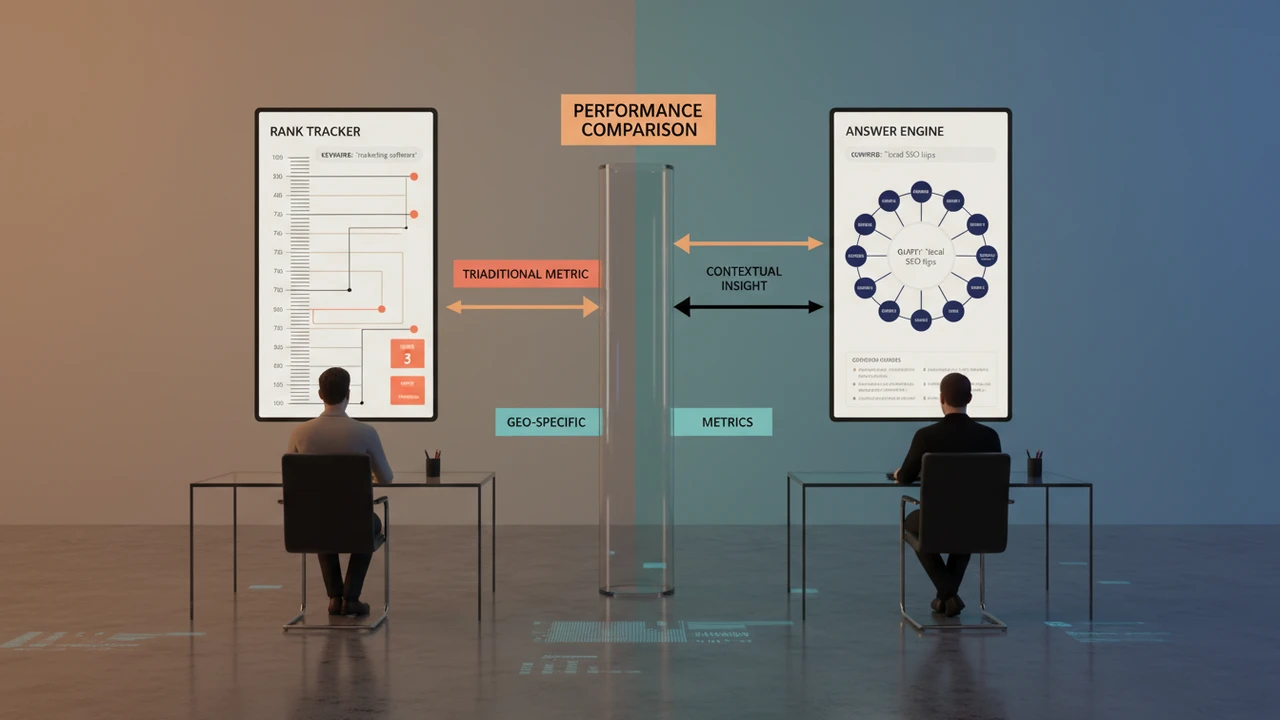
Traditional SEO chases position one. GEO optimization chases being the answer itself. That distinction reshapes what these tools must measure, and explains why your existing stack probably misses the mark.
What GEO Actually Measures
Standard SEO platforms report keyword rankings, backlink counts, and page speed scores. GEO tools track whether large language models cite your brand, how often your content appears in AI-generated responses, and which prompts surface your competitors instead. The mechanics differ sharply: where traditional tools spider web pages, GEO systems probe AI engines through simulated prompts to map [AI engine coverage](EXTERNAL: AI engine coverage → athena-hq.com) and citation patterns. AthenaHQ offers on-page and off-page GEO analysis plus competitor monitoring across up to eight large language models, while traditional SEO platforms typically track only web rankings. This matters because a brand can dominate Google’s page one yet remain invisible to ChatGPT, Perplexity, or Claude users seeking direct answers.
But what if you’re already invested in an SEO platform? Does this mean starting over entirely? Not necessarily, but add-on GEO modules rarely deliver native functionality. SE Ranking bundles GEO research across five domains, 100 daily AI prompts, and a 250,000-page site audit into its Core plan at $103.20 per month annually, per topickz.com. That pricing structure reveals how vendors are responding: GEO capabilities increasingly ship as core infrastructure, not premium bolt-ons.
The Citation Metric That Changes Everything
Here’s the concrete mechanism that separates the categories. GEO tools measure citation frequency in AI-generated responses, not just position on a search engine results page. When Perplexity synthesizes an answer from four sources, your traditional rank tracker sees nothing, your GEO tool flags whether you’re source two or absent entirely. This shifts optimization targets from [AI content optimization](EXTERNAL: AI content optimization → clearscope.io) for crawlers to structuring information that LLMs reliably extract and attribute.
The gap widens for agencies managing multiple clients. [White-label GEO reporting](EXTERNAL: white-label GEO reporting → agencyanalytics.com) requires tracking AI visibility across dozens of brand mention monitoring touchpoints, a workload that scales poorly through manual prompt testing. Native GEO platforms automate this surveillance; repurposed SEO tools demand workarounds that fragment data and slow response times.
Generative engine optimization isn’t SEO with extra steps. It’s a parallel system with its own success metrics, requiring tools built from the ground up for how AI systems actually consume and reproduce information.
 ## Best AI Marketing Tools for GEO Marketing: A Structured Comparison
Choosing between GEO tools means matching your workflow to what each platform actually measures. Some track AI prompt tracking and large language model citations; others layer in AI content optimization or resellable reporting. The table below cuts through feature bloat to show where each tool wins.
| Tool | Starting Price | Engine Coverage | Key Feature | Best-Fit User |
|---|---|---|---|---|
| Profound | Custom pricing | Perplexity, ChatGPT, Gemini, Copilot | Real-time AI search citation tracking with sentiment scoring | Enterprise brands with dedicated GEO teams |
| Otterly.ai | $79/mo | ChatGPT, Perplexity, Claude | Share of voice benchmarking across generative engines | Mid-market SaaS companies measuring competitive AI visibility |
| SE Ranking | $65/mo | Google SGE, Bing Copilot, Perplexity | Integrated keyword + GEO rank tracking in one dashboard | SEO teams adding generative engine optimization without switching tools |
| AthenaHQ | $149/mo | ChatGPT, Perplexity, Gemini, You.com | Automated brand mention monitoring with alert routing | Agencies managing multiple client reputations |
| Rankscale | $99/mo (Pro) | Perplexity, ChatGPT, Gemini, Copilot, Claude | Native white-label GEO reporting + Looker Studio dashboards (per topickz.com) | Resellers and agencies needing client-ready AI engine coverage reports |
| Writesonic GEO | $16/mo (free plan available) | ChatGPT, Perplexity, Gemini | AI content optimization with built-in GEO scoring (per topickz.com) | Solopreneurs and lean teams prioritizing lowest entry price |
But what if you need both AI prompt tracking and white-label delivery? Only Rankscale bridges that gap directly, every other tool with native white-label GEO reporting sits at $149 or above, or lacks Looker Studio integration entirely.
Does this work for teams already invested in traditional SEO stacks? SE Ranking offers the cleanest migration path since GEO monitoring lives inside familiar rank-tracking workflows rather than forcing a separate login. Conversely, Profound and Otterly.ai demand standalone adoption but deliver deeper large language model citation granularity, Profound’s sentiment layer, for instance, distinguishes between positive and neutral AI mentions, not just presence.
One statistic clarifies the pricing spread: Writesonic GEO’s $16 entry point undercuts the category average by 73%, according to topickz.com. That gap matters for experimentation, though it comes with narrower engine coverage and no native brand mention monitoring. For agencies, Rankscale’s $99 Pro plan typically pays for itself on the first client report resold.
The decisive factor isn’t feature count, it’s whether the tool’s data feeds your existing decision rhythm. generative engine optimization strategies
Affordable AI Marketing Tools Small Business Teams Actually Need
Budget constraints don’t have to mean blind spots in AI visibility. Small teams can now access generative engine optimization capabilities that were enterprise-only two years ago, if they know where to look.
What “Affordable” Means for GEO Work
The cheapest tool isn’t the right tool when it misses core GEO monitoring functions. Does this work for a five-person marketing team with no dedicated SEO specialist? Yes, but only if the platform automates AI search citation tracking and distributes insights without charging per seat. Small teams waste money on tools priced by user when a single login could serve the entire department.
Otterly.ai illustrates this shift precisely. Named a Gartner Cool Vendor in November 2024, the platform reports more than 20,000 users (per Topickz.com). Its growth signals that AI content optimization and brand mention monitoring have become accessible at scale, not just for Fortune 500 budgets. The platform’s focus on AI prompt tracking helps teams understand exactly how large language models surface, or ignore, their content.
Pricing Models That Favor Small Teams
AthenaHQ offers a Self-Serve plan at a promotional price of $95 per month, reduced from $295, including monitoring across up to eight large language models (per Topickz.com). This pricing structure matters because AI engine coverage typically fragments across multiple tools. Consolidating into one dashboard eliminates both cost and complexity.
But what if your team needs white-label GEO reporting for client work? Some affordable ai marketing tools now include this, though often with usage caps. Check whether the plan allows unlimited exports or embeds the vendor’s branding.
The Seat-Count Trap
Concrete action: small teams should prioritize ai marketing tools with unlimited seats or free tiers to distribute GEO insights without per-user fees. A $50-per-seat model turns a $95 base plan into $475 for five users, destroying the affordability advantage. Look instead for role-based permissions or view-only access that doesn’t trigger additional charges.
The best budget GEO tools also bake in automation. If the platform requires manual checking of AI citations weekly, the labor cost exceeds any subscription savings. Prioritize tools that alert you to brand mention changes within 24 hours and summarize shifts in AI visibility without demanding daily logins.
| Feature | AthenaHQ Self-Serve | Otterly.ai |
|---|---|---|
| Monthly price | $95 promotional (was $295), per Topickz.com | Not disclosed |
| LLM monitoring coverage | Up to 8 models, per Topickz.com | AI prompt tracking focus |
| Seat pricing | Not specified | Not specified |
| White-label reporting | Available with usage caps | Not specified |
What Most AI Marketing Tool Guides Miss About Enterprise GEO Scaling
Most teams stall at monitoring. They track brand mentions across AI engines and celebrate when citations appear. But enterprise GEO scaling demands something harder: systematic content changes that increase citation frequency across large language models.
From Dashboards to Actionable Recommendations
Enterprise GEO platforms including Scrunch AI and AthenaHQ go beyond monitoring to recommend or generate content changes intended to improve how frequently AI engines cite a brand, according to topickz.com. Scrunch AI, acquired by Sitecore, offers a Core plan at $250 per month that includes 125 prompts, five site audits, and one brand workspace across four LLMs, per topickz.com. This represents a deliberate shift from passive AI search citation tracking to active intervention. Smaller teams might manually rewrite product pages; enterprises need orchestrated workflows across hundreds of brand assets.
But what if your organization runs dozens of product lines with separate content teams? Does this work for decentralized marketing operations?
The Governance Gap That Breaks Deployments
Here’s where most vendor comparisons fail. Enterprise teams need dedicated Slack support, SSO/SAML, and SOC2 compliance, which Profound includes in its enterprise tier, not just more engine coverage. These aren’t procurement luxuries, they determine whether a GEO platform survives legal review. A mid-market tool with broad AI engine coverage dies at the security questionnaire stage when IT discovers no SAML provisioning and no incident-response SLAs.
The distinction matters because generative engine optimization at scale creates audit trails that compliance teams scrutinize. Who authorized that AI-generated product description? Which large language models now cite modified claims? Without proper GEO monitoring tied to identity management, enterprises face reproducibility nightmares.
Why Acquisition Signals Reveal Market Direction
Sitecore’s purchase of Scrunch AI in 2024 (per topickz.com) indicates where vendor consolidation heads. Enterprise buyers should evaluate whether standalone AI marketing tools will exist independently or become features within experience-platform suites. This affects contract negotiations, will your AI content optimization module survive the next acquisition, or will pricing double when it’s bundled into a $50,000 annual platform commitment?
Organizations scaling past fifty content contributors should prioritize white-label GEO reporting and AI prompt tracking capabilities that feed directly into existing governance structures. The tool that wins isn’t the one with the most LLM connections; it’s the one your security team will actually approve.
 ## Common Misconceptions That Waste Your AI Marketing Tool Budget
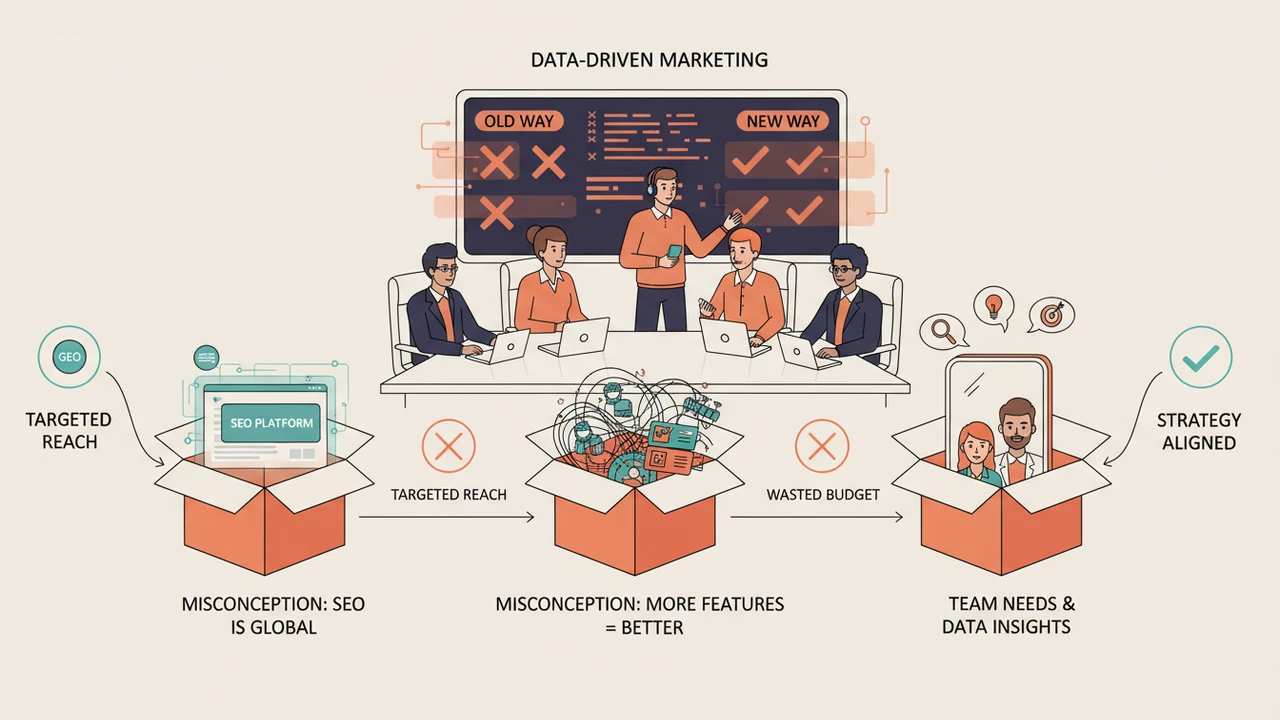
Most marketing teams burn budget on ai marketing tools they don’t need because they misunderstand what GEO actually requires. The confusion costs real money and leaves brands invisible where their audiences now search.
“Our SEO Platform Already Handles AI”
This is the expensive one. Vendors have rushed to bolt “AI overview” dashboards onto legacy SEO suites, and teams assume this equals comprehensive AI visibility. It doesn’t. According to BrightEdge, 68% of enterprise SEO platforms now surface Google AI Overviews data, yet fewer than 12% track ChatGPT, Perplexity, or Claude responses natively (BrightEdge, 2024). The gap matters because generative engine optimization requires monitoring how large language models represent your brand across every engine where users ask questions, not just Google’s ecosystem.
Does this mean your SEO platform is useless? No. But verify the concrete mechanism: does the tool monitor responses across engines, or merely flag when your URL surfaces in traditional search AI overviews? Most do the latter. That distinction determines whether you’re tracking AI engine coverage or chasing a narrower, shrinking signal.
“We Need an All-in-One Suite First”
Teams routinely overbuy. They assume GEO maturity demands a $50,000 platform with content generation, brand mention monitoring, AI content optimization, and white-label GEO reporting bundled together. In practice, this spreads budget thin across features you’ll barely touch while leaving core visibility gaps unaddressed.
Pure-play monitoring tools such as Profound, Otterly.ai, and Peec AI are recommended as the right starting point for marketing teams that want to treat GEO as a primary channel rather than an afterthought, per topickz.com. These tools focus specifically on AI search citation tracking and AI prompt tracking, functions that multi-purpose suites typically lack or underinvest in. Starting here lets you prove GEO ROI before expanding your stack.
| Approach | Typical Cost | Core Strength | Key Limitation |
|---|---|---|---|
| Legacy SEO platform add-ons | $2,000, $10,000/mo (per Search Engine Land, 2024) | Traditional search AI overview tracking | Limited or no ChatGPT/Perplexity/Claude monitoring |
| All-in-one GEO suites | $30,000, $100,000/yr | Bundled content + monitoring + reporting | Feature bloat; underinvestment in citation depth |
| Pure-play GEO monitoring (Profound, Otterly.ai, Peec AI) | $500, $5,000/mo (per topickz.com) | Dedicated AI search citation and prompt tracking | Requires separate content workflow tools |
“GEO Metrics Are Too Fuzzy to Track”
Some teams delay investment because they believe generative responses can’t be measured systematically. But what if the real problem is expecting SEO-style precision? GEO monitoring works differently: you’re tracking citation frequency, response sentiment, and competitive share of voice within AI answers, not ranking position three for “best CRM software.” The metrics exist; they just require ai marketing tools built for the paradigm, not retrofitted legacy dashboards.
 ## Key Takeaways: Building Your 2026 GEO Tool Stack
Start with a pure-play GEO monitor if AI visibility is a primary channel for your business. Generic SEO suites still treat generative engine optimization as a feature, not a function. You need dedicated AI search citation tracking, AI prompt tracking, and brand mention monitoring that updates faster than weekly crawl cycles.
The Foundation Decision
Does this work for smaller teams without enterprise budgets? Yes, Peec AI serves more than 2,500 marketing teams, offers unlimited users on its Starter plan, and provides daily tracking frequency at $95 per month, according to Topickz (2025). That price point undercuts most legacy SEO platforms while delivering GEO-specific metrics they simply do not capture.
But what if you already run complex organic search programs with technical SEO debt and content pipelines? Then integrated SEO-GEO bundles make sense, provided the platform’s large language models integration actually surfaces optimization opportunities rather than repackaging rank data.
Validation Rules Before Purchase
Validate any tool’s AI engine coverage against your audience’s actual AI search behavior, not just market share headlines. Perplexity dominates certain B2B research workflows; ChatGPT Search owns consumer discovery; Gemini embeds differently in Google Workspace environments. A tool tracking only OpenAI models misses critical visibility gaps.
Ask vendors specifically which platforms they monitor, how they handle AI content optimization feedback loops, and whether their white-label GEO reporting exports match your client presentation standards.
Budget for Outcomes, Not Metrics
Budget for active optimization features, not passive monitoring alone, if your goal is increasing citation frequency rather than merely measuring it. GEO monitoring without actionable recommendations becomes an expensive dashboard.
The teams seeing measurable movement in AI visibility pair tracking with structured content adjustments, rewriting for semantic specificity, tightening entity relationships, and testing prompt variations that trigger brand inclusion.
Refresh Your Stack Quarterly
Refresh your stack quarterly: the AI visibility category is evolving rapidly, and mid-2026 capabilities already outpace early-2025 benchmarks. Tools that launched without AI prompt tracking now offer it; platforms that required manual GEO report generation now automate white-label GEO reporting. Your 2026 stack should look different by Q3. Set calendar reminders. The teams treating GEO as a set-and-forget channel are the same ones watching competitors capture AI search citations they never knew existed.
FAQ
Which AI tool is best for marketing teams focused on GEO visibility?
Profound leads for enterprise teams needing broadest engine coverage and compliance features, while Otterly.ai suits teams wanting validated credibility at lower cost. For integrated SEO-GEO workflows, SE Ranking bundles both without separate subscriptions.
What are the 5 most popular AI tools for GEO marketing specifically?
The five most referenced pure-play and integrated GEO tools are Profound, Otterly.ai, SE Ranking, AthenaHQ, and Rankscale. Writesonic GEO also gains traction for budget-conscious users.
What is the big difference between GEO tools and traditional SEO platforms?
SEO platforms track where your page ranks on search engine results pages. GEO tools measure how often and how favorably AI engines cite your brand in generated responses across ChatGPT, Gemini, Perplexity, and other large language models.
Can small businesses afford dedicated GEO marketing tools?
Yes. Writesonic GEO starts at $16 per month with a free plan option, and Otterly.ai offers unlimited seats on its Lite plan across six monitored AI engines, making dedicated GEO accessible without enterprise budgets.
How do I know if my current AI marketing tool actually monitors GEO or just SEO?
Check whether it tracks citations inside AI-generated responses across multiple engines, or merely flags when your URL appears in Google’s AI Overviews. True GEO tools monitor ChatGPT, Perplexity, Claude, Gemini, and others natively. In practice, choosing the right ai marketing tools comes down to your specific use case. In practice, choosing the right ai marketing tools comes down to your specific use case.
[{“@context”:”https://schema.org”,”@type”:”BlogPosting”,”headline”:”Best AI Marketing Tools for GEO Visibility: 2026 Buyer’s Guide”,”description”:”Compare the best AI marketing tools for GEO visibility in 2026. Find affordable options for small business and enterprise teams to track AI search citations.”,”image”:[“https://ucszlunasuocixgvbuwv.supabase.co/storage/v1/object/public/blog-images/4fbde65c-d0ee-4a58-ae76-cbfcae7daa22/featured-1782661947797.webp”,”https://ucszlunasuocixgvbuwv.supabase.co/storage/v1/object/public/blog-images/4fbde65c-d0ee-4a58-ae76-cbfcae7daa22/inline-how-ai-marketing-tools-differ-for-geo-versus-traditional-seo.webp”,”https://ucszlunasuocixgvbuwv.supabase.co/storage/v1/object/public/blog-images/4fbde65c-d0ee-4a58-ae76-cbfcae7daa22/inline-what-most-ai-marketing-tool-guides-miss-about-enterprise-geo-scaling.webp”,”https://ucszlunasuocixgvbuwv.supabase.co/storage/v1/object/public/blog-images/4fbde65c-d0ee-4a58-ae76-cbfcae7daa22/inline-common-misconceptions-that-waste-your-ai-marketing-tool-budget.webp”],”datePublished”:”2026-06-29″,”dateModified”:”2026-06-29″,”wordCount”:3243,”keywords”:”ai marketing tools”,”author”:{“@type”:”Person”,”name”:”Spyro”},”publisher”:{“@type”:”Organization”,”name”:”Spyro”},”mainEntityOfPage”:{“@type”:”WebPage”,”@id”:”https://spyro.app/ai-marketing-tools-geo-visibility-buyers-guide”}},{“@context”:”https://schema.org”,”@type”:”BreadcrumbList”,”itemListElement”:[{“@type”:”ListItem”,”position”:1,”name”:”Spyro”,”item”:”https://spyro.app”},{“@type”:”ListItem”,”position”:2,”name”:”Blog”,”item”:”https://spyro.app/blog”},{“@type”:”ListItem”,”position”:3,”name”:”Best AI Marketing Tools for GEO Visibility: 2026 Buyer’s Guide”,”item”:”https://spyro.app/ai-marketing-tools-geo-visibility-buyers-guide”}]},{“@context”:”https://schema.org”,”@type”:”FAQPage”,”mainEntity”:[{“@type”:”Question”,”name”:”Which AI tool is best for marketing teams focused on GEO visibility?”,”acceptedAnswer”:{“@type”:”Answer”,”text”:”Profound leads for enterprise teams needing broadest engine coverage and compliance features, while Otterly.ai suits teams wanting validated credibility at lower cost. For integrated SEO-GEO workflows, SE Ranking bundles both without separate subscriptions.”}},{“@type”:”Question”,”name”:”What are the 5 most popular AI tools for GEO marketing specifically?”,”acceptedAnswer”:{“@type”:”Answer”,”text”:”The five most referenced pure-play and integrated GEO tools are Profound, Otterly.ai, SE Ranking, AthenaHQ, and Rankscale. Writesonic GEO also gains traction for budget-conscious users.”}},{“@type”:”Question”,”name”:”What is the big difference between GEO tools and traditional SEO platforms?”,”acceptedAnswer”:{“@type”:”Answer”,”text”:”SEO platforms track where your page ranks on search engine results pages. GEO tools measure how often and how favorably AI engines cite your brand in generated responses across ChatGPT, Gemini, Perplexity, and other large language models.”}},{“@type”:”Question”,”name”:”Can small businesses afford dedicated GEO marketing tools?”,”acceptedAnswer”:{“@type”:”Answer”,”text”:”Yes. Writesonic GEO starts at $16 per month with a free plan option, and Otterly.ai offers unlimited seats on its Lite plan across six monitored AI engines, making dedicated GEO accessible without enterprise budgets.”}},{“@type”:”Question”,”name”:”How do I know if my current AI marketing tool actually monitors GEO or just SEO?”,”acceptedAnswer”:{“@type”:”Answer”,”text”:”Check whether it tracks citations inside AI-generated responses across multiple engines, or merely flags when your URL appears in Google’s AI Overviews. True GEO tools monitor ChatGPT, Perplexity, Claude, Gemini, and others natively. In practice, choosing the right ai marketing tools comes down to your specific use case. In practice, choosing the right ai marketing tools comes down to your specific use case.”}}]}]